
A single color variance across a high-volume run is more than a minor oversight. It’s a compromise of corporate identity that South Florida’s professional sector cannot afford. Many executives still struggle with the logistical delays of national online printers and the technical vacuum that often accompanies complex file preparation. Finding reliable booklet printing services requires more than just a search for the lowest price. It demands a partner with the industrial infrastructure to guarantee precision at scale.
You understand that physical marketing only works when the execution matches the strategic intent. This guide will help you master the technical requirements of the new G7+ color standards and the latest USPS regulations for 2026. We’ll provide a professional framework for selecting a Fort Lauderdale partner, ensuring color accuracy across every page, and integrating high-volume booklets into a sophisticated direct mail workflow.
Key Takeaways
- Learn why G7-certified color standards and Heidelberg press technology are essential for maintaining industrial-grade brand consistency across high-volume runs.
- Discover how to integrate professional booklet printing services into a broader direct mail strategy to maximize B2B engagement and ROI in 2026.
- Master the technical nuances of document setup, including how to account for “creep” in saddle-stitched projects to prevent inner margin errors.
- Identify the logistics advantages of partnering with a local, high-capacity production hub in Fort Lauderdale for streamlined South Florida distribution.
- Transition from viewing booklets as simple documents to treating them as precision-engineered tools for comprehensive marketing campaigns.
Understanding Modern Booklet Printing Services for 2026
Professional booklet printing in 2026 is a precision manufacturing process that goes far beyond simple document assembly. While retail copy centers focus on basic stapled sheets, industrial-grade booklet printing services involve sophisticated color management, mechanical durability, and high-speed finishing. A professional booklet serves as a physical extension of your brand’s technical authority. It’s often the most significant high-touch interaction a prospect has with your organization, making structural integrity just as vital as the content itself.
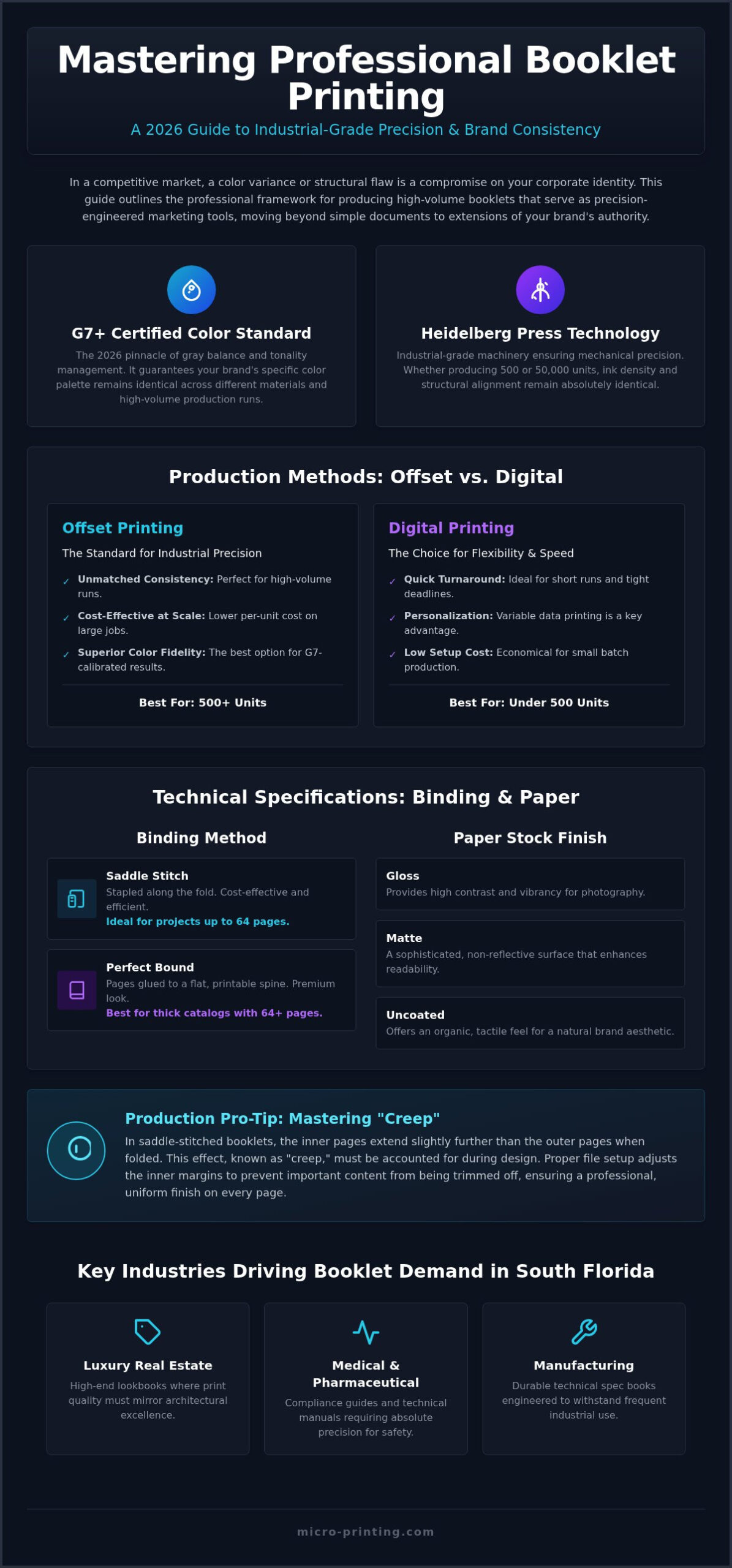
The evolution of modern printing processes has established a clear distinction between digital short-runs and high-volume offset production. Digital printing offers flexibility for personalized batches, but high-volume offset remains the standard for industrial precision. Utilizing Heidelberg press technology ensures that whether you produce 500 or 50,000 units, the ink density and structural alignment remain identical. These high-capacity systems are the cornerstone of effective commercial printing services florida businesses use to maintain a dominant market presence.
The Role of Tactile Marketing in a Digital-First World
Digital fatigue is a documented reality for B2B decision-makers in 2026. Professionals are inundated with ephemeral digital assets that are often ignored or deleted within seconds. A physical booklet commands attention through its weight, texture, and finish; it creates a sensory connection that a PDF cannot replicate. The psychology of holding a brand in one’s hands fosters a sense of stability and trust. For high-stakes sales presentations or annual reports, the tactile feedback of a premium matte or gloss finish communicates an attention to detail that reflects the quality of your own services.
Key Industries Driving Booklet Demand in South Florida
Specific sectors in the Fort Lauderdale region rely on sophisticated booklet printing services to meet rigorous operational standards. The medical and pharmaceutical industries require absolute precision for compliance guides and technical manuals where legibility is a safety requirement. Luxury real estate firms utilize high-end lookbooks to showcase multi-million dollar properties, where the print quality must mirror the architectural excellence of the listing. Manufacturing hubs also utilize technical spec books that are engineered to withstand frequent handling in demanding industrial environments. These diverse applications prove that physical collateral remains a high-ROI tool for serious business engagement.
Industrial printing isn’t just about ink on paper. It’s about a total process management approach that includes file pre-flighting, G7-certified color matching, and automated finishing. By choosing a partner with over 35 years of experience and a dedicated Fort Lauderdale facility, you ensure that your technical specifications are met with industrial-grade accuracy every time.
Technical Specifications: Binding, Paper Stock, and G7 Color
Industrial-grade booklet printing services require rigorous adherence to color calibration standards. In 2026, the G7+ certification represents the pinnacle of gray balance and tonality management. This standard ensures that your brand’s specific palette remains identical across different substrates and production runs. Consistency isn’t a goal; it’s a technical requirement. By utilizing Heidelberg press technology, we achieve a level of mechanical precision that desktop or retail solutions cannot match. For high-volume requirements, leveraging professional offset printing services is the only way to maintain unit-to-unit uniformity while optimizing production costs.
The weight of your paper stock also influences the perceived value of the brand. Gloss finishes provide high contrast for photography, while matte options offer a sophisticated, non-reflective surface. Uncoated stocks are increasingly popular for brands seeking a more organic, tactile feel. South Florida businesses can consult with our production team to select the optimal stock for their specific application.
Choosing the Right Binding: Saddle Stitch vs. Perfect Bound
Binding selection is determined by page count and intended use. Saddle stitching is the standard for projects up to 64 pages. It uses staples along the fold, making it efficient and cost-effective for brochures or event programs. Perfect binding offers a flat, printable spine, which is ideal for thick catalogs or high-end corporate manuals. This method provides a premium, book-like appearance that enhances shelf life. Spiral and Wire-O binding provide 360-degree rotation. This functionality is essential for technical training materials or cookbooks where the pages must lay flat during use.
High-Fidelity Finishing Techniques
Finishing is where technical execution meets sensory impact. UV coating provides essential durability and a high-gloss sheen to covers, protecting them from scuffs during transit. Foil stamping and embossing create a multi-sensory brand experience that demands attention through depth and light reflection. Custom die-cutting allows for unique shapes that differentiate your collateral from standard mail. When designing these pieces for distribution, technical specs must align with postal regulations. The official USPS guide on Booklets and Direct Mail outlines how weight and thickness impact postage rates, a critical consideration for high-volume South Florida campaigns.
Strategic Integration: Booklets, Direct Mail, and Packaging
A booklet isn’t a static asset. It’s a dynamic component of a multi-channel marketing system. In 2026, high-performing brands view booklet printing services as the foundation for integrated customer journeys. By synchronizing print production with logistics and digital tracking, businesses create a seamless transition from tactile engagement to online conversion. This strategic alignment is particularly effective when booklets are utilized as high-value inserts within custom-engineered folding cartons or pouches. This adds technical depth to the unboxing experience and reinforces brand authority at the point of delivery.
Integrating these assets into the workflows of direct mail marketing companies ensures your collateral reaches the right demographic with industrial efficiency. Variable Data Printing (VDP) allows for personalization at scale. You can tailor specific pages or offers to individual recipients without slowing down high-speed press runs. This level of customization transforms a standard catalog into a targeted sales tool that speaks directly to the recipient’s previous purchasing behavior or industry requirements.
Catalog Printing as a Growth Engine
Modern catalogs drive e-commerce traffic by bridging the physical and digital storefronts. By embedding dynamic QR codes, you allow customers to move from a high-fidelity product spread to a digital checkout page in seconds. There’s a significant shift toward the “Magalog” trend. Brands now combine authoritative editorial content with traditional product listings to build long-term trust. Managing this high-volume distribution from a central Fort Lauderdale hub provides a distinct logistics advantage. It reduces transit times and shipping costs across the South Florida corridor.
Direct Mail Synergies for South Florida Businesses
Choosing between Every Door Direct Mail (EDDM) and Targeted Direct Mail depends on your saturation goals. For 2026, the EDDM retail postage rate is $0.260 per piece, which remains a viable option for broad local awareness. However, targeted campaigns often yield higher ROI for niche B2B services. Postage optimization is critical following the July 12, 2026, USPS rate increases. Marketing Mail rates rose by an average of 4.803%, making accurate booklet sizing and weight management essential to mitigating rising logistics costs. One Fort Lauderdale manufacturing client recently reported a 14% increase in repeat orders by replacing standard flyers with a 12-page technical booklet mailer. This proves that depth of information drives higher professional engagement.
Designing for Production: A 2026 Print-Ready Checklist
High-volume production demands technical perfection. Errors in file setup lead to production delays and industrial material waste. Professional booklet printing services require a minimum 0.125-inch bleed and a robust “safety zone” for all critical text and graphics. This setup ensures that high-speed industrial trimmers don’t cut into your essential content during the final finishing stages. Precision at the design level is the only way to guarantee that the physical product matches your digital vision.
One factor that retail copy centers often ignore is “creep.” In saddle-stitched projects, the physical thickness of the paper causes the inner pages to extend further than the outer ones as they are folded together. If your designer doesn’t compensate for this by incrementally adjusting the inner margins, your layout will appear off-center after the final trim. Industrial partners use automated imposition software to calculate this shift, but keeping your safe area at least 0.25 inches from the trim line is a professional best practice.
Image resolution must be a minimum of 300 DPI to leverage the full capability of offset lithography. Lower resolutions result in visible pixelation that undermines corporate credibility. For organizations in the pharmaceutical or financial sectors, integrating microprint into the design provides a layer of authentication and security. These microscopic characters are nearly impossible to replicate through standard desktop scanning, adding a technical barrier against counterfeiting.
File Preparation and Structural Integrity
Always design in the CMYK color space. Converting RGB files at the press stage often leads to unpredictable color shifts, particularly in deep blues and vibrant reds. We recommend exporting your final assets using the PDF/X-1a standard. This format flattens layers and embeds all fonts, ensuring the file remains stable across different prepress environments. Our team performs a comprehensive pre-flight diagnostic on every file before the Heidelberg presses roll to identify these technical bottlenecks early.
Sustainable Printing Choices in 2026
Modern industrial printing balances high-output precision with environmental responsibility. Utilizing FSC-certified paper stocks ensures that your collateral originates from responsibly managed forests. Soy-based inks provide a cleaner alternative to petroleum products while offering superior color vibrancy and easier de-inking during the recycling process. By choosing a local production hub in Fort Lauderdale, you significantly reduce the carbon emissions associated with long-distance logistics. Contact our technical team today for a comprehensive file pre-flight review to ensure your project is ready for industrial-grade production.
Micro Printing: Your Fort Lauderdale Partner for Precision
Micro Printing operates as a strategic infrastructure partner for South Florida’s corporate sector. Since 1989, we’ve provided the industrial capacity required for high-stakes commercial projects while maintaining the accountability of a family-owned organization. Our Fort Lauderdale facility is engineered to manage the entire production lifecycle in-house. This end-to-end control eliminates the technical gaps often found when outsourcing to multiple vendors. Whether your project requires booklet printing services for a local event or a national catalog distribution, our workflow is designed for industrial-grade consistency.
Our facility utilizes Heidelberg press technology to achieve mechanical precision at scale. This infrastructure allows us to bridge the gap between small-batch prototyping and high-volume offset runs. We don’t just print pages; we manage a complex manufacturing process that includes G7-certified color matching and automated finishing. This systematic approach ensures that every unit in a 50,000-piece run matches the approved master proof. By centralizing design, production, and fulfillment, we provide a stable foundation for your brand’s physical marketing assets.
Industrial Capacity with a Local Touch
Proximity is a significant logistics advantage for South Florida businesses. Operating from a local hub allows for faster physical proofing and significantly reduced shipping windows compared to national online printers. You have direct access to our G7-certified experts for technical consultations, ensuring that complex file setups are resolved before production begins. Our deep roots in the Fort Lauderdale business community reflect a 35-year commitment to professional excellence and industrial reliability. We understand the specific market demands of the region and provide the technical support necessary to meet them.
Requesting a Custom Quote for Your 2026 Project
Accuracy in high-volume quoting depends on detailed technical specifications. When contacting our team, please provide the final page count, preferred paper weights for both cover and interior, and your required binding method. Our consultative process identifies opportunities to optimize your design for cost-efficiency without compromising structural integrity. We analyze your project’s dimensions and weight to ensure it aligns with the latest 2026 USPS regulations, helping you mitigate the recent 4.803% average increase in Marketing Mail rates. Professionals interested in verifying our quality standards can contact our Fort Lauderdale office to request a comprehensive sample kit or schedule a facility tour to see our Heidelberg presses in operation.
Advancing Your Brand Through Industrial Precision
Mastering booklet production in 2026 requires a synergy of technical design, G7-certified color accuracy, and strategic distribution. You’ve learned how high-volume offset technology and precise binding selections transform standard collateral into authoritative brand assets. Professional booklet printing services aren’t just about applying ink to paper; they’re about managing a complex manufacturing workflow that integrates with your broader marketing and logistics goals.
Our Fort Lauderdale facility provides the infrastructure necessary to execute these high-stakes projects with total consistency. By aligning your design with industrial requirements like G7 standards and proper creep compensation, you ensure every unit reflects your organization’s commitment to quality. This level of precision is what separates commercial-grade results from retail-level output.
Ready to scale your physical marketing? Request a Custom Booklet Printing Quote from Micro Printing to leverage our G7 Master Certification and state-of-the-art Heidelberg presses. Since 1989, we’ve helped Florida businesses achieve industrial-grade reliability. Your brand’s physical presence deserves the precision of a partner who understands the technical demands of commercial production.
Frequently Asked Questions
What is the standard turnaround time for high-volume booklet printing?
High-volume offset runs typically require five to seven business days after final proof approval. This timeline accounts for technical prepress calibration, industrial press operation, and mechanical bindery. Complex finishing options like UV coating or custom die-cutting may extend this window. We recommend discussing your specific deadline during the initial consultation to ensure logistics align with your campaign launch.
Which binding method is best for a 50-page product catalog?
A 50-page catalog is technically suited for saddle stitching, which remains efficient for documents up to 64 pages. However, perfect binding provides a flat, printable spine that conveys a more premium aesthetic for high-end product lines. Your choice should depend on whether you prioritize functional cost-efficiency or a high-fidelity brand presentation that requires a book-like finish.
Does Micro Printing offer G7-certified color matching for booklets?
Yes, we maintain G7 Master Colorspace certification to ensure absolute color consistency across all industrial runs. Our facility utilizes the 2026 G7+ standard to manage gray balance and tonality with technical precision. This calibration is essential for booklet printing services where brand identity must remain identical across multiple substrates and high-volume production batches.
Can you handle the mailing and distribution of my booklets directly?
We manage the entire distribution process through our in-house direct mail department. This includes data list processing, addressing, and direct delivery to the USPS hub. Integrating your booklet production with our mailing services eliminates the need for third-party logistics and reduces the risk of transit damage or coordination delays between different vendors.
What paper weight should I use for a premium feel booklet cover?
For a premium tactile experience, we recommend a 100lb or 120lb cover stock. Utilizing a 10pt or 12pt cardstock provides the structural integrity needed for high-frequency handling in professional environments. Adding a soft-touch laminate or a spot UV finish further enhances the sensory impact, making your collateral stand out during high-stakes sales presentations.
Do you provide templates for booklet file preparation?
Technical templates are available to assist your design team with proper document setup. These files include pre-defined bleed lines, trim marks, and safety zones to ensure your artwork aligns with our Heidelberg presses. Using these templates prevents common errors like text getting lost in the gutter or vital graphics being trimmed during the final finishing stages.
Can I visit your Fort Lauderdale facility to see a press proof?
Local clients are encouraged to visit our Fort Lauderdale production hub for press proofs and facility tours. Seeing a physical proof under standardized D50 lighting ensures that your color expectations match the final output before the full run begins. This direct access is a significant advantage over national online-only vendors who lack local technical support.
How does page count affect the cost of booklet printing services?
Page counts must be in multiples of four because booklets are manufactured from folded sheets. Increasing the page count impacts the total material cost and the complexity of the bindery process. It also influences the technical “creep” calculation, which requires more adjustment during the prepress stage to maintain consistent inner margins across the entire document.