
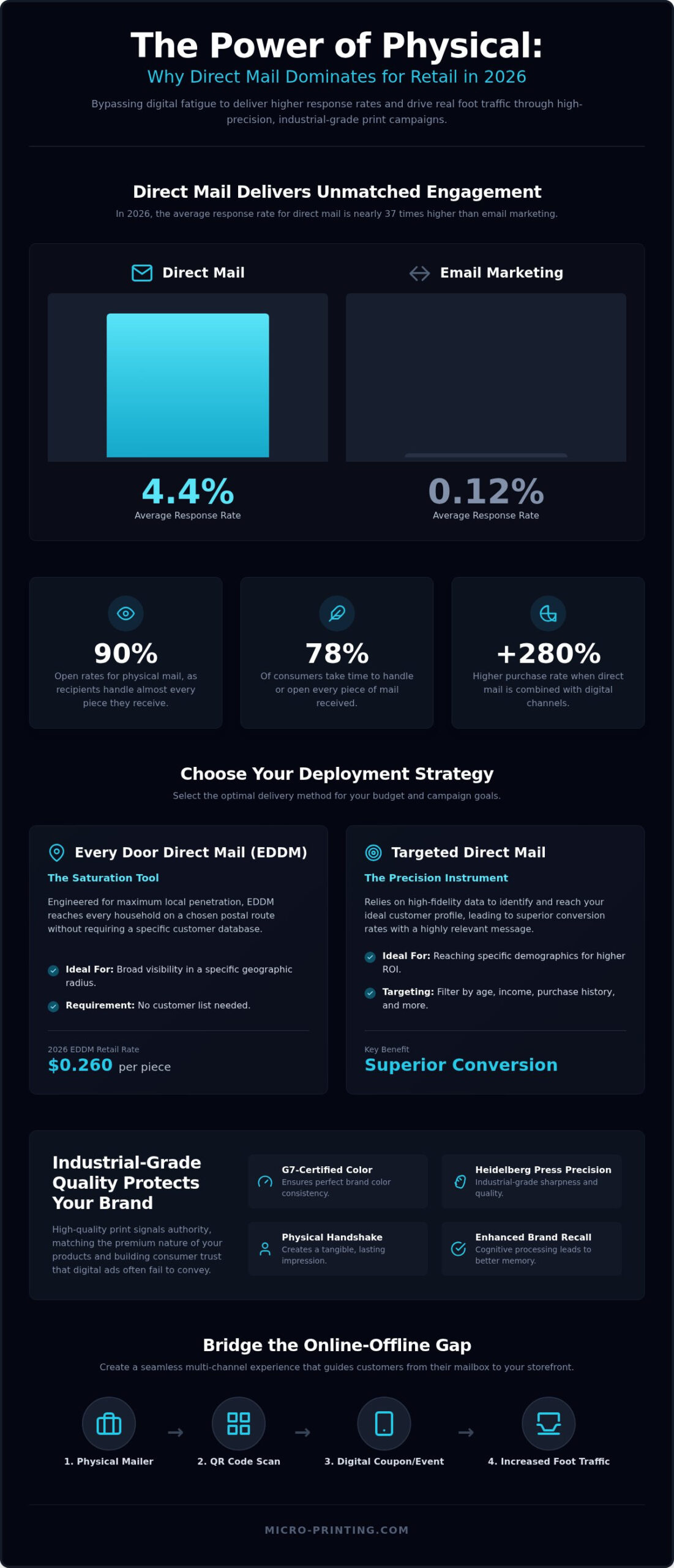
While digital advertising costs continue to climb, a single physical postcard often carries more weight than a thousand ignored emails. In 2026, the average response rate for direct mail stands at 4.4 percent, which is nearly 37 times higher than the 0.12 percent typically seen in email marketing. High-precision direct mail for retail stores has evolved from mass-market flyers into a sophisticated tool for driving local foot traffic with industrial-grade accuracy.
You’ve likely noticed that social media customer acquisition costs are rising while email open rates remain stagnant. It’s becoming harder to prove that digital impressions actually result in customers walking through your doors. This guide will show you how to leverage high-fidelity print and surgical targeting to bypass digital noise and increase physical store visits. We’ll examine the technical infrastructure of modern campaigns, including G7-certified color standards, the latest 2026 postal rates, and efficient Every Door Direct Mail strategies to ensure your brand maintains a dominant physical presence in your local market.
Key Takeaways
- Understand why physical touchpoints are bypassing digital fatigue in 2026 to deliver significantly higher response rates than saturated digital channels.
- Identify the most effective deployment method for your budget by comparing broad EDDM saturation with high-precision direct mail for retail stores.
- Discover how G7-certified color standards and Heidelberg press precision protect your brand equity through industrial-grade print quality.
- Learn to synchronize your mailing schedule with the 2026 retail calendar to capture peak foot traffic during major shopping holidays.
- Explore the benefits of end-to-end process management, from mailing list procurement to matching custom folding cartons for a unified brand experience.
Why Direct Mail for Retail Stores is Rebounding in 2026
Digital saturation has reached a critical threshold. As social media algorithms become more restrictive and customer acquisition costs climb, retailers are returning to a more stable, measurable medium. Direct mail for retail stores provides a “physical handshake” that digital pixels cannot replicate. This tangible connection creates a sense of permanence and trust. When a potential customer holds a high-quality brochure or postcard, your brand occupies a physical space in their home, rather than a fleeting second on a screen.
The data supporting this shift is clear. In 2026, the average response rate for direct mail stands at 4.4 percent, while email marketing struggles to reach 0.12 percent. Open rates for physical mail can reach as high as 90 percent, as 78 percent of recipients take the time to handle or open every piece of mail they receive. According to a comprehensive Direct Mail Overview, the tangible nature of advertising mail drives higher engagement because it requires more cognitive processing than digital ads, leading to better brand recall.
The ROI of Tangibility in Retail
The “keepability” factor is a primary driver of retail success. While a digital ad disappears with a single swipe, a well-designed postcard often ends up on a kitchen counter or refrigerator. This extended lifespan provides multiple impressions for a single cost. For local storefronts, high-precision mailers currently yield a response rate of approximately 4.4 percent, a figure that remains stable despite digital volatility. This stability is essential for retailers who need predictable foot traffic to manage inventory and staffing.
Psychologically, high-quality print materials signal authority. Utilizing G7-certified color standards and state-of-the-art Heidelberg presses ensures that your marketing collateral matches the premium nature of your products. When the weight of the paper and the sharpness of the images reflect industrial-grade quality, the consumer perceives the retail brand as more reliable and established. It’s a professional standard that digital banners often fail to convey.
Bridging the Gap Between Online and Offline
Modern direct mail doesn’t exist in a vacuum. It acts as a powerful bridge to your digital ecosystem. By integrating QR codes into your posters or booklets, you can drive recipients directly to in-store exclusive digital coupons or private event registrations. This creates a seamless multichannel experience. Marketers have found that combining direct mail with at least two digital channels can lead to a 280 percent higher purchase rate compared to single-channel efforts.
Retailers use these physical touchpoints to announce new collection drops or seasonal boutique events with surgical precision. Instead of hoping an algorithm shows your post to a local follower, you can guarantee that your invitation arrives in their hands. This method ensures your most important announcements aren’t lost in a crowded inbox or a fast-moving social feed.
EDDM vs. Targeted Direct Mail: Which is Best for Your Store?
Selecting the correct delivery mechanism is a technical decision that dictates the overall efficiency of your direct mail for retail stores. Every Door Direct Mail (EDDM) operates as a saturation tool, while targeted mail acts as a precision instrument. Understanding the logistical differences between these two approaches allows you to allocate your marketing budget with greater accuracy and measurable results.
The Every Door Direct Mail (EDDM) program is engineered for maximum local penetration without requiring a specific customer database. It allows you to reach every household on a chosen postal route. As of July 12, 2026, the EDDM Retail rate is $0.260 per piece. This makes it an ideal solution for retailers who need broad visibility within a specific geographic radius of their physical storefront.
Targeted direct mail relies on high-fidelity data to identify your ideal customer profile. Instead of mailing to every resident, you can filter by age, household income, or previous purchase history. While the cost per piece is often higher due to list procurement and addressing requirements, the conversion rates are typically superior because the message is highly relevant to the recipient’s specific needs and lifestyle.
Micro Printing facilitates both strategies from our Fort Lauderdale headquarters. We manage the end-to-end process, from procuring high-quality mailing lists to high-volume printing on our Heidelberg presses. Our 35 years of operational history ensures that your campaign meets all USPS technical requirements for mailpiece design, weight, and barcode accuracy.
When to Use EDDM for Retail
Saturation mailing is most effective for grand openings, neighborhood-wide sales, or brand awareness campaigns. It ensures that every resident in your immediate vicinity knows your store exists. By utilizing the USPS mapping tool, you can select specific carrier routes that align with your storefront’s location. For retailers requiring high-volume output, our commercial printing services Florida facility offers the industrial capacity to process and mail thousands of units with minimal turnaround time.
The Power of Targeted Mailing Lists
For luxury boutiques, reaching high-net-worth individuals is a priority. Targeted lists allow you to focus on specific neighborhoods like Las Olas or Victoria Park based on verified income data. This refined version of direct mail for retail stores reduces wasted postage by excluding households that don’t fit your primary buyer persona. Micro Printing automates the Direct Mail campaign execution by handling all addressing and sorting in-house. This precision ensures your brochures or catalogs reach the right hands. If you need assistance with data-driven outreach, you can consult our production team for technical guidance.
Maximizing Retail Impact: Print Quality and Creative Standards
The technical execution of a mailer is just as critical as the data behind it. If the physical piece feels flimsy or the colors appear muted, the recipient’s perception of your brand diminishes instantly. Direct mail for retail stores must function as a high-fidelity representation of your inventory. Achieving this requires industrial-grade hardware and adherence to strict color management protocols that ensure your printed assets match your physical products with surgical precision.
Micro Printing utilizes state-of-the-art Heidelberg presses to deliver the sharpness and clarity necessary for high-end retail catalogs and brochures. These machines provide superior ink coverage and registration compared to standard digital printers. When combined with G7-certified color standards, this technology guarantees that your brand’s specific palette remains consistent across every single piece in a 10,000-unit run. This level of repeatability is essential for maintaining brand equity in a competitive market.
Creative impact is often amplified through tactile finishing. Incorporating UV coating provides a protective, high-gloss layer that makes images pop, while die-cutting allows for unique shapes that stand out in a stack of standard envelopes. To drive actual foot traffic, every design must include four technical pillars:
- Direct Headline: A clear, value-driven statement that identifies the offer immediately.
- Hero Imagery: High-resolution product photography that showcases detail and quality.
- Defined CTA: An unmistakable instruction, such as “Bring this card for 20% off in-store.”
- Tracking Mechanism: A unique QR code or alphanumeric coupon to measure attribution accurately.
Color Accuracy for Fashion and Luxury Retail
For fashion and luxury brands, “close enough” is a failure. A slight shift in a fabric’s hue on a brochure can lead to customer disappointment when they see the item in-store. Our offset printing services are engineered to eliminate these discrepancies. By using physical plates and controlled ink density, we maintain the integrity of your brand’s visual identity across high-volume campaigns, providing a level of sophistication that digital alternatives cannot replicate.
Choosing the Right Format: Postcards vs. Catalogs
The format you choose should align with your specific campaign goal. Postcards are the most efficient vehicle for flash sales or “limited time” alerts because they don’t require the recipient to open an envelope. Conversely, catalogs are superior for seasonal lookbooks and deep brand storytelling, encouraging the customer to spend more time with your products. For retailers needing intricate design details or anti-counterfeit measures on gift certificates, our microprint capabilities provide precision-level security and detail. Whether you are utilizing a broad USPS Every Door Direct Mail strategy or a targeted VIP catalog, the physical quality of the piece remains the primary driver of perceived value.
Executing Your Campaign: Timing and Local Fort Lauderdale Strategy
Precision timing is a technical variable that determines the ultimate success of direct mail for retail stores. A campaign delivered too early loses its urgency; one delivered too late misses the purchase window entirely. Professional retail strategy requires a lead time of four to six weeks to account for list procurement, industrial printing cycles, and USPS logistics. This lead time is especially critical when preparing for major shopping events like Black Friday or Mother’s Day, where postal volumes peak and delivery windows tighten.
Local market dynamics in South Florida require a granular approach to geography. For retailers in Fort Lauderdale, success often depends on reaching specific high-value neighborhoods such as Las Olas, Victoria Park, or Rio Vista. Rather than a single, massive drop, data suggests that a three-part mailing series is more effective. This frequency builds brand recognition and reinforces the “physical handshake” mentioned earlier. To manage these costs, we utilize advanced sorting services and leverage the latest USPS promotions to offset pass-through expenses. It’s vital to note that as of July 12, 2026, domestic postcard rates have adjusted to $0.65, making professional sorting even more essential for budget preservation.
The 4-Week Retail Mailing Countdown
Adhering to a rigid production schedule ensures your mailers arrive exactly when they’ll have the most impact. Our process follows a strict timeline:
- Week 1: List procurement and design finalization. We verify all data points for accuracy.
- Week 2: High-fidelity printing and finishing. We utilize our Heidelberg presses to ensure your brand colors are perfect.
- Week 3: Sorting, addressing, and USPS entry. We handle the technical logistics to ensure maximum postage discounts.
- Week 4: In-home arrival. Your mailer reaches the customer just as your event or sale begins.
Tracking Direct Mail ROI
Measuring the effectiveness of physical mail requires digital-to-physical integration. We implement unique coupon codes for in-store redemption, allowing you to track exactly which mailer drove a specific purchase. Many brands also use Personalized URLs (PURLs) to monitor online engagement triggered by a physical piece. By analyzing this data, you can refine your targeting for future campaigns. Working with experienced direct mail marketing companies provides the technical infrastructure needed to manage these complex attribution models. If you are ready to optimize your local outreach, contact our Fort Lauderdale production team to begin your data-driven campaign.
End-to-End Retail Solutions: From Mailers to Custom Packaging
A comprehensive strategy for direct mail for retail stores reaches its full potential when the physical experience remains consistent from the mailbox to the point of sale. Brand equity is built through repetition and reliability. When the high-fidelity color on your catalogs matches the custom folding cartons on your shelves, you reinforce a message of quality and professional stability. This holistic approach ensures that every physical touchpoint serves as a deliberate extension of your marketing efforts.
Micro Printing provides “Total Process Management” to streamline this complexity. We oversee every stage of production, including design, industrial printing, technical finishing, and final mailing logistics. By centralizing these operations within our Fort Lauderdale facility, we eliminate the communication gaps often found when using multiple vendors. This integrated workflow allows us to maintain strict quality control while ensuring that your direct mail for retail stores aligns perfectly with your broader brand identity.
Packaging as a Marketing Tool
Custom-printed packaging functions as a secondary marketing vehicle that validates the promise made in your initial mailer. If a recipient is drawn to your store by a premium, UV-coated postcard, the in-store packaging must meet that same standard of excellence. Utilizing custom folding cartons or branded labels creates a cohesive experience that begins at the customer’s front door. This continuity is essential for luxury and fashion retailers who rely on perceived value to drive high-margin sales.
The Micro Printing Advantage in Fort Lauderdale
Local retailers require a partner capable of balancing personalized service with industrial-scale capacity. Our family-owned structure allows for direct technical consultation, ensuring you have access to state-of-the-art technology without the typical agency disconnect. With over 35 years of operational history in South Florida, we understand the specific logistical needs of the region’s retail market. We possess the infrastructure to scale your campaigns, whether you’re managing a single boutique location or coordinating volumes for a national retail chain.
Our commitment to G7-certified color standards and Heidelberg press precision applies to every asset we produce, from small-run booklets to high-volume folding cartons. This technical rigor ensures your brand remains dominant in a crowded marketplace. To streamline your production and mailing workflow, Partner with Micro Printing for your next retail campaign.
Securing Local Market Dominance with High-Precision Print
The success of retail marketing in 2026 depends on the seamless integration of industrial-grade quality and surgical data targeting. By strategically selecting between broad EDDM saturation and high-precision lists, you can optimize your reach and minimize wasted postage. Maintaining brand equity requires a commitment to technical excellence, ensuring that your brochures and catalogs reflect the same premium standards as your in-store inventory. This consistency establishes the trust necessary to convert a physical mailpiece into a store visit.
Micro Printing provides the technical infrastructure to manage this entire production lifecycle. Our facility utilizes Heidelberg Press Precision and G7-Certified Color Standards to deliver repeatable, high-fidelity results for every campaign. With over 35 years of Fort Lauderdale printing expertise, we function as a stable partner for businesses ready to bypass digital noise. Implementing professional direct mail for retail stores is a strategic investment in tangible customer relationships that drive verifiable foot traffic. It’s time to reclaim your local market presence with a campaign built on industrial precision.
Request a Custom Direct Mail Quote for Your Retail Store
Frequently Asked Questions
How much does direct mail for retail stores cost in 2026?
Postage rates are a fixed component of your budget, while production costs depend on volume and finishing. As of July 12, 2026, the USPS has set the Every Door Direct Mail (EDDM) Retail rate at $0.260 per piece and the domestic postcard rate at $0.65. Total campaign investment is influenced by your choice of paper stock, specialized coatings, and whether you require targeted list procurement or broad saturation delivery.
Is EDDM or Targeted Direct Mail better for a new retail store?
Every Door Direct Mail is generally superior for grand openings because it prioritizes local saturation and brand awareness within a specific radius of your storefront. Targeted direct mail for retail stores is more effective for established businesses that need to reach specific high-net-worth demographics or re-engage past customers based on purchase history. New stores often use EDDM to introduce themselves to the entire neighborhood efficiently.
How do I track the ROI of my retail direct mail campaign?
Attribution is managed through unique tracking mechanisms integrated into the design. You should use exclusive in-store coupon codes, Personalized URLs (PURLs), or scannable QR codes that lead to a dedicated landing page. These tools allow you to measure exactly how many recipients transitioned from their mailbox to your physical retail location, providing a clear picture of your conversion rate and cost per acquisition.
What is the best size for a retail postcard mailer?
Oversized postcards, such as 6″ x 9″ or 6″ x 11″ formats, are highly effective because they physically stand out among standard letter-sized mail. These dimensions provide sufficient surface area for high-resolution hero imagery and a prominent call to action. Utilizing these larger formats for direct mail for retail stores ensures your message isn’t overlooked while still qualifying for cost-effective automation postage rates.
How long does it take to print and mail a retail campaign?
A standard end-to-end production cycle typically requires 10 to 14 business days following final design approval. This timeframe accounts for industrial-scale printing on Heidelberg presses, technical finishing, and the sorting required for USPS entry. You should plan your campaign at least four to six weeks in advance of major retail holidays to ensure your mailers arrive exactly when consumer intent is at its peak.
Can Micro Printing help with the graphic design of my retail mailers?
We provide comprehensive process management that includes technical design assistance to ensure your assets are optimized for industrial print. Our team verifies that your files meet G7 color standards and USPS mailing specifications for aspect ratios and barcode placement. This technical oversight prevents costly production errors and ensures your brand identity remains consistent across all physical touchpoints.
Do I need a mailing permit to send direct mail in Fort Lauderdale?
You don’t need your own permit when partnering with a professional provider. Retailers can utilize our existing corporate permits to bypass the annual fees and administrative complexities associated with USPS permit management. We handle all postal documentation and sorting from our Fort Lauderdale facility, ensuring your campaign complies with all current regulations while securing the highest possible postage discounts.
What is the minimum number of pieces for an EDDM campaign?
The USPS requires a minimum of 200 pieces per ZIP code for an Every Door Direct Mail filing. Additionally, you must mail to at least one complete carrier route rather than selecting individual addresses. Most carrier routes in urban areas include between 300 and 600 households, making this a highly accessible entry point for local boutiques and independent retailers looking to test a specific neighborhood.