
A label that peels in a cold storage unit or shifts color between production runs isn’t just a branding oversight. In 2026, these technical failures often signal a deeper risk to your regulatory standing. You likely recognize that maintaining a vibrant shelf presence while navigating the FDA’s FSMA Section 204 requirements is a high-stakes balancing act. The pressure to integrate Traceability Lot Codes and comply with California’s AB 660 date labeling mandates has made the margin for error effectively zero. Achieving success requires more than just a sticker; it demands a rigorous approach to food safe label printing that prioritizes material science and chemical safety.
This guide provides the technical roadmap you need to master these requirements and ensure your packaging remains both legally compliant and visually superior. We’ll examine the critical intersection of low-migration inks, G7+ color precision, and the durable substrates required to survive the modern industrial supply chain. By the end of this analysis, you’ll understand how to leverage advanced printing methodologies to protect your brand’s reputation and its bottom line. Through industrial precision and technological confidence, you can transform compliance from a hurdle into a competitive advantage.
Key Takeaways
- Identify the critical distinctions between direct and indirect contact standards to ensure your food safe label printing meets the rigorous 2026 safety requirements.
- Understand why technical substrates like BOPP are the industrial benchmark for maintaining label adhesion in moisture-heavy or freezer environments.
- Leverage G7 Master Qualification to achieve absolute color consistency across diverse packaging formats, from primary labels to folding cartons.
- Master precise FDA placement and font size regulations for mandatory declarations, including nutrition facts and allergen warnings, to mitigate regulatory risk.
- Streamline your supply chain by integrating label production with structural packaging through a consultative partner capable of rapid prototyping.
What is Food Safe Label Printing? Standards for 2026
At its core, food safe label printing is a rigorous engineering process rather than a simple aesthetic application. For manufacturers in 2026, food safe label printing requires a validated combination of certified substrates, low-migration inks, and specific overprint varnishes. It’s a system designed to ensure that no chemical components from the packaging materials leach into the food product, which would compromise consumer safety and brand integrity. This technical discipline has become increasingly complex as global supply chains demand longer shelf lives and higher resistance to environmental stressors.
The 2026 standards emphasize a holistic approach to packaging. Regulatory bodies no longer view the label as an isolated component. Instead, they evaluate the entire package as a singular unit. This shift is driven by the FDA’s FSMA Section 204, which mandates strict traceability and record-keeping for high-risk foods. Compliance now requires that every element of the label, from the adhesive to the top coating, meets documented safety thresholds for its specific application environment.
The Role of Low-Migration Inks in Food Safety
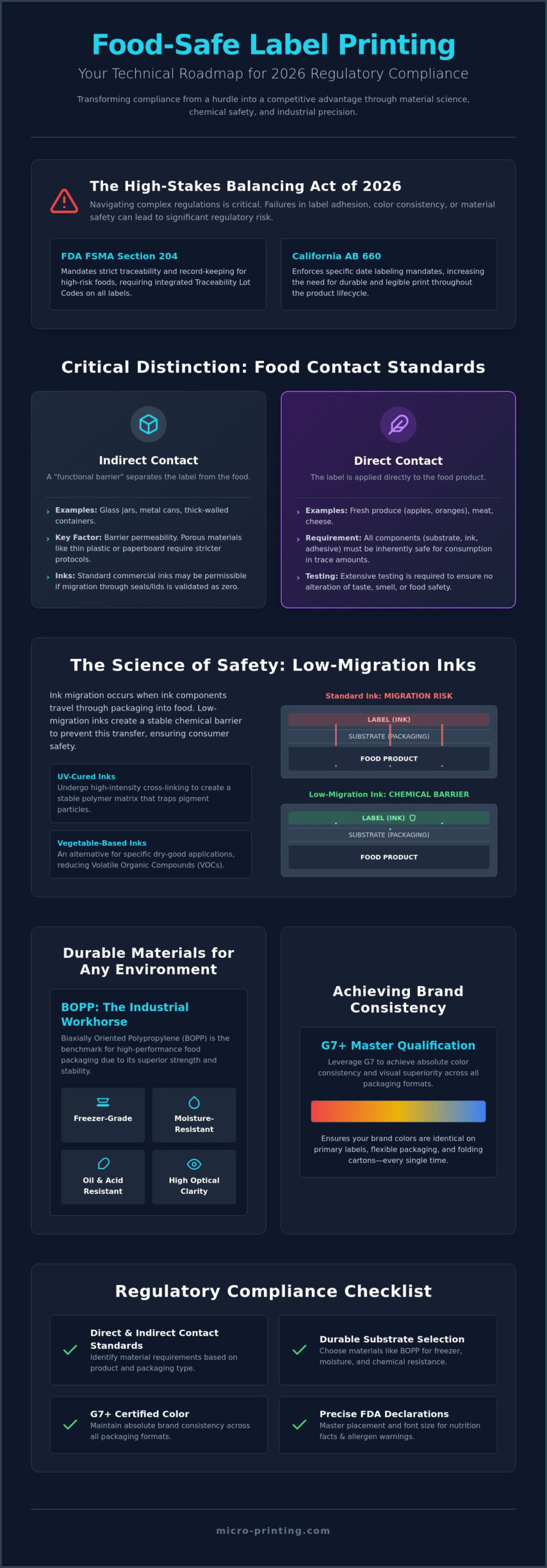
Ink migration occurs when small molecules from the printing ink travel through the packaging substrate and contact the food inside. This often happens through “set-off” in rolls or “diffusion” through porous materials like paper. Modern industrial solutions utilize UV-cured inks that undergo a high-intensity cross-linking process. This reaction creates a stable polymer matrix that effectively traps pigment particles. Vegetable-based inks offer an alternative for specific dry-good applications, reducing the presence of volatile organic compounds (VOCs). Low-migration ink acts as a chemical barrier that prevents the transfer of hazardous components from the label surface into the consumable product.
Indirect vs. Direct Contact Requirements
The distinction between direct and indirect contact determines the technical specifications of your production run. Direct contact labels, such as those applied to fresh produce or meat, must use materials that are inherently safe for consumption in trace amounts. These materials undergo extensive testing to ensure they don’t alter the taste, smell, or safety of the food. Understanding the specific food labeling regulations is the first step toward industrial compliance for these high-sensitivity applications.
Indirect contact applies when a “functional barrier” exists between the label and the food. Glass jars and thick metal cans are excellent examples of functional barriers. In these cases, standard commercial inks might be permissible, provided they don’t migrate through the lid or seals. However, for porous primary packaging like thin plastics or paperboard, the safety protocols remain stringent. We assess each project based on the packaging’s permeability and the product’s fat or moisture content, as these factors significantly influence the rate of chemical migration.
Selecting Durable Materials: From Freezer-Grade to Moisture-Resistant
The physical environment of the supply chain dictates the success of your packaging. A label that performs in a dry ambient warehouse will likely fail in a blast freezer or a high-humidity refrigeration unit. Effective food safe label printing starts with selecting a substrate that maintains its structural integrity under these specific stressors. We analyze variables such as surface energy, temperature fluctuations, and exposure to fats or oils before recommending a material specification. This technical rigor ensures that your branding remains intact from the production line to the consumer’s kitchen.
BOPP Labels: The Industrial Workhorse
Biaxially Oriented Polypropylene (BOPP) remains the industry benchmark for high-performance food packaging. Its manufacturing process involves stretching the film in two directions, which results in superior tensile strength and dimensional stability. This makes BOPP exceptionally resistant to the oils and acids common in food processing environments. For brands seeking a “no-label” aesthetic on glass or clear plastic containers, clear BOPP provides high optical clarity without sacrificing durability. Its rigidity also allows for consistent performance during high-speed automated application, significantly reducing downtime caused by label tearing or misalignment on the production line.
Adhesive Performance in Extreme Conditions
Adhesion is a matter of chemical engineering. “Label flagging”, where the edges of a label lift away from a curved surface, often occurs when the adhesive isn’t matched to the container’s radius or the application temperature. Acrylic adhesives offer excellent long-term stability and resistance to UV light. Rubber-based alternatives provide the high initial tack required for damp or cold surfaces. We subject our labels to rigorous testing protocols to simulate industrial freezer conditions. This ensures the bond remains permanent even at sub-zero temperatures. Consulting the FDA Food Labeling Guide helps ensure that your chosen material and adhesive combination doesn’t compromise the legibility of mandatory safety data over time.
For brands transitioning toward sustainable goals, we provide recycled kraft and compostable films that meet modern environmental standards. These are often paired with protective matte or gloss laminates to provide an additional layer of moisture and UV resistance. When your project requires a cohesive look from the primary label to the secondary packaging, selecting high-performance folding cartons ensures your brand maintains a premium, unified presence on the shelf. Industrial precision in material selection is what separates a professional brand from its competitors.
Achieving Brand Consistency with G7-Certified Color Standards
Color consistency serves as a silent indicator of quality control. In the competitive food and beverage sector, a brand’s signature palette must remain identical across labels, folding cartons, and point-of-sale displays. If a signature red appears slightly orange on a bottle label but deep crimson on the secondary packaging, consumers subconsciously perceive a lack of professional oversight or potential product spoilage. Achieving this uniformity in food safe label printing requires a shift from traditional ink-limit management to a rigorous, visual appearance-based calibration system. Our industrial approach eliminates the variables that typically cause batch-to-batch inconsistencies.
The Science of G7 Color Matching
G7 Master Qualification isn’t a mere aesthetic preference; it’s a mathematical methodology focused on gray balance and neutral tonality. Traditional printing often relies on ink density, but G7 focuses on spectral data to ensure visual appearance is consistent across different devices and substrates. This is vital for multi-SKU product lines where a brand must maintain its identity on both porous paperboard and synthetic films. By targeting specific L*a*b* coordinates, the G7 methodology ensures your brand colors look identical regardless of the material’s surface energy. This technical precision aligns with the clarity standards established in the FDA Food Labeling Guide, where maintaining the legibility of safety data is a regulatory mandate.
High-Fidelity Printing on Heidelberg Presses
Our facility utilizes state-of-the-art Heidelberg presses to deliver the high-fidelity imagery necessary for modern food branding. These machines allow for hyper-realistic detail and saturated colors that create immediate appetite appeal on the retail shelf. For complex ingredient lists, nutritional panels, and allergen warnings, our microprint capabilities ensure that even the smallest fonts remain sharp and fully compliant. The integration of automated color measurement systems within the press allows for real-time adjustments, keeping Delta E variance within strict industrial tolerances.
When scaling production from a pilot run to a national rollout involving millions of units, our offset printing services provide the necessary industrial capacity and stability. Offset technology remains the benchmark for high-volume food label production because it offers the lowest unit cost without compromising photographic quality. This systematic approach to color management ensures that your brand’s visual identity is as stable and reliable as the product inside the package. We manage the entire workflow to ensure that your packaging serves as a precise reflection of your brand’s commitment to quality.
Navigating FDA Regulations and Food Safety Compliance
Regulatory compliance isn’t a suggestion; it’s the absolute foundation of market access. Maintaining an industrial standard for food safe label printing involves more than just selecting non-toxic inks. It requires a precise architectural layout that satisfies the FDA’s strict hierarchy of information. Every label must feature a Statement of Identity and the Net Quantity of Contents on the Principal Display Panel (PDP). By 2026, these elements must be accompanied by a Traceability Lot Code (TLC) if your product is on the Food Traceability List. This is a direct result of the FDA FSMA Section 204 deadline on January 20, 2026. Failure to integrate these identifiers can lead to immediate shipment rejections and costly product recalls.
FDA Nutrition Facts Panel Requirements
The Nutrition Facts panel remains the most scrutinized section of any food package. For 2026, manufacturers must adhere to specific formatting that prioritizes servings per container, caloric density, and added sugars. These values must be presented in a legible, high-contrast format that survives the environmental stressors discussed in previous sections. We ensure that your barcodes and QR codes remain scannable even after applying protective laminates or UV coatings. This is critical for the growing trend of smart labeling, where consumers access detailed ingredient sourcing via a quick scan. For manufacturers operating in South Florida, partnering with commercial printing services florida ensures that these regional and federal nuances are managed with precision.
Allergen and Traceability Compliance
Allergen declarations are a matter of consumer safety and legal liability. The FDA mandates that the “Big 9” allergens, including sesame, milk, and tree nuts, must be declared in a specific “Contains” statement or within the ingredient list using bold type. Font sizes are not arbitrary; they must meet minimum height requirements to ensure visibility for visually impaired consumers. Beyond allergens, the implementation of variable data printing allows for unique tracking identifiers on every unit. This technology is essential for managing product recalls and expiration dates, especially with California’s AB 660 now requiring standardized “Best If Used By” and “Use By” terminology as of July 1, 2026. We provide the technical infrastructure to manage these complex data sets across your entire product line.
Managing multi-language labeling adds another layer of complexity to the production process. Regional markets often require Spanish or French translations that must mirror the English safety data exactly. Our workflow includes rigorous proofing stages to ensure that no technical data is lost in translation. This systematic approach to food safe label printing protects your brand from the financial and reputational risks of non-compliance. Consult our specialists at micro-printing.com to audit your current label architecture for 2026 compliance and ensure your brand is prepared for the next generation of food safety standards.
Scalable Label Solutions for Fort Lauderdale Food Manufacturers
For South Florida food and beverage producers, proximity to a specialized production facility is a strategic asset. The shift toward digital production in the label industry, which is projected to reach 11.3% of the global market by 2030, allows for the rapid prototyping necessary for seasonal releases and regional testing. However, high-volume consistency still requires the industrial weight of a local partner. Our facility provides the infrastructure to manage food safe label printing with the speed and precision required by the Fort Lauderdale manufacturing sector. This local presence ensures that your brand remains agile as federal and state regulations evolve.
Total Packaging Integration: Labels and Cartons
Procuring labels and secondary packaging from separate vendors often leads to visual drift and logistical friction. We eliminate this by coordinating finishes and structural designs between your primary labels and custom folding cartons. This unified approach ensures that a matte laminate on a jar label perfectly matches the tactile feel of its external box. For automated labeling equipment, structural considerations are paramount. We design each component to withstand the mechanical stress of high-speed application lines, preventing downtime and material waste. A single-source provider in Florida simplifies the procurement process, allowing your team to focus on product development rather than vendor management.
Local Logistics and B2B Partnership
Remote proofing has its limits when brand equity is at stake. Local brand managers benefit from in-person press checks, where they can verify G7+ color accuracy and material feel in real-time. This level of oversight is impossible with distant or international suppliers. Beyond quality control, a regional manufacturing model supports just-in-time delivery for perishable goods. Beverage and snack producers can maintain leaner inventories, reducing the risk of obsolete packaging as regulations like California’s AB 660 change the requirements for date labeling. This model also reduces the carbon footprint of your distribution network, aligning with the 2026 industry trend toward sustainable logistics.
Scaling from a boutique local brand to a national retail presence requires a partner who understands industrial logistics. We provide the technical background and production volume to support your growth at every stage of the lifecycle. Consult with our packaging experts in Fort Lauderdale for your next food-safe project and experience the stability of a professional printing partnership. Our systematic approach ensures that your packaging remains a reliable asset to your brand’s reputation and compliance profile.
Securing Your Brand’s Future in the 2026 Food Market
Navigating the transition to the 2026 regulatory landscape requires a partner who prioritizes technical precision over simple output. We’ve examined how material science, low-migration ink chemistry, and rigorous FDA compliance form the backbone of a successful product launch. Achieving a consistent, high-fidelity shelf presence is no longer just a branding goal. It’s a measurable outcome of G7 Master Qualification and state-of-the-art Heidelberg press technology. By integrating your primary labels with custom folding cartons, you create a unified supply chain that’s both efficient and resilient.
As an industrial partner serving Fort Lauderdale brands since 1989, we provide the stability and technological confidence needed to scale your operations from boutique runs to national retail distribution. Our systematic approach to food safe label printing ensures that every unit meets the highest safety standards while maintaining the visual impact your brand deserves. Take the next step in professionalizing your packaging infrastructure and ensuring long-term compliance. We’re ready to help you master the complexities of the modern food industry.
Request a Custom Quote for Your Food-Safe Labels
Frequently Asked Questions
Are your food labels microwave and freezer safe?
Yes, we provide labels specifically engineered for extreme thermal environments. Freezer-grade substrates like BOPP utilize all-temperature adhesives that maintain a permanent bond at sub-zero temperatures. For microwave applications, we select heat-stable films that won’t distort or release odors during heating. We match the material specification to your product’s specific storage and consumption lifecycle to ensure industrial-grade durability.
What is the difference between food-safe ink and regular commercial ink?
The primary difference lies in the chemical stability and “low-migration” properties of the pigments and carriers. Regular commercial inks contain volatile components that can leach through porous packaging into the food. Professional food safe label printing utilizes UV-cured or vegetable-based inks designed to minimize chemical transfer. This ensures your packaging remains compliant with federal safety standards while maintaining high visual fidelity.
Do I need a special laminate for labels that will be exposed to oils or fats?
Yes, a protective laminate or specific varnish is necessary for products containing oils, fats, or acidic components. These substances can break down standard inks and adhesives over time, leading to smudging or label failure. We apply moisture-resistant gloss or matte laminates that serve as a physical barrier. This protection preserves your branding and ensures mandatory safety data remains legible throughout the product’s shelf life.
Can you print clear labels for glass beverage bottles?
Yes, we utilize high-clarity BOPP films to achieve the “no-label” look preferred for premium glass beverage bottles. These labels offer excellent optical transparency while providing superior resistance to moisture and refrigeration cycles. Our technical process ensures that the adhesive remains invisible and bubble-free. This creates a high-end aesthetic that allows the product’s natural color and texture to remain the focal point.
What are the FDA requirements for font sizes on food labels?
The FDA mandates specific minimum font sizes based on the package’s total surface area to ensure legibility. For most standard retail packages, the Statement of Identity and Net Quantity must be prominent. Mandatory declarations like Nutrition Facts and ingredient lists generally require a minimum height of 1/16 of an inch based on the lowercase “o”. We audit your artwork to ensure every technical element satisfies these federal requirements.
Do you offer G7-certified color matching for high-volume runs?
Yes, our facility maintains G7 Master Qualification to ensure absolute color precision across high-volume production runs. This methodology allows us to match brand colors across different substrates, such as labels and folding cartons, with mathematical accuracy. By focusing on gray balance and neutral tonality, we eliminate batch-to-batch variance. This ensures your product line presents a unified and professional image on every retail shelf.
How do I ensure my labels will stick to cold, damp plastic containers?
Achieving permanent adhesion on cold or damp surfaces requires a high-tack, rubber-based adhesive system. Standard acrylic adhesives often fail when applied to containers with surface condensation. We recommend applying labels to dry containers whenever possible, but our all-temperature adhesives are engineered to “bite” into damp plastic and maintain a secure bond. We analyze your application environment to select the correct chemical formulation for your specific production line.
What is the minimum order quantity for custom food-safe labels?
We focus on scalable B2B solutions tailored to the needs of growing and established food manufacturers. While we don’t publish a fixed minimum, our industrial infrastructure is optimized for professional-grade production runs that require consistent quality and regulatory oversight. This approach allows us to support local brands as they scale from regional distribution to national retail. Contact our team to discuss the specific volume requirements for your upcoming project.