
A product label that peels or fades under the South Florida sun isn’t just a manufacturing oversight; it’s a direct compromise of your brand’s industrial integrity. Maintaining visual consistency across complex product lines remains a primary challenge for many manufacturers, especially when dealing with the high humidity levels typical of the region. When sourcing high-performance custom product labels Fort Lauderdale companies must look beyond basic aesthetics to find a partner that integrates advanced color science with climate-resilient material engineering.
We understand that your packaging must survive rigorous supply chain conditions while meeting strict FDA labeling requirements. This guide will show you how to engineer labels that elevate your brand through G7-certified precision and durable substrates designed for local environmental stressors. We’ll analyze the latest 2026 manufacturing standards, including the transition to G7+ calibration, and explain how a localized production strategy eliminates the shipping delays and color variances that often plague out-of-state procurement. By aligning your technical requirements with expert local manufacturing, you ensure your products maintain their premium status from the production line to the retail shelf.
Key Takeaways
- Identify the specific material engineering required to prevent label peeling and fading in South Florida’s high-humidity environment.
- Master the G7-certified standards and Heidelberg press capabilities necessary for maintaining absolute color consistency across diverse product packaging.
- Determine the optimal format for your production volume, comparing high-speed roll-fed applications against specialized sheet-fed or die-cut designs.
- Secure industrial-grade custom product labels Fort Lauderdale that meet the latest 2026 FDA and pharmaceutical compliance requirements for the medical and food sectors.
- Streamline your supply chain by leveraging local manufacturing to eliminate the risks and delays associated with out-of-state printing partners.
The Strategic Role of Custom Product Labels in the South Florida Market
By 2026, the retail and industrial landscape in Fort Lauderdale has shifted toward a requirement for high-fidelity, resilient packaging. Generic stickers no longer suffice for brands competing in high-density markets. Companies now require engineered custom product labels Fort Lauderdale that function as technical components rather than mere decorative elements. This transition is driven by a need for industrial-grade durability and precise color matching that survives the logistical journey from the production line to the shelf.
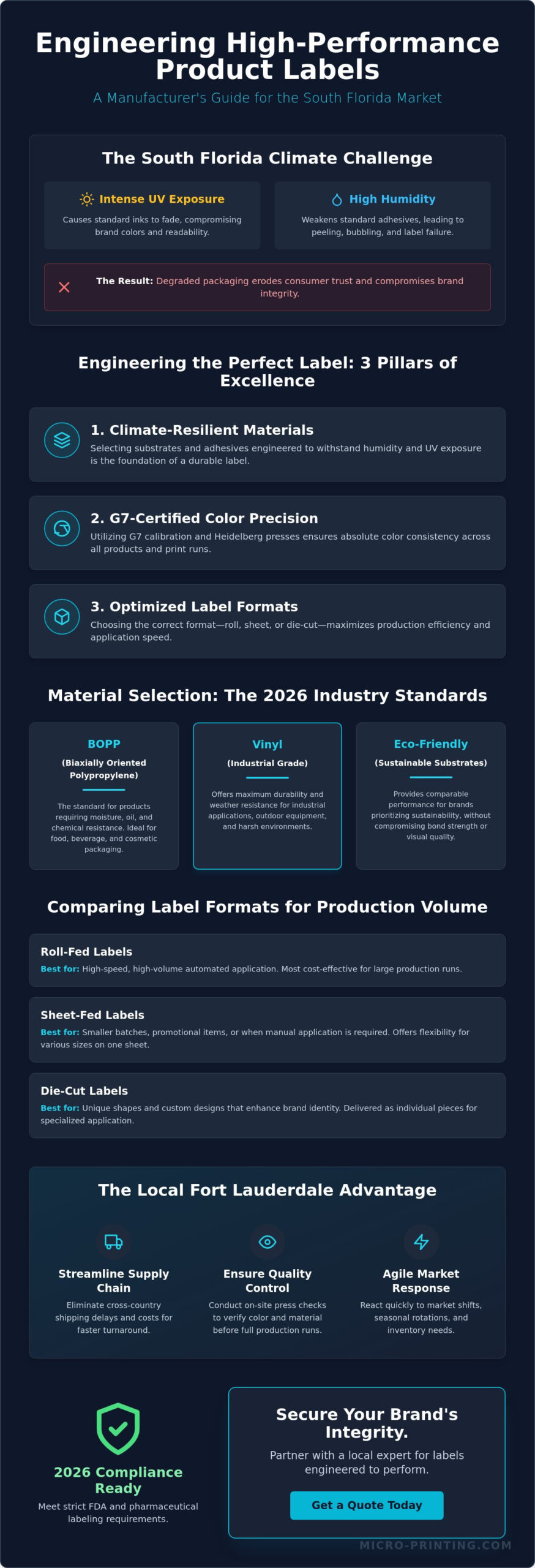
The Florida climate presents unique engineering challenges that standard adhesives cannot overcome. High humidity levels and intense UV exposure can cause inferior labels to peel, bubble, or fade within weeks. Professional labeling utilizes advanced pressure-sensitive adhesive technology specifically formulated to maintain a permanent bond in tropical environments. When a label fails, consumer trust evaporates instantly; shoppers associate degraded packaging with a compromised product inside. Investing in high-performance materials is a safeguard for your brand’s perceived value and professional reputation.
Beyond Aesthetics: Labels as Functional Brand Assets
A label is the primary physical interface between your product and the consumer. In high-end retail environments like Las Olas Boulevard or Sunrise, the tactile quality of a label communicates premium status. It isn’t just about what the customer sees, but what they feel. A textured finish or a spot UV coating provides a sensory cue of quality that digital screens cannot replicate. These assets should be integrated into a comprehensive commercial printing services florida strategy to ensure that your catalogs, folding cartons, and labels present a unified, high-fidelity brand image.
The Local Advantage: Why Proximity Matters for Label Production
Relying on out-of-state manufacturers introduces unnecessary friction into the South Florida supply chain. Local production offers distinct strategic advantages that impact your bottom line. Eliminating cross-country shipping ensures that seasonal product rotations or inventory refills happen without delay. Furthermore, a local facility allows your team to conduct on-site press checks. This is critical for high-stakes product launches where color accuracy and material finish must be verified in person before the full production run begins.
Choosing a partner for custom product labels Fort Lauderdale ensures that your logistics remain lean and your quality control remains absolute. This proximity allows for a more agile response to market shifts and ensures that your technical specifications are met with industrial precision. By manufacturing locally, you align your production with the specific needs of the South Florida climate while maintaining a transparent and responsive supply chain.
Engineering the Perfect Label: Materials, Finishes, and G7 Standards
Technical excellence in label production begins with the hardware. High-fidelity industrial output is achieved through the use of Heidelberg presses, which remain the benchmark for precision in the printing industry. These machines allow for tight registration and consistent ink density, ensuring that every production run of custom product labels Fort Lauderdale manufacturers order meets exact specifications. This level of mechanical reliability is essential for brands that cannot afford the downtime or waste associated with inferior equipment.
Material selection is a critical engineering decision based on the product’s lifecycle and environment. While standard paper stocks are suitable for dry goods, Biaxially Oriented Polypropylene (BOPP) has become the 2026 industry standard for products requiring moisture resistance and durability. Vinyl provides a robust alternative for industrial applications where mechanical wear is a factor. For brands prioritizing sustainability, eco-friendly substrates now offer comparable performance without compromising the bond strength or visual quality required for premium shelf presence.
Color Management and Brand Integrity
Maintaining visual uniformity across different packaging formats is a complex challenge. G7 Master Status is a calibration methodology that ensures visual consistency across all print platforms. By utilizing G7-certified workflows, we eliminate color variance between your labels and folding cartons, ensuring your brand identity remains stable regardless of the substrate. This process relies on the physics of ink-to-substrate bonding, where spectral data guides the press to achieve a neutral gray balance, resulting in photographic accuracy and repeatable results across multiple production cycles.
Specialized Coatings for the Florida Environment
The intense UV radiation and humidity in South Florida demand specialized finishing techniques. UV-resistant coatings are no longer optional; they are a functional requirement to prevent ink degradation and fading. For refrigerated beverages or bath products, moisture-wicking adhesives ensure the label remains anchored even when subjected to condensation. Tactile finishes, such as soft-touch laminates or grit coatings, improve grip in humid conditions while providing a premium sensory experience. Adhering to the FDA Food Labeling Guide requires that all mandatory information remains legible under these harsh conditions. Consulting with a technical specialist at micro-printing.com helps determine the exact combination of face stock, adhesive, and coating for your specific industrial application.
Comparing Label Formats: Roll-Fed vs. Sheet-Fed vs. Die-Cut
Selecting the correct format for custom product labels Fort Lauderdale is a decision rooted in production efficiency and application mechanics. Roll-fed labels represent the industry standard for high-speed, automated application lines. This format allows for continuous feeding into labeling equipment, which minimizes downtime and ensures a consistent throughput for large-scale manufacturing. Conversely, sheet-fed labels are the preferred choice for short-run artisanal products or manual application workflows where the complexity of an automated line isn’t necessary. The choice between these formats dictates the speed of your packaging line and the overall agility of your South Florida supply chain.
Die-cut precision allows brands to break the standard rectangular mold. By using custom die-lines, we create unique shapes that conform to specific bottle geometries or packaging contours. This level of customization is essential for creating a distinct profile on retail shelves. As production volumes scale, businesses must assess the transition from digital output to high-capacity offset printing services. While digital printing offers flexibility for small batches, offset printing provides the per-unit economy and speed required for industrial-scale distribution in the 2026 market.
The Economics of Label Formatting
The per-unit cost of a label is heavily influenced by the chosen format and the associated setup requirements. Roll-fed production involves higher initial setup times but offers significant savings on high-volume runs. Plate costs and material waste are critical factors in these calculations. We utilize intelligent die-line design to maximize the number of labels per linear foot, reducing substrate waste and lowering the overall environmental footprint. Maintaining strict G7 standards throughout this process ensures that whether you choose roll or sheet formats, the color fidelity remains identical across your entire inventory.
Application Compatibility
Industrial labeling machines require precise roll specifications to function without failure. It’s vital to verify unwind directions, core sizes, and outer diameter limits before production begins. For automated lines, the orientation of the label on the roll must match the machine’s applicator head exactly. Custom die-cutting for unique bottle geometries adds another layer of complexity; the label must be engineered to adhere smoothly to curved surfaces without flagging or edge lifting. By coordinating these technical details during the design phase, Fort Lauderdale businesses avoid costly application errors and ensure a seamless integration into their existing manufacturing lines.
Industry-Specific Requirements for Fort Lauderdale Businesses
Fort Lauderdale’s industrial landscape demands specialized engineering for custom product labels Fort Lauderdale based on specific sector regulations. A cosmetics manufacturer near the Las Olas district faces different technical hurdles than a biotech firm in the growing South Florida life sciences corridor. Precision in these applications is mandatory to ensure both legal compliance and functional reliability. Each industry has unique failure points that must be addressed during the material selection and design phases.
Pharmaceutical and medical device companies require high-fidelity output to meet strict tracking standards. microprint is essential for anti-counterfeiting in pharmaceutical labeling because it integrates microscopic security elements that verify product authenticity at the point of distribution. For the food and beverage industry, labels must adhere to the 2026 FDA guidelines, which mandate clear statements of identity, net quantity of contents, accurate ingredient lists, and the name and address of the manufacturer or distributor. These labels must maintain legibility even when exposed to the condensation of the cold chain or the high-heat environments of industrial storage.
Industrial and chemical sectors require labels engineered for extreme durability. These substrates must resist abrasion, chemical spills, and prolonged environmental exposure without losing critical safety information. In the luxury cosmetics market, the focus shifts to high-end finishes like foil stamping and soft-touch laminates that communicate brand value while surviving the oils and moisture common in personal care products. Failure to account for these environmental stressors results in packaging that degrades before the product reaches the end consumer.
Compliance and Regulatory Labeling
Navigating regulatory frameworks requires a partner that understands the nuances of font legibility and ingredient list placement. FDA standards dictate specific formatting that cannot be compromised for the sake of design. Safety and warning labels on industrial equipment must meet ANSI or ISO standards for durability, ensuring that hazard communications remain visible for the entire lifecycle of the machine. We ensure that every technical specification meets these rigorous legal mandates.
Smart Labeling and Traceability
The 2026 supply chain relies heavily on traceability. Integrating QR codes and serialized data into your label design allows for real-time inventory tracking and direct consumer engagement. For local food producers, batch coding and expiration date integration are functional requirements that streamline recalls and inventory management. This level of technical complexity ensures your brand remains competitive in an increasingly data-driven market. To ensure your packaging meets these rigorous industrial standards, consult with the experts at micro-printing.com for a comprehensive technical review.
Scalable Label Solutions with Micro Printing: Your Fort Lauderdale Partner
Our state-of-the-art facility in Fort Lauderdale is engineered for high-volume production and industrial precision. Unlike providers who treat packaging as an isolated component, we offer a comprehensive end-to-end service model. This process begins with structural design and material consultation, moving through G7-certified production, and concluding with final delivery. For businesses seeking custom product labels Fort Lauderdale, this localized approach eliminates the logistical risks associated with fragmented supply chains and long-distance shipping.
We recognize that labels are part of a broader brand ecosystem. Effective packaging requires coordination between the primary label, the folding carton, and your promotional materials. By integrating label production with direct mail marketing and box manufacturing, we ensure color consistency across every physical touchpoint. This synergy prevents the visual disconnect often seen when brands source different components from multiple vendors. It’s a system-level approach that guarantees your brand’s integrity remains intact from the initial mailer to the product on the shelf.
Sustainability is a core component of the 2026 manufacturing landscape. We utilize eco-friendly inks and recyclable substrates that meet the environmental standards of modern consumers without sacrificing industrial performance. These materials are tested to ensure they provide the same level of bond strength and UV resistance as traditional options. You can meet your corporate responsibility goals while maintaining the premium shelf presence required in the South Florida market.
The Micro Printing Quality Assurance Process
Quality control is managed by a G7-certified team that monitors spectral data throughout the entire print run. This ensures that the first label is identical to the last, regardless of the run’s volume. We perform rigorous testing for adhesive strength and environmental resistance, specifically simulating the heat and humidity stressors found in Florida. Personalized consultation is available for complex packaging challenges, ensuring that your technical specifications are translated into a functional, durable product that resists flagging and fading.
Streamlining Your Supply Chain
Local proximity allows us to offer Just-In-Time (JIT) delivery and local warehousing options. This model reduces your inventory carrying costs and allows for rapid reordering as your product lines grow. Beyond small-scale packaging, we also provide large format signage to ensure that your retail displays and promotional graphics match the precision of your product labels. This holistic management of your physical brand assets creates a stable, predictable supply chain that supports long-term scaling for any Fort Lauderdale business.
Securing Your Brand’s Industrial Future in South Florida
Engineering high-performance packaging requires more than just high-quality graphics; it demands a rigorous application of material science and color calibration. We’ve analyzed how G7-certified standards and moisture-resistant substrates protect your brand’s integrity against the unique environmental stressors of the region. By choosing localized production for your custom product labels Fort Lauderdale, you eliminate the logistical friction of out-of-state shipping while ensuring your products meet every industrial and regulatory mandate.
Micro Printing combines over 35 years of Fort Lauderdale manufacturing excellence with advanced Heidelberg press technology to deliver scalable, precision-engineered solutions. Our G7-Certified Master Printer status guarantees that your visual identity remains consistent across every label, folding carton, and marketing asset. This technical reliability provides the stability your organization needs to scale operations with confidence in the 2026 market.
Request a Custom Label Quote from Micro Printing Today to align your packaging with the highest industrial standards. We look forward to engineering a solution that elevates your product’s shelf presence and operational durability.
Frequently Asked Questions
What is the best label material for products that will be refrigerated?
BOPP (Biaxially Oriented Polypropylene) is the industrial standard for refrigerated applications. Its synthetic construction prevents moisture absorption, ensuring the label doesn’t degrade or peel when subjected to condensation. Combined with a permanent, cold-temp adhesive, BOPP maintains its bond and legibility within the cold chain. This material is essential for beverages, chilled foods, and pharmaceutical products requiring stable packaging in fluctuating temperatures.
How does G7 certification impact the quality of my custom product labels?
G7 certification serves as the global benchmark for color calibration and visual consistency. By following this methodology, we ensure that your custom product labels Fort Lauderdale match the spectral data of your original brand assets. This process eliminates color variance between production runs and different substrates. It provides a neutral gray balance and photographic accuracy, which is critical for maintaining professional brand integrity across complex product lines.
Can I get custom die-cut labels in unique shapes for my brand?
We provide high-precision die-cutting to create labels in virtually any unique geometry. This process uses custom-engineered die-lines to cut shapes that conform to specific bottle contours or packaging designs. Moving beyond standard rectangles allows your brand to establish a distinct visual profile on the retail shelf. Our technical team works with your structural design to ensure the shape remains functional during high-speed automated application.
What is the difference between digital and offset label printing for high-volume orders?
Digital printing is optimized for short-run flexibility and rapid prototyping. However, for high-volume industrial orders, offset printing on Heidelberg presses is the superior choice. Offset technology provides a lower per-unit cost and faster throughput once the initial setup is complete. It also offers exceptional ink density and fine-line detail, making it the preferred method for large-scale distribution where manufacturing efficiency and repeatability are the primary objectives.
Do you offer eco-friendly or sustainable label materials in Fort Lauderdale?
Sustainable label options include recyclable substrates and materials made from post-consumer waste. We offer eco-friendly inks that reduce environmental impact while maintaining the durability required for the Florida climate. These substrates are engineered to perform identically to traditional plastics, ensuring your brand meets its corporate responsibility goals without compromising on adhesive strength or UV resistance. Local production in Fort Lauderdale further reduces the carbon footprint associated with long-distance logistics.
How long does the typical label production process take at your Fort Lauderdale facility?
The production timeline depends on the complexity of the finishing and the total volume of the run. Because our manufacturing facility is located in Fort Lauderdale, we eliminate the delays inherent in out-of-state shipping and cross-country logistics. Most industrial orders move from final file approval to delivery within a streamlined window that supports Just-In-Time inventory management. We prioritize a predictable, methodical workflow to ensure your production schedule remains on track.
What file formats are required for high-resolution label printing?
High-resolution label printing requires vector-based file formats such as Adobe Illustrator (AI), EPS, or high-fidelity PDFs. All fonts must be outlined and images should have a minimum resolution of 300 DPI at the final print size. We require files to be set in the CMYK color space to align with our G7-certified workflows. Providing these technical specifications ensures that fine text and complex graphics remain sharp and legible during the production process.
Can you match the colors of my labels to my existing product boxes?
We use G7-certified color management to ensure an exact match between your labels and existing product boxes. By analyzing the spectral data of your folding cartons, our team calibrates the presses to maintain visual uniformity across different materials. This system-level approach prevents the color drift that often occurs when sourcing packaging components from multiple vendors. It’s the most reliable way to maintain a cohesive brand presence across your entire inventory.