
A presentation folder is never just a container; it’s the physical embodiment of your sales team’s professionalism and the definitive anchor of a B2B deal. When a high-stakes contract is on the line, the structural integrity of your custom presentation folders for sales teams communicates more about your operational stability than any digital slide deck ever could. You’ve likely experienced the frustration of folders that tear at the seams or brand colors that shift inconsistently across different print runs. These technical failures don’t just look poor. They suggest a lack of precision that can quietly erode a prospect’s trust in your brand’s reliability.
We agree that your physical collateral should reflect the same industrial rigor as your core business operations. This guide provides the technical blueprint to engineer high-impact folders that reinforce brand authority and drive conversions through superior manufacturing standards. You’ll learn how to move beyond basic stationery to create durable, cohesive assets that feel expensive to the touch and keep documents secure through every meeting. We’ll preview the specific material selections, precision finishing techniques, and structural designs that ensure your sales materials remain a high-performance asset.
Key Takeaways
- Understand why paper weight and tactile texture serve as critical psychological anchors in a digital-first sales environment.
- Identify the technical specifications, such as G7-certified color matching, required to produce high-performance custom presentation folders for sales teams.
- Evaluate the performance gap between precision-manufactured folders and standard templates to eliminate the hidden costs of structural failure.
- Learn how to optimize internal layouts and document hierarchy to strategically guide a prospect’s eye path during a presentation.
- Discover the efficiency gains of direct-to-manufacturer communication for managing complex structural designs and physical proofing.
The Strategic Role of Custom Presentation Folders for Sales Teams
In an era where digital assets are often ignored or deleted, a physical presentation folder acts as the tangible anchor for your entire sales process. While a PDF can be lost in a cluttered inbox, a high-quality physical asset occupies permanent space on a prospect’s desk. This physical presence serves as a persistent reminder of your brand’s authority long after the initial meeting concludes. The manufacturing of custom presentation folders for sales teams requires a deep understanding of tactile psychology. When a sales executive hands over a proposal, the weight and texture of the material immediately influence the perceived value of the offer. Lightweight, flimsy materials suggest a lack of operational stability, whereas a rigid, high-caliper stock signals industrial-grade reliability. Generic, off-the-shelf folders undermine the credibility of high-ticket services by suggesting your organization cuts corners on the details.
The First Impression: The Physical Hand-off
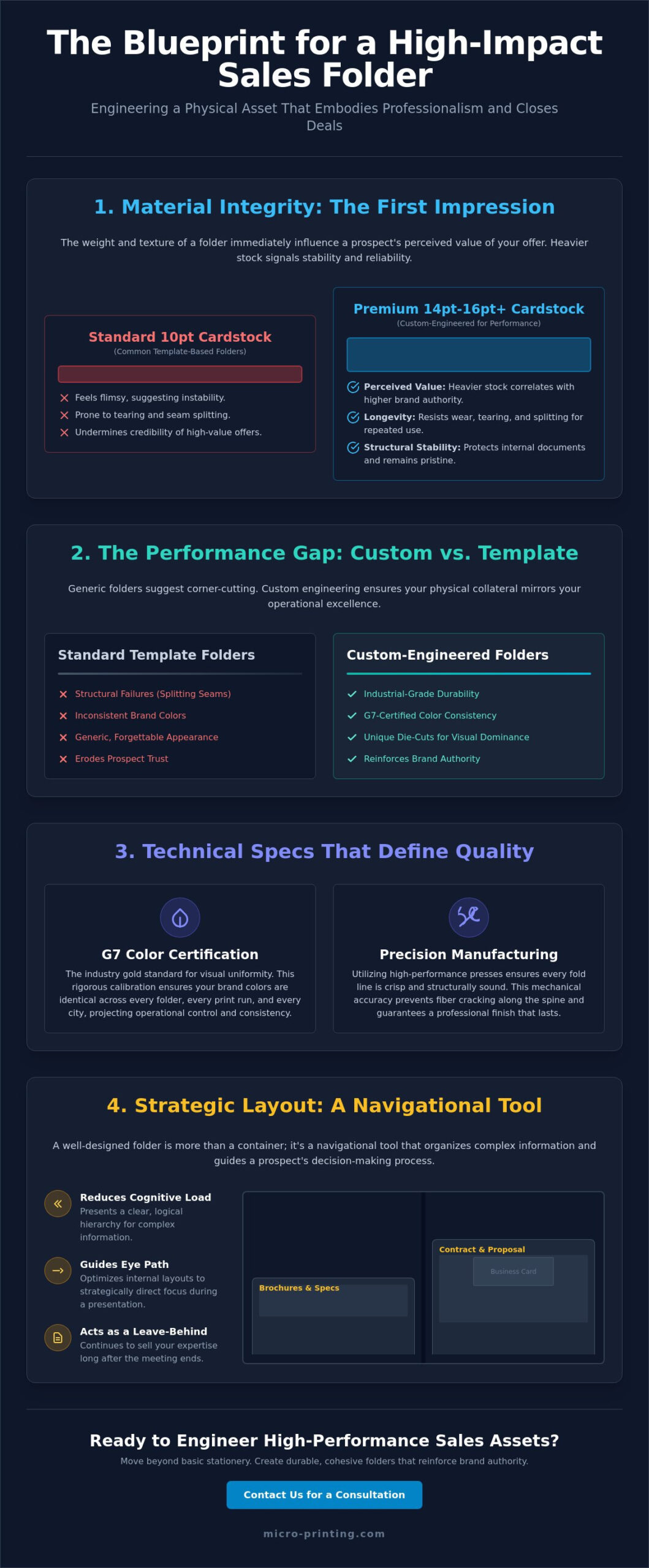
The moment of exchange is a critical psychological touchpoint. It’s the literal transfer of a solution from your organization to theirs. Standard 10pt cardstock often feels insufficient for high-stakes B2B proposals because it lacks the structural integrity required for repeated handling. Transitioning to premium 14pt or 16pt cardstock provides several technical advantages:
- Perceived Value: Heavier stock correlates directly with higher brand authority in the mind of the decision-maker.
- Longevity: Thicker materials resist the tearing and seam splitting common in cheap, template-based alternatives.
- Structural Stability: Rigid folders protect the internal documents, ensuring your brochures and contracts remain pristine.
By utilizing custom dimensions or unique die-cuts, your collateral achieves visual dominance. It ensures your brand remains visible even in a crowded stack of documents. This level of precision mirrors the standards found in durable ring binder construction, where material durability is prioritized to protect sensitive technical data and maintain organizational standards over time.
Beyond Storage: Creating a Cohesive Sales Narrative
A folder is more than a container; it’s a navigational tool. It organizes complex information, such as brochures, technical specs, and contracts, into a logical hierarchy that guides the prospect’s decision-making process. This structure reduces cognitive load and presents your organization as a partner capable of managing complex systems. When the meeting ends, the folder remains as a high-performance leave-behind that continues to sell your expertise. You shouldn’t view these assets in isolation. Aligning folder design with your broader commercial printing services florida strategy is essential for maintaining brand consistency across all physical touchpoints. Inconsistent colors or poor finishing on custom presentation folders for sales teams can quietly erode a prospect’s trust. Professional, industrial-scale manufacturing ensures that every folder reinforces your market position through technical excellence and material stability.
Engineering for Durability: Technical Specs that Define Quality
High-performance sales environments demand hardware that doesn’t fail under pressure. Engineering custom presentation folders for sales teams is a matter of industrial precision rather than simple aesthetic design. A folder that splits at the seams or shows inconsistent color across a multi-city rollout suggests a lack of operational control. To prevent these failures, you must prioritize technical specifications that balance material rigidity with mechanical flexibility. Utilizing high-performance Heidelberg presses ensures that every fold line is crisp and structurally sound, reducing the risk of fiber cracking along the spine. This mechanical accuracy is what separates a professional sales tool from a disposable commodity.
G7 Certification and Color Consistency
G7 Master Qualification is the industry gold standard for visual uniformity. It’s a rigorous calibration process that uses gray-balance data to ensure color density remains identical across different substrates and print runs. If your folders don’t match your catalogs or direct mail assets, your brand identity appears fragmented. G7 certification provides the mathematical framework to maintain this consistency, which is vital for organizations managing large-scale collateral distribution. When your sales reps operate across multiple territories, visual uniformity becomes a non-negotiable requirement for professional credibility.
Coating selection further defines the folder’s environmental resilience. UV high-gloss coatings provide a vibrant, scratch-resistant surface ideal for high-traffic trade shows. Conversely, matte lamination offers a sophisticated, non-reflective finish that excels in executive boardroom settings. For those seeking maximum durability, soft-touch lamination adds a protective layer that resists fingerprints while providing a premium tactile experience. You can explore these finishing options in detail through the technical resources at Micro Printing to ensure your selection aligns with your specific sales environment.
Structural Integrity: Pockets, Slits, and Spines
The internal architecture of the folder determines its functional lifespan. Standard pockets often fail when loaded with heavy technical packets or multi-page contracts. Reinforced pockets, achieved through double-gluing or specific die-cut folds, provide the necessary support for high-volume collateral. The configuration of business card slits also matters. You can choose between horizontal, vertical, or corner-mount styles depending on your card’s design and how you want the prospect to engage with your contact information.
- Gusseted Spines: Essential for folders holding 50 or more pages. These engineered “box” folds prevent the folder from bowing or popping open.
- Reinforced Edges: Extra thickness along the perimeter prevents “dog-earing” during transit in sales bags.
- Die-Cut Windows: Precision-cut openings allow personalized cover sheets to show through, combining the efficiency of a template with the impact of a custom build.
Precision manufacturing ensures these structural elements work in harmony. A well-engineered spine allows the folder to lay flat on a conference table, presenting a organized and stable image to your prospect. By focusing on these technical specs, you ensure your custom presentation folders for sales teams remain a high-performance asset through every stage of the sales cycle.
Custom-Engineered vs. Template-Based: The Performance Gap
Relying on generic templates for high-stakes sales collateral is a strategic risk that often leads to structural failure. While “big box” online providers prioritize mass-market convenience, custom-engineered folders are built for industrial durability. The performance gap becomes evident the moment a folder enters the field. Custom presentation folders for sales teams manufactured with a focus on structural longevity don’t suffer from the common defects of commodity templates, such as delamination or ink chipping. Cheap folders carry hidden costs that extend beyond the initial invoice; they include the damage to brand reputation when a pocket tears during a proposal or when colors fade under office lighting. Custom die-cutting allows your organization to create unique shapes that mirror your brand’s visual identity, ensuring your materials don’t blend into the background of a prospect’s desk.
The ROI of Custom Finishing
Precision finishing techniques like foil stamping and embossing require industrial-grade expertise to execute correctly. These aren’t just decorative additions; they’re investments in brand authority. Soft-touch lamination, for example, provides an executive appeal that standard aqueous coatings can’t match. It creates a velvety texture that resists fingerprints and keeps the folder looking pristine through multiple meetings. Spot UV application allows you to highlight specific elements, like a logo or a technical icon, creating a high-contrast visual impact that draws the eye. When you combine these with embossing or debossing, you add a third dimension to your sales materials, making the brand literally stand out from the page. These finishes demand precise pressure and heat management that only specialized industrial equipment can provide.
Why Precision Matters in High-Volume Runs
Maintaining quality across a 10,000-piece run requires a level of technical control that template-based services simply don’t offer. Small errors in registration can lead to “off-center” cuts that ruin the professional look of your collateral. Utilizing expert offset printing services ensures that ink distribution and alignment remain perfect from the first unit to the last. This mechanical precision is especially critical when dealing with dark-colored folders. Standard folding processes often cause “cracking” on the spine, where the white paper fibers show through the dark ink. Industrial folding machines, calibrated for specific paper weights, apply the exact force needed to create a clean, sharp fold without compromising the material’s integrity. Ensuring every unit is identical isn’t just about aesthetics; it’s about projecting a consistent, reliable image of your organization to every potential client.
Strategic Layout: Designing for the Sales Interaction
The internal architecture of custom presentation folders for sales teams serves as a silent conductor for the sales conversation. A well-engineered layout doesn’t just store documents; it maps the prospect’s eye path to ensure information is consumed in a specific, high-conversion sequence. When a decision-maker opens a folder, their gaze typically follows a left-to-right trajectory. By placing your brand vision and core value propositions on the left panel, you establish a strategic foundation before the prospect reaches the transactional documents on the right. This collateral hierarchy ensures that brochures and step-sheets provide the necessary context before the final contract or pricing sheet is even viewed.
Advanced structural designs now incorporate “secret pockets” or hidden tiers for sensitive materials. This strategy is particularly effective for high-stakes negotiations where confidential pricing or NDAs need to be accessible but not immediately visible. Integrating digital elements into the physical folder further bridges the gap between tactile and virtual sales. Placing QR codes or NFC tags within the interior layout allows executives to instantly upload technical specs to their mobile devices; this ensures your brand remains active in their digital ecosystem long after the physical meeting has concluded.
Anatomy of a High-Converting Interior
In a tri-fold configuration, the center panel serves as the primary real estate for data visualizations or key performance indicators. This central position commands the most attention and should be reserved for your most compelling evidence. White space is a deliberate engineering tool used to drive executive focus toward these critical data points. By avoiding visual clutter, you signal organizational clarity and professional restraint. If you are ready to optimize your sales collateral for maximum impact, you can request a custom structural prototype to test these layout strategies in the field.
Business Card Placement and Accessibility
Business card placement is the most critical functional element of the entire folder. If a card is difficult to remove or, conversely, falls out too easily, it creates a moment of friction that can undermine an otherwise flawless presentation. Designing for the “grab” requires precision die-cutting to ensure the card stays secure during transit but remains accessible for the hand-off. Utilizing die-cut windows on the front cover or internal pockets allows the card to remain visible even when the folder is closed. This provides immediate identification of the point of contact and ensures your sales team’s identity is always front and center. These small mechanical details reflect the precision of your entire operation and reinforce your brand’s commitment to excellence through every physical touchpoint.
Precision Manufacturing in Fort Lauderdale: The Micro Printing Advantage
Selecting a manufacturing partner for your sales collateral is a decision that impacts your entire distribution chain. Leveraging a local Fort Lauderdale facility provides a distinct logistical edge that national online brokers cannot replicate. When you work directly with the manufacturer, you eliminate the communication gaps that often lead to structural errors in custom presentation folders for sales teams. This proximity allows for physical press checks, where your team can verify color accuracy and material thickness before the full production run begins. For high-stakes projects, the ability to touch the physical proof ensures the final product meets your exact industrial standards.
Local Expertise, National Reach
Our Fort Lauderdale hub operates with a commitment to state-of-the-art Heidelberg technology and G7 color precision. This ensures that every folder produced maintains the same visual integrity, whether it’s destined for a local South Florida office or a regional branch across the country. We streamline fulfillment for regional sales offices by managing the entire workflow from our centralized facility. This systematic approach allows you to integrate your folders with targeted direct mail campaigns, creating a complete marketing ecosystem where every physical touchpoint is synchronized. By housing manufacturing and distribution under one roof, we reduce turnaround times and maintain total control over the quality of your brand assets.
Next Steps: From Concept to Production
Transitioning from a conceptual layout to professional-grade production requires technical preparation. Your artwork must be configured for high-caliper cardstock, accounting for bleed lines and the mechanical requirements of industrial folding. Consulting with our structural design team early in the process allows you to explore custom die-cuts and specific pocket capacities tailored to your collateral volume. This direct-to-manufacturer communication ensures that your structural designs are both functional and durable. If you require a high level of detail for security features or intricate branding, you can request samples that showcase our specialized microprint capabilities. Our team is ready to provide the technical guidance necessary to engineer custom presentation folders for sales teams that perform as reliably as the products they represent. Contact our Fort Lauderdale facility to begin the structural prototyping phase of your next project.
Optimizing Your Sales Infrastructure for 2026
Your physical collateral is the permanent anchor of your brand’s authority. Transitioning from generic templates to precision-engineered custom presentation folders for sales teams ensures your organization maintains a professional presence long after the initial proposal. By prioritizing G7 Master Certified Color and high-caliper materials, you eliminate the risks of structural failure and visual inconsistency that plague commodity printing. These technical standards, combined with strategic internal layouts, transform a simple container into a high-performance sales tool capable of driving complex conversions.
Micro Printing leverages over 35 years of Fort Lauderdale manufacturing expertise to deliver industrial-grade solutions for regional and national sales offices. Our facility utilizes Heidelberg precision press technology to ensure every fold is sharp and every color is mathematically accurate. This commitment to technical excellence provides the stability and reliability your team needs to compete in high-stakes B2B environments. It’s time to move beyond standard stationery and invest in assets that reflect your company’s operational rigor. Request a Custom Presentation Folder Quote from Micro Printing today to begin engineering your team’s next competitive advantage.
Frequently Asked Questions
What is the standard size for a sales presentation folder?
The industry standard size for a sales presentation folder is 9″ x 12″. This dimension is specifically engineered to house standard 8.5″ x 11″ documents while providing a 0.25-inch margin to protect the edges of your internal collateral. This sizing ensures that brochures and contracts remain pristine and the folder closes securely without document overhang.
Why is 14pt cardstock recommended over 10pt for sales teams?
14pt cardstock provides the necessary structural rigidity to withstand repeated handling in high-stakes environments. While 10pt is suitable for lightweight mailers, 14pt is the preferred standard for custom presentation folders for sales teams because it resists seam splitting and corner damage. This heavier weight communicates brand stability and ensures the folder remains a durable asset throughout the sales cycle.
What is G7 color certification and why does it matter for my folders?
G7 certification is a rigorous technical calibration that ensures visual color consistency across different printing presses and material substrates. It matters because it guarantees that the brand colors on your folders will mathematically match your catalogs and brochures. Maintaining this level of color density is critical for brand authority; it prevents the unprofessional appearance of mismatched collateral during a presentation.
Can I include custom die-cut pockets in my presentation folder design?
Yes, our facility utilizes precision die-cutting technology to create unique pocket configurations tailored to your specific sales materials. Beyond standard horizontal pockets, we can engineer vertical, curved, or tiered pockets that strategically organize your brochures and business cards. These custom structural designs allow you to guide the prospect’s eye path and manage the hierarchy of information more effectively.
How long does the custom printing and finishing process take in Fort Lauderdale?
Standard production for custom folders typically requires 5 to 10 business days depending on the complexity of the finishing techniques, such as foil stamping or embossing. Local South Florida organizations often benefit from shorter logistical timelines and the ability to perform physical press checks. This proximity allows for faster structural prototyping and immediate verification of the manufacturing quality before the full run begins.
What is the difference between soft-touch lamination and standard matte coating?
Soft-touch lamination provides a velvety, tactile texture and superior resistance to fingerprints and scuffing compared to standard matte coating. While a matte finish is non-reflective and professional, soft-touch lamination adds a premium physical weight and a high-end feel to the material. It’s an ideal choice for executive-level proposals where the tactile experience of the folder influences the prospect’s perception of brand value.
How many pages can a standard 9″ x 12″ folder comfortably hold?
A standard 9″ x 12″ folder with flat pockets is designed to hold approximately 15 to 20 pages of 20lb bond paper. For sales packets that exceed 30 pages, we recommend engineering a gusseted spine. This “box” fold provides the necessary expansion to accommodate heavy packets without causing the folder to bow or pop open during a meeting.
Do you offer fulfillment services for national sales teams?
Yes, our Fort Lauderdale hub manages full-scale distribution and fulfillment for regional and national organizations. We coordinate multi-city shipments to ensure that every office receives identical, G7-certified custom presentation folders for sales teams on a synchronized schedule. This centralized manufacturing model eliminates the quality variances that occur when using multiple local printers across different territories.