
A single color shift on a high-volume catalog run or a missed delivery window for a 2026 product launch can compromise your brand’s integrity before a single piece reaches its destination. You’ve likely experienced the frustration of managing fragmented workflows where rush fees and shipping errors are treated as inevitable costs of doing business. It’s a common struggle, but finding a way to reduce stress of managing print projects is essential for protecting your bottom line. Professionals in high-stakes environments understand that print stress is simply a symptom of a decentralized process.
This guide will show you how to master the art of seamless print management by shifting to an industrial-grade model. We’ll explore expert strategies to eliminate technical errors, protect your budget from the July 2026 USPS postage rate increases, and ensure high-fidelity color matching across every material. You’ll learn how to master end-to-end production through a structured and predictable methodology that prioritizes technical precision over guesswork.
Key Takeaways
- Identify the technical friction points that cause production delays and learn why centralized management is the industrial solution for complex runs.
- Discover how G7 Master Color Certification and Heidelberg technology eliminate mechanical variance to ensure absolute brand consistency across different materials.
- Learn how to reduce stress of managing print projects by integrating manufacturing with logistical support to eliminate the “mailing gap.”
- Master the management of intricate finishing processes, including die-cutting and UV coating, within a single, streamlined production workflow.
- Understand the operational advantages of leveraging a high-capacity facility with a proven history of national distribution and technical precision.
The Hidden Costs of Fragmented Print Management
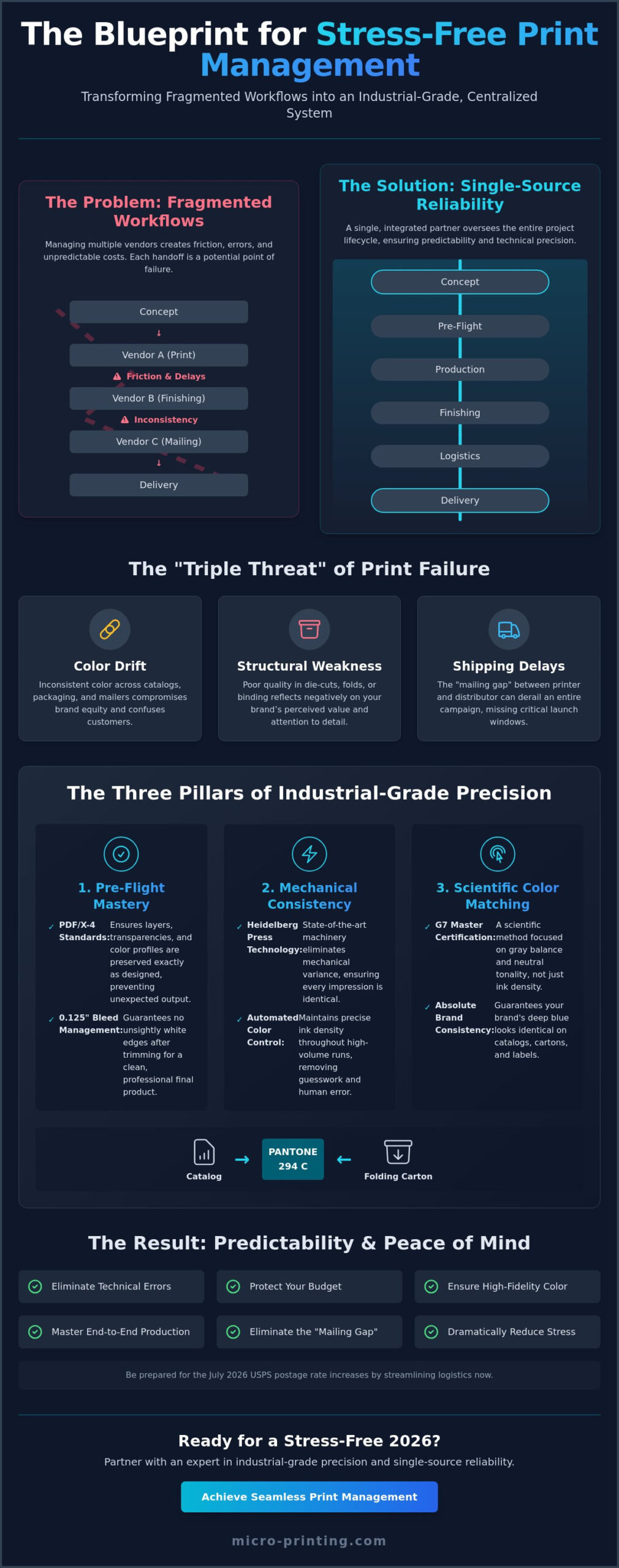
Industrial print management is not merely about ink on paper; it is a complex orchestration of chemistry, mechanics, and logistics. Stress in this field typically stems from the friction between creative intent and manufacturing reality. When a marketing team’s vision meets the high-speed demands of a pressroom, technical gaps can lead to catastrophic failures. To reduce stress of managing print projects, professionals must first recognize that fragmented workflows are the root cause of most production anxieties. Each handoff between disparate vendors is a potential point of failure.
The “Triple Threat” of print failure consists of color drift, structural weakness, and shipping delays. Color drift compromises brand equity when a catalog doesn’t match the folding cartons on a retail shelf. Structural weakness in presentation folders or booklets suggests a lack of quality control that reflects poorly on the brand’s perceived value. Shipping delays, often caused by a “mailing gap” between the printer and the distributor, can derail an entire quarterly campaign. Managing multiple vendors for these various components, such as one for flyers and another for targeted direct mail, exponentially increases the risk of these failures occurring simultaneously. True efficiency comes from Single-Source Reliability, where one partner oversees the entire lifecycle of the project.
Why Traditional Workflows Fail in 2026
Traditional workflows often collapse because of siloed production. When designers and manufacturers operate in isolation, critical technical data is lost. This fragmentation is particularly dangerous during the pre-flight phase, where digital files are prepared for the physical press. If the manufacturer isn’t integrated into the early stages of design, brand inconsistency becomes inevitable across different substrates and materials. Errors cost more than money; they cost time. A 24-hour delay in a retail launch can result in thousands of dollars in lost revenue and missed consumer engagement opportunities.
The Emotional and Professional Toll on Marketing Teams
The professional toll of print mismanagement extends beyond the balance sheet. Marketing directors often experience intense anxiety during press checks, fearing that unexpected production errors will require costly reprints. This procurement fatigue drains creative energy and replaces it with damage control. When a project fails to meet a hard deadline for a trade show or product launch, your professional credibility with internal stakeholders is at stake. Relying on a stable, high-capacity partner is the most effective way to reduce stress of managing print projects. By consolidating the process from design to delivery, you replace uncertainty with industrial-grade predictability and technical precision.
Mastering the Pre-Flight Phase: Technical Prep for Zero Errors
Precision in industrial printing starts long before the ink meets the substrate. It begins with a rigorous technical evaluation of your digital assets. In 2026, the complexity of brand assets requires more than a simple file check; it demands adherence to PDF/X-4 standards. This protocol ensures that transparencies, layers, and color profiles are preserved exactly as intended. Proper bleed management, typically a minimum of 0.125 inches, is equally vital to prevent unsightly white edges during the trimming process. By establishing these technical safeguards, marketing teams can significantly reduce stress of managing print projects and avoid the high costs of reprints.
Mechanical variance is the enemy of consistency. Utilizing state-of-the-art Heidelberg presses ensures that every impression is a mirror image of the last. These machines use automated color control systems to maintain ink density throughout a high-volume run. Establishing these technical safeguards is one of the most effective ways to reduce stress in a high-pressure corporate environment. When you rely on industrial-grade equipment, you eliminate the “guesswork” that often plagues smaller, less equipped facilities.
G7 Certification: The Science of Color Consistency
Visual harmony across different materials is achieved through the science of G7 Master Color Certification. This methodology focuses on gray balance and neutral tonality rather than just ink density. It ensures that the deep blues on your catalogs match the identical shades on your folding cartons, regardless of the substrate used. This level of calibration is a hallmark of Expert Offset Printing Services in Fort Lauderdale. Without G7 standards, color drift becomes inevitable, leading to fragmented brand representation that confuses consumers and frustrates stakeholders.
Advanced Structural Engineering for Custom Packaging
Custom-engineered boxes and folding cartons require more than a basic 2D dieline. They demand high-fidelity structural design that accounts for the weight of the product and the rigors of the shipping cycle. Selecting the right material, such as heavy-duty corrugated board for shipping or premium SBS paperboard for retail folding cartons, is a critical decision. Creating physical prototypes before a high-volume production run provides a “fail-safe” that 2D digital proofs cannot offer. This proactive approach allows you to test the “unboxing experience” and structural integrity in the real world. If you want to secure your next launch, partnering with an industrial-grade printing partner for structural engineering is the most reliable path to success.
Streamlining Custom Packaging and Label Production
Packaging production is a high-stakes manufacturing process where structural failure or aesthetic inconsistency can halt a product launch. Managing the intersection of die-cutting, foil stamping, and UV coating requires a level of technical oversight that goes beyond standard commercial printing. When you integrate these finishing techniques into a single workflow, you effectively reduce stress of managing print projects. Instead of coordinating with a separate finisher, a centralized partner ensures that the registration of a foil stamp aligns perfectly with the printed graphics on a folding carton. This industrial precision is maintained through advanced structural design software. This technology predicts how a package will perform under real-world pressure, such as stacking in a warehouse or handling at retail, before the first sheet is ever fed into the press.
High-Fidelity Labels and Pouches
Labels and pouches must do more than look professional; they must function in specific environments. Whether your product requires medical-grade adhesives or moisture-resistant finishes for food retail, the technical specifications are non-negotiable. G7 color standards are non-negotiable for labels because they ensure that the branding on your primary packaging remains visually identical to your brochures and marketing collateral across every substrate. High-fidelity finishing, such as spot UV or tactile coatings, enhances shelf presence while maintaining the industrial durability required for national distribution. Specialized finishes are not just aesthetic choices; they are functional layers that protect the brand’s image throughout the product’s lifecycle.
Folding Cartons and Corrugated Solutions
Folding cartons represent the pinnacle of brand presentation and structural protection. Smart engineering allows you to balance aesthetic appeal with the necessary structural integrity for high-volume shipping. By utilizing localized production in Fort Lauderdale, businesses can significantly reduce lead times and shipping-related anxieties. This proximity allows for faster turnarounds on physical prototypes and easier oversight of complex production runs. Local manufacturing also mitigates the risks associated with long-distance logistics, such as damage during transit or customs delays. When production and distribution are handled within a stable, high-capacity facility, the logistical friction that usually complicates large-scale rollouts is eliminated. This systematic approach is the only way to reduce stress of managing print projects while protecting your brand’s bottom line. High-volume production fees are also optimized through this smart engineering, as material waste is minimized during the die-cutting process.
The Logistics of Peace: From Production to Direct Mail
The mailing gap is a critical point of failure in commercial printing. It occurs when a project is completed at a manufacturing facility but must be transported to a separate mailing house for addressing and distribution. This handoff introduces unnecessary delays and potential for data errors. To reduce stress of managing print projects, businesses should utilize a single-source partner that integrates production and delivery under one roof. In-house mailing services eliminate transport time and allow for immediate verification of postal requirements. When your printer and your mailer are the same entity, you eliminate the logistical friction that typically compromises delivery schedules.
Budget protection in 2026 requires precise technical planning. The USPS has filed for an average rate increase of 4.8 percent across First-Class and Marketing Mail, effective July 12, 2026. This change will see the price of a Forever stamp rise from $0.78 to $0.82. It’s essential to leverage metered mail, which currently sits at $0.74, or bulk Marketing Mail rates that range from $0.372 to $0.433 depending on presort levels. Targeted direct mail reduces marketing waste by ensuring your catalogs and postcards reach only the most relevant recipients. This precision lowers the procurement stress associated with overproduction and excessive postage costs.
End-to-End Direct Mail Execution
Managing list procurement and data hygiene within the same facility as printing ensures that your targeted campaigns are executed with technical precision. This integration is a primary reason to work with established Direct Mail Marketing Companies in Fort Lauderdale. In-house sorting capabilities allow mail pieces to bypass several steps in the standard postal network by moving directly to USPS hubs. This acceleration is vital for time-sensitive product launches. Every Door Direct Mail (EDDM) remains a powerful tool for local marketing efficiency, allowing for saturation coverage without the need for specific mailing lists.
Large Format Signage and Trade Show Logistics
A cohesive brand presence requires visual harmony between your small-form collateral and your large-scale displays. Coordinating banners, posters, and presentation folders ensures that your brand’s color profile remains consistent across all touchpoints. For companies operating in South Florida, durability is a technical requirement. Oversized marketing materials must be engineered to withstand high humidity and UV exposure. Professional Large Format Signage Production in Fort Lauderdale utilizes industrial-grade inks and substrates specifically chosen for these conditions. When your posters and displays are produced alongside your booklets and catalogs, you eliminate the risk of visual fragmentation. To secure your next campaign, you can optimize your distribution strategy through our integrated production facility.
Partnering with Micro Printing for a Stress-Free 2026
Since 1989, Micro Printing has provided the technical infrastructure necessary to manage high-volume manufacturing without the typical friction of commercial print. Stability is the foundation of our operation. Our Fort Lauderdale facility serves as a centralized hub for both local South Florida requirements and national distribution networks. By consolidating prepress, production, and mailing into a single industrial workflow, we help partners reduce stress of managing print projects through systemic reliability rather than reactive problem-solving. We don’t just print materials; we engineer production cycles that protect your brand’s professional standing.
The Micro Printing Guarantee is rooted in measurable quality standards. We utilize G7 Master Color Certification to ensure visual harmony and employ state-of-the-art Heidelberg technology to eliminate mechanical variance. While we operate at an industrial scale, our family-owned structure ensures a level of accountability and professional care that larger, impersonal conglomerates often lack. Every project, from complex folding cartons to high-volume catalogs, benefits from this blend of technological confidence and professional oversight. This approach transforms the procurement process from a source of anxiety into a predictable manufacturing routine.
Our Industrial Capacity, Your Competitive Edge
B2B partners require more than just a vendor; they need a high-capacity manufacturing ally. Our G7 Master Color Certification allows us to maintain absolute brand integrity across diverse product lines, which is vital for maintaining consumer trust. This is particularly critical for high-volume custom packaging manufacturing, where structural integrity must meet aesthetic precision. By leveraging our Commercial Printing Services in Fort Lauderdale, you gain access to an infrastructure designed for zero-error execution. Our facility is equipped to handle the complexity of 2026’s market demands, ensuring your brochures and presentation folders are produced with industrial-grade accuracy.
Contact Our Fort Lauderdale Experts
Starting your next campaign with a professional structural consultation is the most effective way to reduce stress of managing print projects. Our experts handle end-to-end execution, from the initial design phase to the final postal drop. This comprehensive management eliminates the “mailing gap” and ensures your targeted direct mail arrives on schedule. To request a structural design or color matching quote, follow these steps:
- Submit your project specifications and brand style guides for a rigorous technical review.
- Schedule a consultation to discuss substrate selection and structural requirements for your folding cartons or booklets.
- Review a physical prototype to verify the structural integrity and unboxing experience before high-volume production.
- Authorize the production run for a G7-certified execution on our Heidelberg presses.
Technical precision isn’t an accident; it’s the result of a proven methodology that has been refined over decades. Contact Micro Printing today for a stress-free consultation and secure your brand’s production schedule for the remainder of 2026.
Securing Your 2026 Production Schedule
Mastering the complexities of industrial manufacturing requires a transition from fragmented vendor management to a centralized, technical partnership. By integrating the pre-flight phase with high-fidelity production and direct mail logistics, you effectively eliminate the friction points that cause delays. Utilizing G7 Master Color Certification and advanced Heidelberg press technology ensures your brand remains consistent across all substrates, from catalogs to folding cartons. This systematic approach is the only proven method to reduce stress of managing print projects while protecting your professional credibility and brand budget.
Micro Printing has been serving the South Florida business community since 1989, providing the infrastructure and expertise needed for zero-error execution. Our facility is engineered to handle the most demanding national and local distribution requirements with industrial-grade precision. Don’t let logistical gaps or technical variance compromise your next launch. Get a Stress-Free Quote from Micro Printing today and experience the stability of a partner dedicated to your brand’s long-term success. We’re ready to transform your production workflow into a predictable, high-performance asset.
Frequently Asked Questions
What is the most common cause of stress in print projects?
Fragmented communication between creative teams and manufacturing facilities is the primary source of production anxiety. When design intent is disconnected from technical reality, errors in color and structure become inevitable. Centralizing your production with a single partner helps eliminate these handoff errors. This integrated approach is the most effective strategy to reduce stress of managing print projects by ensuring technical oversight from the initial file check to the final delivery.
How does G7 certification help reduce my project anxiety?
G7 Master Color Certification reduces anxiety by providing a scientific methodology for visual consistency across disparate substrates. It relies on neutral gray balance rather than simple ink density to ensure your brochures match your folding cartons. This technical standard eliminates the subjective guesswork often found in non-certified shops. You can trust that your brand identity remains intact regardless of the material or the volume of the production run.
Can I manage packaging design and printing in one place?
You can manage both the structural engineering and the high-volume manufacturing of your packaging within our integrated facility. We utilize advanced design software to create physical prototypes for folding cartons and corrugated solutions before starting the press. This end-to-end management ensures that the die-cutting and finishing align perfectly with the printed graphics. Consolidating these steps within one industrial workflow removes the risks associated with third-party finishers.
What is the benefit of using a local Fort Lauderdale printer for national projects?
Utilizing a local Fort Lauderdale facility for national distribution provides logistical stability and faster turnaround times for physical proofing. Proximity allows for immediate oversight of complex structural prototypes and press checks. Once production is complete, our facility manages the distribution to national hubs or local South Florida targets. This proximity minimizes the lead times and shipping risks that often complicate large-scale product launches or trade show preparations.
How do I avoid rush charges on high-volume catalog orders?
Avoiding rush fees requires early technical preparation and adherence to a structured production timeline. By completing the pre-flight phase well in advance, you allow for predictable scheduling on high-speed Heidelberg presses. It’s also critical to account for external factors, such as the July 2026 USPS rate increases, which can cause seasonal surges in mail volume. Proactive planning ensures your high-volume catalogs are produced and distributed without the need for expensive expedited manufacturing.
Does Micro Printing handle the mailing process for direct mail campaigns?
Micro Printing manages the entire mailing lifecycle, including list procurement, addressing, and USPS sorting. By integrating mailing with production, we eliminate the mailing gap that typically delays direct mail campaigns. Our in-house capabilities allow mail pieces to move directly to postal hubs, which speeds up delivery and reduces postage costs. This seamless transition from the press to the mailbox is a key component in a strategy to reduce stress of managing print projects.
What is the difference between a folding carton and a corrugated box for my product?
Folding cartons are typically used for primary retail packaging and are made from premium paperboard. Corrugated boxes are engineered for secondary packaging and shipping durability, featuring a fluted layer for structural strength. The choice depends on whether your priority is brand presentation on a retail shelf or protection during the rigors of national shipping. Our structural experts help you select the appropriate material based on your product’s weight and intended environment.
How can I ensure my brand colors are consistent across different materials?
Consistency is maintained through G7 Master Color Certification and the use of automated color control on our Heidelberg presses. These technologies monitor ink density and gray balance in real-time throughout the entire production run. By using the same technical standards for your booklets, postcards, and labels, we ensure that brand colors remain identical across different substrates. This industrial-grade precision prevents the color drift that often occurs when using multiple, uncertified vendors.