
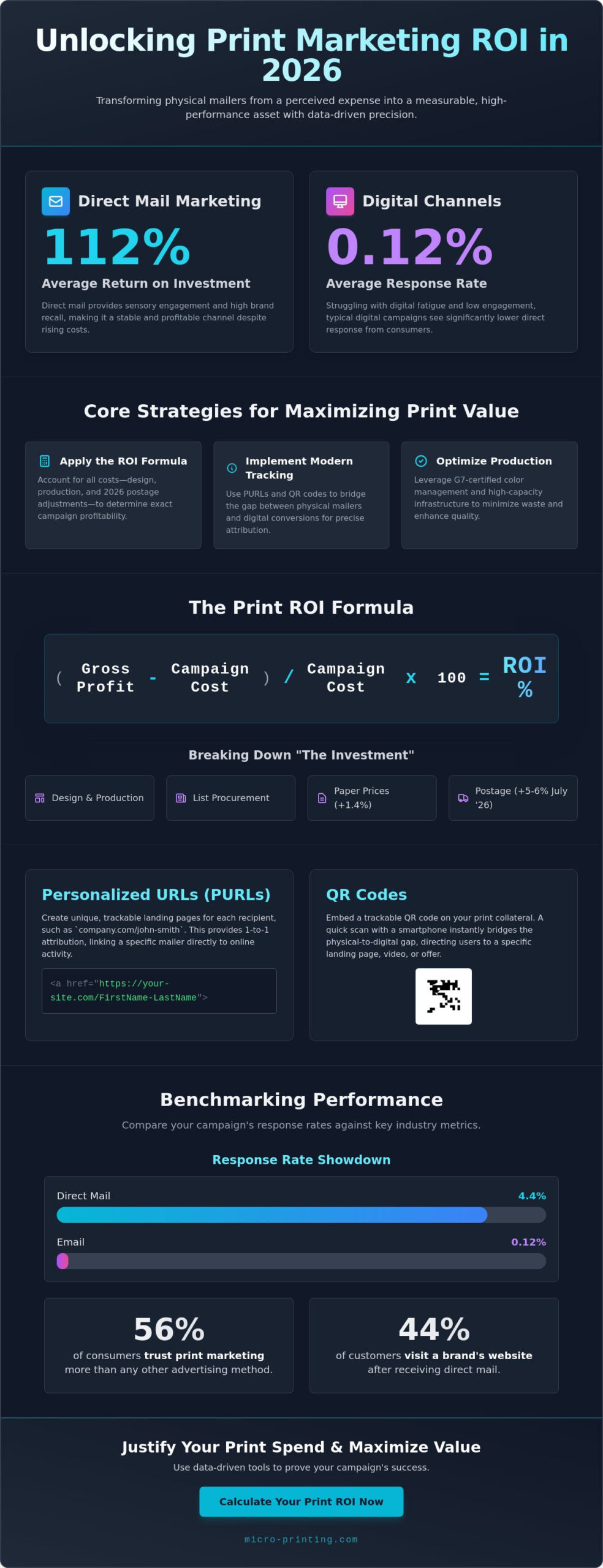
While digital channels struggle with a 0.12% response rate, direct mail marketing maintains an average ROI of 112% in 2026. You’ve likely felt the pressure to shift budgets toward digital because tracking a pixel feels more certain than tracking a postcard. It’s frustrating to watch postage rates rise while you struggle to prove exactly which flyer or catalog drove a specific sale. That’s why a robust print marketing ROI calculator is no longer a luxury; it’s a technical requirement for industrial-scale marketing.
You’ll master the science of physical attribution and learn how to account for every cent spent on your collateral. We’ll break down the exact ROI formula, modern tracking methods like QR codes and unique URLs, and strategies to protect your margins against the July 2026 postage increases. This guide provides the precision tools needed to justify your print spend and maximize campaign value through data-driven decisions. By applying these methods, you’ll transform physical mailers from a perceived expense into a measurable, high-performance asset.
Key Takeaways
- Determine the exact profitability of your campaigns by applying a formula that accounts for design, production, and the July 2026 postage adjustments.
- Leverage a dedicated print marketing ROI calculator to provide leadership with objective, data-driven evidence of campaign success.
- Implement advanced attribution techniques, such as PURLs and QR codes, to bridge the gap between physical mailers and digital conversions.
- Verify your campaign’s performance by comparing response rates against the latest industry benchmarks for catalogs and targeted direct mail.
- Enhance your bottom line through production efficiencies, utilizing G7-certified color management and high-capacity infrastructure to minimize waste.
The Fundamentals of Print Marketing ROI in 2026
The calculation of value for physical collateral has evolved into a disciplined engineering task. In the context of 2026 marketing, measuring the Return on Marketing Investment (ROMI) for print involves more than just counting coupon redemptions. It’s a systematic approach to quantifying how tangible assets like catalogs or targeted direct mail influence the customer journey. While digital fatigue continues to rise, physical media provides a sensory engagement that digital pixels can’t replicate. This tangibility is the foundation of long term brand recall.
Industry data confirms the efficacy of this approach. Direct mail marketing currently yields an average ROI of 112%, a figure that remains stable despite rising postage costs. The persistent myth that print is an untrackable expense is being dismantled by sophisticated attribution models and the use of a professional print marketing ROI calculator. Precision in measurement allows businesses to treat every postcard or brochure as a high performance asset rather than a sunk cost.
Why Traditional Metrics Still Matter
The psychological impact of high quality catalogs and booklets remains a primary driver of conversion. Research indicates that 56% of consumers trust print marketing more than any other advertising method. This trust translates into measurable revenue when integrated into a multi channel strategy. A physical touchpoint often serves as the catalyst for a digital search; 44% of customers visit a brand’s website after receiving direct mail. Traditional metrics like response rates, which average 4.4% for direct mail compared to 0.12% for email, provide the baseline data needed to evaluate these complex interactions.
The Shift Toward Data-Driven Print
Modern print operations have moved away from broad reach flyers toward highly targeted direct mail. This shift is powered by variable data printing and industrial precision. Achieving a high ROI depends on technical execution. For instance, G7 color management standards ensure brand consistency across large volumes, which directly impacts the perceived value of the offering. When a recipient holds a perfectly calibrated brochure, the professional quality reinforces the credibility of the message. Using a print marketing ROI calculator helps managers account for these technical variables, ensuring that production quality aligns with financial objectives. This data driven focus transforms print from a simple service into a strategic component of the industrial marketing mix.
The Print ROI Formula: Calculating Your Physical Campaign Value
Quantifying the success of a physical campaign requires a rigorous accounting of both the capital deployed and the revenue generated. The standard mathematical expression for this is (Gross Profit – Campaign Cost) / Campaign Cost x 100. This percentage provides an objective baseline for comparing print performance against other marketing channels. Using a professional print marketing ROI calculator ensures that no variable is omitted from the denominator, which is often where calculations lose accuracy.
Identifying “The Investment” involves a comprehensive audit of production and logistics. For 2026 campaigns, this must include design fees, list procurement, and production costs for items such as catalogs, brochures, or folding cartons. It’s critical to account for the 1.4% forecasted increase in paper prices and the USPS postage rate adjustments effective July 12, 2026. These operational expenses represent the total cost of entry for reaching a customer’s physical mailbox.
The “Return” component is often more complex than a simple sales tally. While direct sales are the primary goal, high-quality print materials like booklets and presentation folders possess a “Tail Effect.” Unlike a digital ad that disappears after a click, a well-produced catalog may remain in a household for weeks, driving multiple touchpoints over time. Capturing this extended value is essential for a complete financial picture.
Breaking Down Campaign Costs
Industrial production costs are the most significant variable in your investment. This includes the technical execution of flyers and postcards, where volume and efficiency dictate the unit price. Postage management is equally vital; with Marketing Mail commercial letters increasing by approximately 5-6% in mid-2026, logistics planning is a prerequisite for profitability. List procurement also adds to the total, as targeted direct mail relies on high-quality, verified data to minimize waste. You can optimize these production variables by leveraging advanced micro printing techniques that prioritize high efficiency and precision.
Calculating Lead Value and Conversion
Assigning a dollar value to a new lead allows you to track the cost per acquisition (CPA) for every mailer sent. If a targeted direct mail campaign generates 100 leads and your historical data shows a 10% closing rate with a $1,000 average order value, each lead is worth $100. Print ROI is the ratio of net profit to total production and distribution costs. By maintaining this level of technical detail, you transform your print marketing ROI calculator from a simple spreadsheet into a powerful strategic asset.
Tracking the Untrackable: Modern Attribution for Direct Mail and Collateral
Precision in attribution is the only way to validate marketing spend in a high-cost environment. The data gathered from digital checkpoints provides the raw input for any professional print marketing ROI calculator. Without these metrics, physical media remains a black box. By integrating tracking technology directly into the production of postcards, brochures, and catalogs, businesses can observe the exact moment a physical asset triggers a digital action. This systematic approach transforms traditional collateral into a traceable component of the modern sales funnel.
Digital Bridges for Physical Media
QR codes have become an industrial standard for bridging the gap between a mailbox and a web browser. Research indicates that 44% of customers visit a brand’s website after receiving direct mail; capturing this traffic is essential for accurate ROI modeling. Best practices involve placing high-contrast QR codes on flyers or postcards that lead to dedicated landing pages. These pages isolate print traffic from organic or paid search results, ensuring that every conversion is correctly attributed to the physical mailer. Leading direct mail marketing companies utilize these bridges to provide clients with real-time engagement data. Additionally, vanity phone numbers and unique coupon codes serve as secondary attribution layers, capturing phone-based leads and offline sales that a digital pixel might miss.
The Power of Variable Data
Variable Data Printing (VDP) represents the technical peak of personalized marketing. It allows for the customization of text, images, and unique identifiers for every individual recipient within a single production run. Studies suggest that personalized messaging can increase response rates significantly compared to static mailers. By assigning a unique PURL (Personalized URL) to each recipient, marketers can track individual behavior, from the initial scan to the final checkout. This level of granularity is particularly effective when leveraging high-volume offset printing services for complex, multi-page booklets or catalogs. When every piece of collateral carries its own tracking ID, the print marketing ROI calculator can provide a detailed breakdown of which segments, demographics, or geographic areas are delivering the highest yields. This precision eliminates the guesswork from large-scale distributions and allows for the continuous optimization of campaign performance.
Benchmarking Your Results: What a Good Print ROI Looks Like
Evaluating campaign performance requires a baseline of industrial standards. In 2026, a 3:1 or 4:1 return is widely recognized as a benchmark for successful print initiatives. This means for every dollar deployed, the campaign generates three to four dollars in gross profit. While digital channels often prioritize high-volume, low-intent clicks, physical media focuses on high-value conversions. Integrating these standards into your print marketing ROI calculator allows for a realistic assessment of your market position. It’s not just about the total return; it’s about the stability and predictability of the channel.
The break-even point is the precise mathematical moment where gross profit equals the total investment identified in previous sections. For a direct mail campaign, this calculation must be performed before the first piece is mailed. If your production and postage costs for 1,000 postcards total a specific amount, and your average order value is $500 with a 30% margin, you can determine exactly how many sales are required to clear your expenses. This level of technical foresight is what separates professional operations from speculative marketing.
Response Rates vs. Conversion Rates
Direct mail achieves an average response rate of 4.4%, while email marketing often stagnates at 0.12%. This significant gap exists because physical mail requires tactile interaction. A recipient must physically handle a catalog or flyer, which creates a higher level of cognitive engagement. However, the quality of your mailing list is the primary variable in this equation. Even the most precise print marketing ROI calculator will show poor results if the data is unverified. Trust is further established through technical excellence; utilizing high-fidelity color and microprint services ensures that security features and fine details are rendered with industrial accuracy, directly impacting lead quality.
Long-Term ROI: The Value of Brand Persistence
Physical collateral possesses a “shelf life” that digital ads simply don’t have. Brochures and presentation folders often remain in an office or household for months, serving as a persistent brand touchpoint. This durability leads to delayed conversions that may occur weeks after the initial distribution. Attributing these sales back to the original print run is vital for an accurate long-term ROI analysis. High-quality finishing options like UV coating can extend a piece’s ROI by increasing its durability. To achieve these benchmarks, your production must be handled by a facility capable of industrial-grade precision. You can explore our full range of high-capacity solutions at micro-printing.com to ensure your collateral meets these high-performance standards.
Maximizing Every Cent: How Micro Printing Optimizes Your Campaign Performance
Optimizing the production phase is the final step in ensuring your campaign data aligns with your financial projections. While the print marketing ROI calculator provides the mathematical framework, industrial efficiency provides the actual margins. Utilizing high-capacity Heidelberg presses allows for a significant reduction in unit costs through sheer volume and mechanical speed. This technical advantage is compounded by G7-certified color management, which eliminates the waste associated with color drift and costly re-runs. By standardizing these processes, we ensure that every catalog, brochure, and folding carton meets industrial quality requirements without inflated overhead.
A streamlined workflow from design to USPS delivery is essential for protecting your return on investment. Managing the entire lifecycle of postcards, flyers, and booklets under one roof removes the friction of multi-vendor logistics. This end-to-end approach allows for tighter control over production timelines and distribution accuracy. When your manufacturing partner handles everything from initial file preparation to final mailing, you gain the transparency needed to feed accurate data into your print marketing ROI calculator. This level of oversight is a prerequisite for any brand aiming to achieve a 4:1 ROI in a competitive market.
Precision Manufacturing for Better Margins
Structural engineering plays a critical role in margin protection. For folding cartons and complex booklets, precise layout design can minimize paper waste and reduce the overall weight of the shipment. This is especially relevant given the 1.4% forecasted increase in paper prices for 2026. Leveraging commercial printing services florida provides access to advanced die-cutting and foil stamping. These premium finishing options increase the perceived value of presentation folders and calendars, allowing brands to command higher price points or achieve better conversion rates without a proportional increase in production spend.
Your South Florida Printing Partner
Local oversight remains a strategic asset for Fort Lauderdale enterprises. Managing a campaign from design through to USPS delivery requires tight coordination to avoid the impact of the postage increases effective July 12, 2026. A local partner provides the logistics expertise needed for efficient sorting and drop-shipping, ensuring that targeted direct mail and EDDM campaigns reach their destination at the lowest possible cost. This proximity allows for real-time adjustments and physical proofing, ensuring the final output matches your technical specifications exactly. It’s a level of stability that remote providers can’t replicate. Contact our experts to calculate the potential value of your next campaign and ensure your production strategy is built for maximum profitability.
Precision Printing as a Strategic Financial Asset
Mastering your campaign’s financial performance requires transitioning from estimated guesses to industrial precision. By integrating modern attribution tools with a robust print marketing ROI calculator, you transform physical media into a traceable, high-performance channel. The data remains clear; the tactile engagement of high-quality collateral consistently outperforms digital display when executed with technical excellence. You’ve learned how to bridge the gap between a physical mailbox and a digital checkout using QR codes and variable data printing to ensure every cent is accounted for.
Maximizing your return depends on the quality of your production partner. We combine state-of-the-art Heidelberg presses with G7-certified color standards to ensure every piece meets the highest industrial benchmarks. As a family-owned and operated enterprise since 1989, we provide the stability and technical expertise required to navigate rising postage costs and complex logistics. This historical perspective combined with modern infrastructure ensures your brand’s longevity.
Request a Custom Quote and ROI Analysis from Micro Printing to optimize your 2026 marketing strategy. Your campaigns deserve the precision and reliability of a partner committed to your measurable success. Confidence in your marketing spend starts with verifiable data and superior manufacturing.
Frequently Asked Questions
How do I calculate the ROI of a direct mail campaign?
ROI is calculated by subtracting the total campaign investment from the gross profit generated and dividing that result by the total investment. This figure is then expressed as a percentage to represent your return. Inputting precise data for production, logistics, and postage into a print marketing ROI calculator ensures you’re measuring the true profitability of your physical outreach rather than relying on estimates.
What is a typical response rate for commercial print marketing?
Direct mail marketing achieves an average response rate of 4.4%, which significantly outperforms the 0.12% average seen in email campaigns. This higher engagement is driven by the physical nature of the medium and the tactile interaction it requires. Consumers are more likely to trust and act upon tangible materials like catalogs or postcards than ephemeral digital advertisements.
How can I track who visits my website from a printed brochure?
You can track website traffic from physical collateral by using digital bridges like QR codes and Personalized URLs (PURLs). When a recipient scans a code on a brochure, they’re directed to a dedicated landing page that isolates print traffic from other sources. This method allows for precise attribution of online conversions to specific physical mailers in your tracking software.
Does the quality of paper affect my print marketing ROI?
Paper quality and tactile finishes directly impact ROI by establishing brand credibility and increasing the perceived value of your offer. Research confirms that 56% of consumers trust print marketing more than other advertising channels. Using high-fidelity paper stocks for booklets or presentation folders reinforces this trust, leading to higher conversion rates that justify the initial production cost.
What are the most cost-effective print materials for B2B marketing?
Postcards and targeted direct mail are the most cost-effective options for high-volume lead generation due to their lower production and postage requirements. For deeper technical engagement, high-quality catalogs and brochures provide the necessary space to present complex information. These materials often have a long shelf life, continuing to drive value weeks after the initial distribution.
How does postage impact the total cost of a direct mail campaign?
Postage is a primary variable in your investment, often accounting for a significant portion of the total campaign budget. With First-Class metered letters at $0.74 and a 5-6% increase in commercial rates effective July 12, 2026, efficient sorting and logistics are essential. Proper planning and local distribution ensure that rising rates don’t erode your profit margins.
Can Variable Data Printing (VDP) actually improve my ROI?
Variable Data Printing (VDP) significantly improves ROI by allowing for individual personalization within a single production run. Customizing text and images for each recipient increases engagement and response rates compared to static, generic mailers. This precision allows a print marketing ROI calculator to show higher yields by targeting the specific needs of different audience segments.
Why should I use a G7-certified printer for my marketing collateral?
G7 certification ensures color consistency and visual accuracy across all your marketing collateral, regardless of the substrate used. This industrial standard is vital when producing large volumes of catalogs or brochures where brand integrity is paramount. Using a G7-certified printer minimizes waste from color errors and ensures the final product meets professional technical specifications every time.