
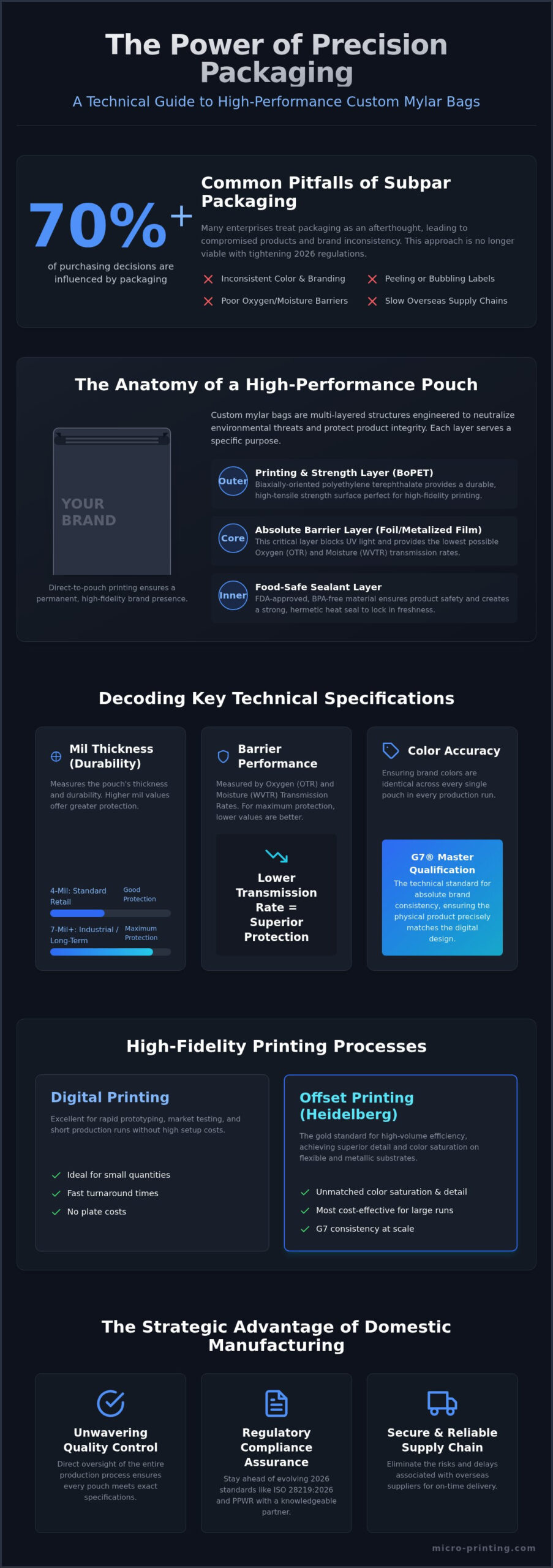
Research indicates that packaging influences more than 70% of purchasing decisions, yet many enterprises still treat their custom printed mylar bags as a secondary concern. In a market where 2026 regulations like the No Toxic Chemicals in Food Packaging Act are tightening, settling for subpar materials is no longer an option. You’ve likely experienced the frustration of inconsistent color across production runs or pouches that fail to maintain a strict oxygen barrier, compromising your product’s integrity. Relying on slow turnaround times from overseas suppliers only adds unnecessary risk to your supply chain.
This guide demonstrates how industrial-grade packaging can protect your product and elevate your brand through precision printing and advanced material science. We’ll explore how G7-certified color standards and Heidelberg press technology ensure your packaging meets exact brand guidelines every time. You’ll learn about the latest ISO 28219:2026 labeling requirements and why a reliable domestic manufacturing partner is the most effective way to secure a durable, high-barrier solution for your 2026 product lineup.
Key Takeaways
- Understand the engineering behind high-performance packaging, including how specific material layers optimize oxygen and moisture transmission rates (OTR/WVTR).
- Learn how custom printed mylar bags provide critical protection for specialty food, beverage, and pharmaceutical products through advanced light and sterilization barriers.
- Identify the most effective pouch configurations, from stand-up to gusseted styles, and the prepress requirements necessary for high-fidelity retail presentation.
- Examine the technical role of G7 Master Qualification and high-capacity Heidelberg presses in maintaining absolute brand consistency across large-scale industrial runs.
- Discover the strategic advantages of utilizing a domestic manufacturing partner to ensure quality control and compliance with evolving 2026 packaging standards.
What Are Custom Printed Mylar Bags and Why Do They Matter?
Custom printed mylar bags represent the intersection of high-barrier engineering and strategic marketing. At its core, Mylar is a brand name for BoPET (biaxially-oriented polyethylene terephthalate), a polyester film valued for its high tensile strength and chemical stability. For the industrial sector, this material provides a critical shield against environmental degradants. It effectively blocks ultraviolet light, resists moisture vapor, and contains volatile organic compounds that would otherwise compromise product quality.
In 2026, the transition from generic pouches with adhesive labels to direct-to-pouch custom printed mylar bags has become a standard for professional brands. Labels often fail under stress. They bubble, peel, or misalign during transit. Direct printing onto the substrate ensures a shelf-ready presence that communicates reliability. It turns a functional container into a high-fidelity brand asset that withstands the rigors of the global supply chain while maintaining its visual appeal.
The Evolution of Flexible Packaging
Flexible packaging has moved far beyond its origins in industrial bulk storage. Modern manufacturing now allows for sophisticated, high-end retail applications that don’t sacrifice durability for aesthetics. We’re seeing a significant shift toward recyclable mylar variants as brands align with the 2026 European Union Packaging and Packaging Waste Regulation (PPWR). Advanced digital and offset printing technologies, such as our Heidelberg press systems, have made high-volume custom printed mylar bags accessible to sectors ranging from pharmaceuticals to specialty foods.
Essential Terminology for B2B Buyers
Precision in procurement requires a grasp of technical specifications. Mil thickness is the primary measurement of durability. A 4-mil bag offers standard retail protection, while 7-mil or higher is required for long-term industrial storage. Finish options also play a functional role. Matte finishes reduce glare under retail lighting, while holographic elements provide a layer of security against counterfeiting.
The most critical metric for brand managers is G7 Certification. This isn’t a mere marketing badge. It’s a technical standard ensuring that your brand’s specific color profiles remain consistent across every batch, regardless of the substrate or printing method used. High-capacity partners utilize this certification to guarantee that the physical product matches the digital design with absolute precision.
Technical Specifications: Engineering the Perfect Pouch
Engineering a professional pouch requires more than just selecting a bag size. It involves a precise lamination of material layers designed to neutralize environmental threats. While BoPET provides the outer strength, manufacturers often add an aluminum foil or metalized film layer to create an absolute barrier. This is critical for long-term food storage where preventing oxidation is the priority. These layers work in tandem to shield contents from UV light, which can degrade organic compounds and alter flavor profiles.
The efficacy of custom printed mylar bags is measured through Oxygen Transmission Rate (OTR) and Moisture Vapor Transmission Rate (WVTR). Lower numbers indicate superior protection. Beyond the film itself, the closure system must maintain this seal. Industrial designs utilize heavy-duty zippers, laser-scored tear notches for easy access, and wide heat-sealable tops to ensure a hermetic environment. This mechanical integrity is what separates commercial packaging from hobbyist alternatives.
High-Fidelity Printing Processes
Printing on flexible substrates demands high-precision equipment. Digital printing serves as an excellent solution for short runs or rapid prototyping. It allows brands to test designs without high plate costs. However, offset printing remains the gold standard for high-volume efficiency. Our Heidelberg presses achieve superior detail and color saturation that digital methods can’t always replicate on metallic surfaces. This ensures that every graphic remains crisp and professional throughout the entire production run.
Structural Integrity and Safety
Safety compliance is non-negotiable for 2026 production. All materials must meet FDA food-grade certifications and remain strictly BPA-free. For regulated industries like pharmaceuticals, child-resistant (CR) mechanisms are integrated directly into the pouch structure to prevent unauthorized access while remaining senior-friendly. In 2026, puncture resistance standards require pouches to withstand a minimum of 20 Newtons of force to ensure integrity during high-speed automated fulfillment.
Color accuracy is the final technical hurdle. Multi-channel brands rely on G7-certified color matching to ensure their physical packaging aligns with their digital presence. Inconsistent hues suggest poor quality control to the end consumer. By partnering with a professional printing facility in Fort Lauderdale, you gain access to the technical expertise needed to manage these complex variables from the first proof to the final shipment. This level of precision ensures your custom printed mylar bags function as both a protective vessel and a high-performance marketing tool.
Industry Applications for Custom Printed Mylar Bags
The versatility of custom printed mylar bags extends across multiple high-stakes industries. Each sector demands a specific balance of barrier performance and visual communication. While a retail brand might prioritize the tactile feel of a matte finish, a medical manufacturer requires absolute sterility and tamper-evident security. These pouches aren’t merely containers. They’re precision-engineered tools designed to meet rigorous industrial standards while serving as the primary touchpoint for the end user.
Beyond standard consumer goods, industrial electronics require ESD (Electrostatic Discharge) shielding. Specialized mylar films prevent static buildup that could destroy sensitive components. These bags provide a moisture-free environment for circuit boards and high-precision sensors during transit. In the retail and apparel space, the focus shifts to the unboxing experience. A custom-printed, high-mil pouch offers a premium feel that basic plastic bags cannot replicate. It signals to the customer that the contents are of superior value, which is a critical differentiator in a crowded 2026 marketplace.
Food and Beverage Requirements
Specialty coffee, tea, and spice producers rely on aroma barriers to maintain product integrity. Without a high-density BoPET layer, essential oils and scents dissipate quickly. This leads to a stale consumer experience. Brands often utilize window features to showcase product quality. However, these must be strategically placed to balance visibility with light protection. All materials used in these pouches must strictly adhere to FDA food contact regulations to ensure consumer safety. To create a cohesive brand presence, many businesses pair their custom printed mylar bags with high-quality Commercial Printing Services Florida for brochures and point-of-sale displays.
Medical and Regulated Goods
In the pharmaceutical sector, the stakes are higher. Packaging must ensure long-term shelf-life stability and protection from light-induced degradation. Precision printing is mandatory here. Dosage instructions and critical safety warnings must remain legible under various storage conditions. Tamper-evident heat seals provide a necessary layer of security, confirming that the product hasn’t been compromised since leaving the facility. Compliance labeling is equally critical. In 2026, manufacturers must integrate scannable QR codes and human-readable data that align with updated ISO 28219:2026 requirements. This ensures full traceability throughout the medical supply chain, providing peace of mind for both providers and patients.
Designing Your Custom Mylar Bags for Maximum Impact
Design is a strategic variable in the manufacturing process. It bridges the gap between material science and consumer behavior. When developing custom printed mylar bags, the physical form factor must align with the product’s retail environment and logistics requirements. A well-executed design doesn’t just attract attention. It communicates the technical superiority of the product within. The choice of pouch style, finish, and prepress accuracy determines whether a brand appears as a market leader or a generic entry.
The psychology of packaging is rooted in tactile and visual cues. Research indicates that the texture and weight of a pouch influence a consumer’s perception of value. A thicker mil bag with a soft-touch matte finish creates a sense of durability and premium quality. Conversely, high-gloss finishes with vibrant color saturation suggest energy and freshness. Leveraging specialty finishes like spot UV or foil stamping allows brand managers to highlight specific logos or certifications, creating a multi-dimensional look that stands out in high-density retail environments.
Selecting the Right Pouch Shape
The geometry of the pouch dictates how a product interacts with the shelf and the consumer. Stand-up pouches (SUP) are the industry standard for retail visibility. Their bottom gusset allows them to remain upright, maximizing the “billboard space” for brand graphics. In contrast, lay-flat pouches are optimized for space-efficient shipping and single-use samples. For high-volume industrial or agricultural contents, such as bulk pet food, side-gusseted bags provide the necessary internal capacity while maintaining structural stability under significant weight.
The Design-to-Print Workflow
Transitioning from a digital concept to a physical product requires rigorous prepress preparation. Vector graphics are mandatory for logos and typography to prevent pixelation at large scales. High-resolution raster images, at a minimum of 300 DPI, are reserved for complex photographic elements. Managing bleeds and safe zones ensures that graphics aren’t lost during the high-speed conversion process. A critical step in our microprint workflow involves the production of physical proofs. Digital screens can’t accurately replicate how ink interacts with metallic or matte mylar substrates. Physical verification is the only way to guarantee that the final custom printed mylar bags meet your exact brand guidelines. Modern designs also incorporate smart packaging elements, such as scannable QR codes, to bridge the gap between the physical product and digital traceability data.
To ensure your design translates perfectly to the final substrate, consult with our prepress specialists to review your technical files before production begins.
Precision Manufacturing: The Micro Printing Difference
Manufacturing custom printed mylar bags requires a level of technical oversight that commodity suppliers simply cannot provide. At our Fort Lauderdale facility, we treat packaging as a critical component of the product’s engineering rather than a mere container. This localized approach eliminates the risks commonly associated with overseas production, such as erratic lead times and a lack of material transparency. By maintaining domestic control, we ensure that every pouch meets the exact structural and aesthetic requirements of the corporate sector.
The foundation of our quality control is the G7 Master Qualification. This industry standard ensures that visual properties remain consistent across different substrates and printing platforms. Whether a brand is printing a heavy-duty folding carton or a metallic mylar pouch, the color values stay within a tight, measurable tolerance. This technical precision is vital for national enterprises that cannot afford brand dilution through inconsistent packaging. It’s about delivering a physical product that matches the digital proof with absolute fidelity.
A strategic advantage of professional manufacturing is the ability to integrate packaging into a wider marketing ecosystem. For instance, high-barrier custom printed mylar bags can be effectively paired with direct mail marketing campaigns. This synergy allows brands to deliver product samples in a secure, shelf-ready format while leveraging targeted data to reach specific demographics. It turns a simple delivery into a high-impact brand experience.
Local Expertise, National Reach
While our facility serves as a primary hub for South Florida brands, our infrastructure supports national distribution with high-capacity reliability. We utilize Heidelberg-level precision in every batch to guarantee that the first bag is identical to the millionth. US-based manufacturing allows for rapid prototyping and faster turnaround times. This speed is essential for businesses responding to 2026 regulatory updates or sudden market shifts where delay equals lost revenue.
Comprehensive Packaging Solutions
Our capabilities extend beyond the pouch itself to provide a total process management solution. We offer a full spectrum of services by combining mylar production with offset printing services for custom boxes and labels. This end-to-end management ensures that all packaging components arrive with synchronized color and quality. We scale our production to meet the needs of growing mid-sized brands and established national enterprises alike. Contact us today for a custom engineered packaging consultation to secure your supply chain for the 2026 fiscal year.
Securing Your Brand’s Future with Precision Packaging
Professional packaging is no longer just about containment; it’s a critical component of your product’s technical and commercial success. By prioritizing barrier integrity and high-fidelity printing, you ensure your goods remain protected and your brand remains distinct. We’ve explored how material science and G7-certified color standards work together to eliminate the risks of inconsistent batches and failed seals. These technical foundations are what separate market leaders from generic competitors in an increasingly regulated landscape.
Choosing a domestic partner for your custom printed mylar bags provides the oversight necessary to navigate the complex 2026 regulatory environment with confidence. Our Florida-based manufacturing facility combines Heidelberg press precision with end-to-end process management. This ensures your packaging isn’t just a pouch, but a high-performance asset designed for the rigors of the modern supply chain. Reliability in your packaging translates directly to consumer trust in your product.
Ready to elevate your retail presence? Request a Custom Packaging Quote from Micro Printing today to see how industrial-grade precision can transform your brand’s physical identity. Let’s build a more reliable future for your products together.
Frequently Asked Questions
What is the minimum order quantity (MOQ) for custom mylar bags?
Minimum order quantities for custom printed mylar bags depend on the specific printing technology utilized for your project. Digital printing typically accommodates smaller runs for rapid prototyping or market testing. High-capacity offset printing is optimized for larger industrial volumes where cost efficiency and high-speed production are the primary requirements. We recommend requesting a technical consultation to determine the most efficient scale for your needs.
How do I ensure my brand colors are accurate on mylar material?
We maintain brand color accuracy through G7-certified standards and state-of-the-art Heidelberg press technology. This methodology ensures that the physical ink on the mylar substrate matches your digital brand guidelines with industrial precision. Because ink interacts differently with metallic or matte films, we provide physical proofs to verify color fidelity before full-scale manufacturing begins.
Are your mylar bags food-safe and BPA-free?
All materials used in our production are strictly food-safe and BPA-free. They comply with FDA Title 21 CFR regulations regarding food contact substances, ensuring that your products remain free from chemical contaminants. These high-barrier films provide the necessary protection against oxygen and moisture while meeting the safety standards required for the food and beverage industry.
Can I get child-resistant zippers on my custom pouches?
Yes, we integrate child-resistant (CR) closure mechanisms designed for regulated industries such as pharmaceuticals and medical goods. These zippers meet the requirements of the Poison Prevention Packaging Act. They’re engineered to prevent unauthorized access by children while remaining functional and senior-friendly for adult consumers.
What is the typical turnaround time for custom printed bags in Florida?
Our Florida-based manufacturing facility offers significantly faster turnaround times than overseas suppliers. While specific timelines depend on the structural complexity and order volume, domestic production eliminates the unpredictable delays associated with international shipping and customs. This proximity allows for tighter quality control and more reliable delivery schedules for our partners across the United States.
Do you offer different finishes like matte or holographic?
We provide a wide array of specialty finishes, including matte, high-gloss, and holographic options. These finishes serve both aesthetic and functional purposes; for example, matte coatings reduce glare under retail lighting, while holographic elements can act as a deterrent against counterfeiting. We also offer spot UV and foil stamping to emphasize specific brand graphics or logos.
Can mylar bags be recycled in 2026?
In 2026, recyclability has become a central focus due to updated regulations like the EU’s Packaging and Packaging Waste Regulation (PPWR). We offer recyclable custom printed mylar bags that utilize advanced mono-material structures designed to be compatible with modern recycling streams. These variants provide the same high-barrier protection as traditional multi-layer films while supporting your brand’s sustainability commitments.
Do you provide design assistance for structural packaging?
Our team provides comprehensive assistance for both structural design and prepress preparation. We ensure that your vector files are optimized for the substrate and that the pouch geometry is compatible with your automated fulfillment equipment. This technical support bridges the gap between the initial design concept and a high-performance physical product, preventing costly errors during the production phase.