
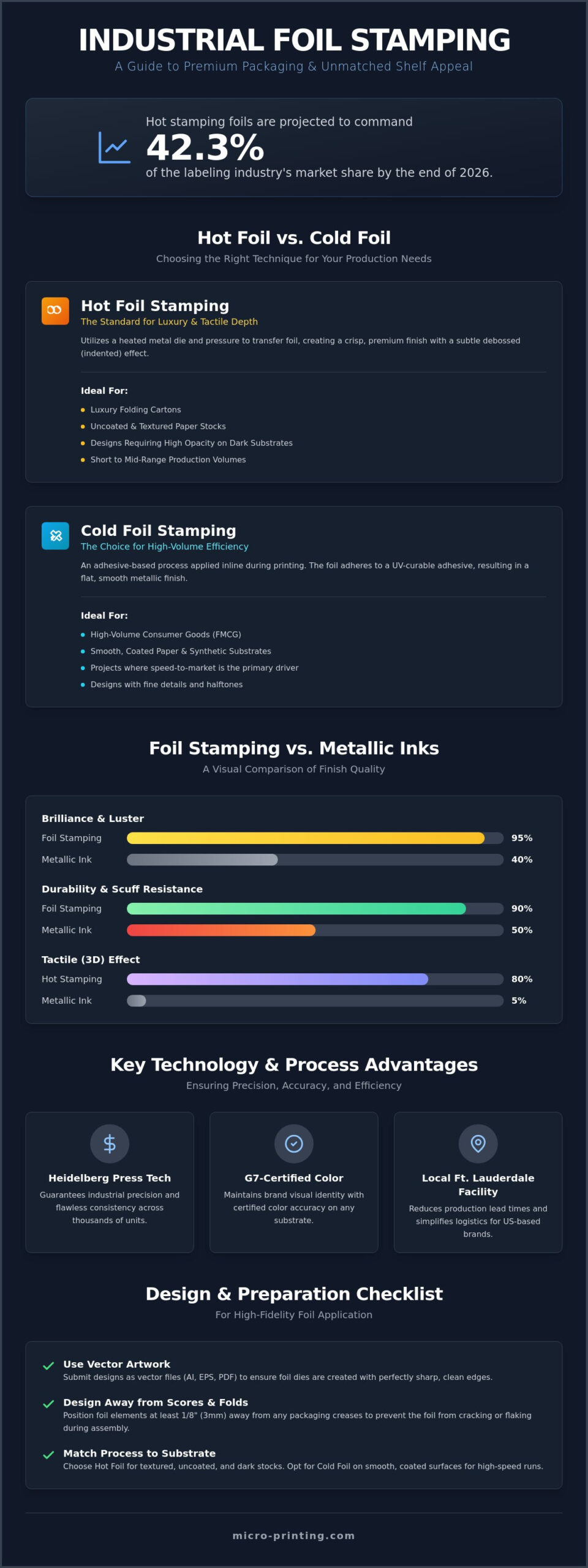
In a market where hot stamping foils are projected to command a 42.3% share of the labeling industry by the end of 2026, relying on standard print alone is a calculated risk your brand can’t afford. You’ve likely felt the frustration of seeing a meticulously designed product blend into the background on a crowded shelf, or perhaps you’ve worried that a premium metallic finish might flake or fail to match your brand’s exact color specifications. These concerns are valid in an era where industrial precision is the only way to maintain a competitive edge.
This guide will show you how to utilize industrial foil stamping for packaging to command higher perceived value and ensure your shelf appeal remains as durable as it is striking. We’ll break down the technical choice between hot and cold foil processes, explain how Heidelberg press technology ensures G7-certified color accuracy across different materials, and provide a roadmap for sourcing high-volume, precision finishing from our local Fort Lauderdale facility. You’ll gain a clear understanding of how to integrate these high-end finishes into your production workflow without compromising on structural integrity or 2026 recycling standards.
Key Takeaways
- Understand how foil accents serve as a premiumization signal to elevate brand perception and increase the perceived market value of your products.
- Evaluate the technical differences between hot and cold foil stamping for packaging to select the most efficient process for your specific production volume.
- Learn critical structural design and vector file preparation techniques to ensure high-fidelity foil application that does not interfere with scores or folds.
- Identify the optimal applications for metallic and pigment foils to achieve either a high-luster luxury aesthetic or a specialized matte finish.
- Discover how leveraging a local Fort Lauderdale partner with Heidelberg press technology ensures G7-certified color accuracy and reduced production lead times.
Elevating Brand Perception with Foil Stamping for Packaging
Industrial foil stamping for packaging is a specialty finishing process that utilizes heated metal dies to bond metallic, holographic, or pigmented films to a substrate. Commonly referred to as Hot stamping, this method creates a permanent, high-contrast bond that transforms standard paperboard into a premium asset. In the 2026 market, consumer attention is a finite resource. These finishes act as a “premiumization signal,” communicating quality and stability before a customer ever touches the product. Whether applied to folding cartons, custom presentation folders, or high-end catalogs, foil stamping provides a physical and visual weight that digital-only prints cannot match.
Beyond simple aesthetics, foil stamping for packaging creates a multisensory experience. The slight indentation left by the die provides a tactile quality that increases brand recall. This is effective for high-capacity manufacturing where consistency is non-negotiable. Our Fort Lauderdale facility utilizes Heidelberg technology to ensure every pass meets G7-certified color standards. This maintains the integrity of the brand’s visual identity across thousands of units, ensuring the final product reflects the technical precision of the manufacturer.
The Psychology of Shelf Appeal
Metallic finishes function as light-traps on a retail shelf. While matte surfaces absorb light, foil reflects it, naturally drawing the eye toward the brand’s logo or key selling points. There is a documented correlation between these high-fidelity finishes and higher price points. Consumers instinctively associate reflective accents with craftsmanship and value. In sectors like medical, gourmet food, or custom apparel manufacturing with PowerSweet Fashion, foil is often used to denote “professional grade” or “artisanal” luxury. It serves as a silent validator of the product’s quality, justifying a premium position in a competitive environment.
Foil Stamping vs. Standard Metallic Inks
Standard metallic PMS inks often fall flat. They rely on suspended metal particles within a liquid carrier, which limits their reflective potential. In contrast, the hot stamping process utilizes a solid film layer that creates a mirror-like finish. This provides a level of brilliance that liquid-based pigments simply cannot achieve. The durability of foil is also superior. It resists scuffing and abrasion during the shipping process, ensuring the packaging arrives in pristine condition. Additionally, the pressure of the stamping process allows for a subtle 3D effect. This depth adds a layer of sophistication that remains sharp and legible, even on complex folding carton designs or textured paper stocks.
Hot Foil vs. Cold Foil: Choosing the Right Technique for Your Project
Selecting the appropriate method for foil stamping for packaging requires a precise understanding of your production volume, substrate type, and desired visual depth. While both techniques yield metallic finishes, their mechanical applications differ significantly. Hot stamping relies on a combination of heat, pressure, and a metal die to transfer foil onto the material. In contrast, cold foil is an adhesive-based process that occurs inline during the offset printing cycle. The choice between them isn’t merely aesthetic; it’s a structural decision that impacts your manufacturing timeline and per-unit cost.
For a detailed technical breakdown of these methods, the Foil Cheat Sheet provides a comprehensive comparison of how different foils react to various surface tensions. In industrial settings, hot foil remains the standard for projects requiring a tactile, “debossed” feel. Because the metal die physically strikes the paperboard, it creates a crisp, lustrous effect that cold foil cannot replicate. However, the upfront cost of custom dies makes hot stamping more suitable for luxury short-runs or mid-range volumes where the premium look justifies the setup fee. Cold foil, while flatter, offers unmatched efficiency for high-volume Fast-Moving Consumer Goods (FMCG) where speed to market is the primary driver.
When to Choose Hot Foil Stamping
Hot foil is the superior choice for luxury folding cartons and high-end retail packaging that utilizes uncoated or heavily textured paper stocks. Because the process uses heat to melt the foil’s release layer, it achieves maximum opacity even on dark or black substrates. If your design requires sculpted or multi-level embossing, hot foil is the only viable path. The mechanical pressure ensures the foil reaches into the fibers of the material, providing a level of durability and brilliance that stands up to rigorous handling. For brands focused on high-fidelity results, consulting with a structural design partner early in the process ensures the die placement aligns perfectly with your packaging folds.
The Advantages of Inline Cold Foil
Cold foil is optimized for high-speed production of labels and mid-weight folding cartons. Since the foil is applied inline on a standard printing press, it eliminates the need for a secondary pass, drastically reducing lead times. One of its most significant technical advantages is design flexibility. You can print CMYK inks directly over the silver cold foil, allowing you to create an infinite spectrum of metallic colors in a single run. This makes it an ideal solution for complex gradients or photographic elements that require a metallic undertone. While it lacks the physical depth of hot stamping for packaging, its ability to handle fine lines and halftones with precision makes it a staple for modern, high-volume manufacturing.
Common Foil Types and Their Industrial Applications
Selecting the right foil is a precise exercise in material science. Beyond the standard gold and silver, industrial applications require a specific match between the foil’s chemical composition and the packaging substrate. When choosing the right paper for foil stamping, you must account for the foil’s release properties. Metallic foils remain the industrial standard for gold, silver, and copper finishes, providing a level of opacity and luster that liquid-based inks cannot achieve. These are used extensively in folding cartons for the gourmet food and cosmetics sectors, where brand consistency is paramount.
Pigment foils offer a different functional advantage. Unlike translucent inks, these foils are completely opaque. They provide a “painted” look that stays vibrant even on dark or recycled corrugated boxes. This is essential for maintaining brand integrity on shipping containers or secondary packaging. Clear and pearl foils provide a more subtle, sophisticated accent. They are often used on white or light-colored folding cartons to create a ghosted effect that only becomes visible when the packaging catches the light. This creates a tactile, premium feel without the aggressive flash of traditional metallics, making it ideal for the health and beauty sector.
Functional Foils for Security and Brand Protection
Holographic foils have evolved beyond mere decoration. In the medical and pharmaceutical sectors, these foils serve as critical anti-counterfeiting measures. By integrating custom holographic patterns or microprint within the foil design, manufacturers can create packaging that is nearly impossible to replicate. This adds a layer of security that protects both the consumer and the brand’s reputation. Tamper-evident foil seals are another industrial application, providing a visual confirmation that the product’s integrity hasn’t been compromised during transit. These security features are often mandatory for high-value goods where supply chain transparency is a legal requirement.
Matte vs. Gloss Pigment Foils
Modern packaging design has shifted toward a minimalist aesthetic, driving the demand for matte pigment foils. These finishes provide a high-contrast, non-reflective look that pairs well with the raw texture of folding cartons or corrugated materials. Combining a matte foil with a spot UV coating creates a multi-layered texture that invites consumer interaction. Gloss pigment foils, on the other hand, are used to create bold, high-impact branding that stands out in high-traffic retail environments. Each choice is a deliberate step in the structural design process, ensuring the final product meets both aesthetic and functional requirements. Every application of foil stamping for packaging must be evaluated based on the durability requirements of the distribution cycle.
Designing and Preparing Packaging for High-Fidelity Foil Application
High-fidelity results in foil stamping for packaging are the product of rigorous structural planning. If a design places foil over a score line or a 180-degree fold, the metallic layer will likely crack. This compromises the premiumization signal established in the initial design phase. We recommend a minimum clearance of 0.125 inches from any fold to maintain the integrity of the finish. Precision at this stage prevents material waste and ensures the final folding cartons maintain their structural and aesthetic value throughout the distribution cycle.
Vector file preparation is the next critical step in the manufacturing process. Digital files must contain separate layers for the CMYK print and the foil die. Don’t flatten these elements. Use a dedicated spot color, often named “Foil” or “Die,” set to overprint. This allows our prepress team to isolate the stamping area and manufacture the brass or copper die with micron-level precision. This separation is vital for achieving the sharp registration required for complex logos or fine-line typography on presentation folders and booklets.
Material Compatibility: Folding Cartons vs. Corrugated
Folding cartons typically utilize Solid Bleached Sulfate (SBS) to achieve the sharpest foil edges. The smooth, clay-coated surface of SBS provides a stable base for the heated die. Corrugated shipping boxes present a different challenge. The fluted interior can cause “telegraphing,” where the ridges of the cardboard appear through the foil. To solve this, we often apply the foil to a top liner before it’s laminated to the fluting. Testing adhesion on recycled fibers is also necessary; residual oils in the pulp can affect how the foil bonds to the surface. For brands requiring high-volume precision, you can request a technical consultation to review your structural files before production begins.
G7-Certified Color Standards in Finishing
Most industrial guides overlook the synchronization of color between printing and finishing passes. G7-certified color standards are the solution. By calibrating our Heidelberg presses to these global benchmarks, we ensure that the printed elements and the foil accents exist in a unified visual space. G7 certification ensures color accuracy across diverse materials by standardizing the visual appearance of grayscale and color regardless of the printing substrate. This level of control is vital when a brand requires a specific PMS match to sit adjacent to a metallic gold accent. It removes the uncertainty of color shifting between different production runs, providing a reliable outcome for pharmaceutical and gourmet food clients who demand absolute consistency.
Custom Foil Stamping Services in Fort Lauderdale: The Micro Printing Advantage
Micro Printing provides specialized foil stamping for packaging from our Fort Lauderdale facility, ensuring that the technical standards discussed throughout this guide are met with industrial precision. Since our founding in 1989, we’ve positioned ourselves as a high-capacity partner for the South Florida business sector. We manage the entire production cycle in-house. This includes everything from structural design to the final execution of commercial printing services florida. By maintaining end-to-end control, we eliminate the communication gaps that often occur between separate designers and manufacturers.
Our 35 years of experience in the Fort Lauderdale market gives us a unique perspective on the regional supply chain. We understand the specific durability requirements for products distributed in humid climates, particularly for the medical and gourmet food sectors. This expertise ensures that your chosen foil type, whether metallic or pigment-based, maintains its bond and brilliance from the press to the consumer’s hands.
Why Local Manufacturing Matters for Packaging
Operating within the Fort Lauderdale market allows our partners to perform real-time press checks. You can verify foil adhesion and color accuracy in person before a full production run begins. This level of transparency is critical for premium folding cartons where a single error in registration can compromise an entire batch. Local production also removes the logistical risks associated with long-distance shipping. Delicate finishes like holographic or pearl foils are susceptible to temperature fluctuations and rough handling during transit. By producing locally, we reduce lead times and ensure your packaging arrives in the exact condition it left the press.
Advanced Finishing with Heidelberg Technology
Our facility utilizes state-of-the-art Heidelberg infrastructure to synchronize complex multi-pass projects. This technology allows us to combine high-pressure foil dies with the precision of offset printing services, maintaining G7-certified standards across all materials. Whether you require a small run for a boutique launch or high-volume commercial orders for retail distribution, our equipment is built for scalability. We apply the same level of technical scrutiny to every project, ensuring that your foil stamping for packaging serves as a durable, high-fidelity brand asset. Contact Micro Printing for a Custom Foil Stamping Quote to discuss your structural requirements and production timeline.
Precision Finishing for the 2026 Competitive Market
Precision is the baseline for success in the 2026 retail environment. Integrating foil stamping for packaging into your production workflow isn’t just a decorative choice; it’s a strategic move to secure your market position. By understanding the mechanical differences between hot and cold foil and prioritizing G7-certified color accuracy, you ensure your brand maintains a high-fidelity presence across every retail channel. This technical foundation prevents the common issues of color shifting and scuffing that often compromise brand integrity during the shipping process.
Micro Printing brings this level of industrial mastery to every project. As a G7 Master Certified Printer utilizing state-of-the-art Heidelberg equipment, we’ve been serving Fort Lauderdale brands since 1989. Our facility provides the structural expertise and local logistics needed to scale your high-end folding cartons and presentation folders without the risks of long-distance shipping. We provide the technical stability and high-volume capacity your organization needs to grow.
Ready to elevate your product’s shelf appeal with consistent, premium results? Request a Custom Packaging Quote from Micro Printing today. We look forward to engineering your next manufacturing success.
Frequently Asked Questions
Is foil stamping for packaging recyclable and sustainable?
Yes, foil-stamped paperboard is fully recyclable according to industry studies by the Foil & Specialty Effects Association (FSEA). The foil layer is extremely thin, typically less than 2.5 microns, which allows it to separate easily from paper fibers during the standard re-pulping process. As long as the substrate itself is a recyclable paperboard and not a plastic-laminated material, it meets the 2026 sustainability standards for municipal recycling programs.
What is the difference between foil stamping and foil embossing?
Foil stamping is a flat application where heat and pressure bond a metallic film to the surface of the material. Foil embossing, also known as a combination die, performs two functions simultaneously by transferring the foil and raising the image into a three-dimensional shape. While standard stamping provides a visual metallic accent, foil embossing adds a tactile depth that requires a specialized male and female die set to reshape the paper fibers.
Can I use foil stamping on corrugated shipping boxes?
Yes, foil stamping for packaging is applicable to corrugated materials, though it requires a specific manufacturing sequence. To avoid the ridges of the cardboard fluting showing through the foil, we typically stamp the top liner before it is laminated to the corrugated medium. This method ensures a smooth, high-fidelity finish that maintains brand consistency on secondary shipping containers and subscription boxes.
How much does foil stamping add to the cost of custom packaging?
The cost is primarily influenced by the initial setup of the custom metal die and the production volume. While there is a fixed upfront investment for the brass or copper die, the per-unit cost decreases as the quantity of the run increases. This makes industrial foiling a scalable solution for brands that have moved beyond the prototyping phase and require high-volume commercial production with consistent results.
What is the minimum order quantity for foil-stamped folding cartons?
Most industrial facilities require a minimum order that justifies the mechanical setup of the Heidelberg press and die-cutting equipment. For foil-stamped folding cartons, cost-efficiency typically begins at 250 to 500 units. While smaller boutique runs are possible, these minimums ensure that the setup costs for the custom dies are distributed effectively across the total unit count, maintaining a viable per-piece price.
How do I prepare my design files for foil stamping?
Design files must contain a dedicated vector layer specifically for the foil elements, separate from the CMYK print layers. This layer should use a unique spot color set to overprint to ensure the prepress team can isolate the die-making data. All foil graphics must be vector-based to ensure the metal die is manufactured with the sharp edges required for fine lines and small typographic details.
How long does the foil stamping process take to complete?
The total production timeline usually spans 7 to 10 business days, depending on the complexity of the die and the number of passes required. This includes approximately 3 to 5 days for the fabrication of the custom metal die and the subsequent time for the secondary stamping pass after the initial offset printing. Sourcing these services from a local Fort Lauderdale facility reduces this window by eliminating the transit time for physical proofs.
Can I combine foil stamping with other finishes like spot UV?
Yes, combining foil accents with spot UV or soft-touch coatings is a standard practice for creating multi-layered, premium textures. This technique is often used in the cosmetics and luxury spirits industries to create a high-contrast visual experience. It’s vital to sequence these finishes correctly during the manufacturing process to ensure the coatings adhere to the substrate without dulling the brilliance of the metallic foil.