
Industrial precision and technical integrity are the true markers of a premium brand in 2026. A product loses its authority the moment a customer touches packaging that feels generic or shows signs of finish degradation like peeling and cracking. You likely recognize that inconsistent color across different luxury packaging finishes can signal a lack of quality control, undermining the prestige you’ve worked hard to build. This guide details how to leverage advanced printing techniques and tactile finishes to transform standard folding cartons into high-end brand experiences that survive the entire retail lifecycle.
We’ll provide a professional overview of the latest Heidelberg-driven coating technologies and the G7+ color standards released in June 2026. You’ll learn how to balance the sensory appeal of soft-touch matte and debossing with the strict durability and sustainability requirements of the new EU PPWR regulations. This analysis focuses on the measurable quality and technical felicity required to ensure your packaging reflects the stability and sophistication of your organization. By the end of this guide, you will understand how to engineer a “wow” unboxing experience that remains consistent from the first production run to the final consumer interaction.
Key Takeaways
- Understand the psychology of haptic perception and how tactile depth influences high-end buying decisions.
- Learn how to apply various luxury packaging finishes to specific materials like SBS board or kraft to prevent peeling and cracking.
- Implement G7-certified color standards to ensure technical precision and brand consistency across all print runs.
- Adapt your production to 2026 sustainability mandates like the EU PPWR without sacrificing the premium aesthetic of your folding cartons.
- Explore the strategic synergy between custom-engineered packaging and targeted direct mail for specialized corporate marketing.
Understanding Luxury Packaging Finishes: More Than Just Aesthetics
In high-capacity production, post-press treatments are far more than decorative additions. They represent the final stage of industrial engineering where technical precision meets consumer psychology. Utilizing advanced luxury packaging finishes allows a brand to signal its market position before a customer even views the product inside. This transition from standard folding cartons to high-fidelity presentation pieces is essential for companies aiming to command a premium in the 2026 marketplace. It moves the conversation from mere containment to a comprehensive brand experience.
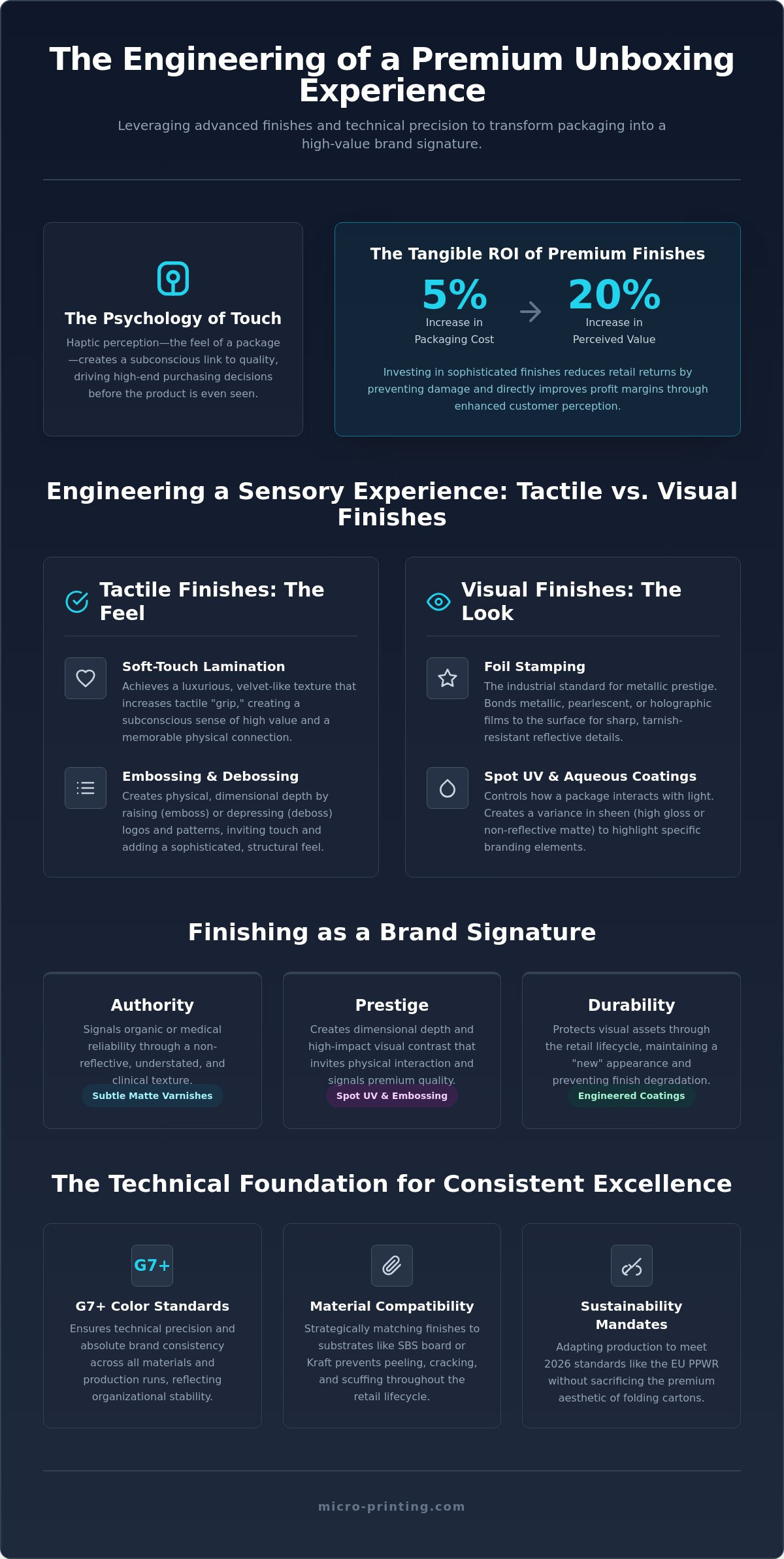
The science of haptic perception explains why physical touch remains a dominant driver in purchasing behavior. When a consumer handles a package, the brain processes the weight, texture, and temperature of the material. A finish that feels substantial or uniquely textured creates an immediate subconscious link to quality. To understand what is luxury packaging in a modern context, one must look past the visual design and analyze the technical application of these finishes. Beyond aesthetics, these treatments serve a functional purpose by reinforcing the structural integrity of the box. High-grade coatings and laminations provide a protective barrier against moisture, scuffing, and UV degradation. This ensures the package survives the rigors of the global shipping cycle without losing its prestige.
The ROI of Premium Packaging
Investing in sophisticated finishes is a strategic financial decision rather than a marketing expense. Durable finishes like soft-touch matte or aqueous coatings reduce the rate of retail returns by preventing visible damage during handling. A 5% increase in packaging cost can lead to a 20% increase in perceived value. This margin improvement is critical for brands operating in competitive sectors where shelf presence and unboxing experiences determine customer retention. Choosing the right finish is an exercise in engineering that directly impacts the bottom line through increased durability and rigid construction.
Finishing as a Brand Signature
Consistency across various product lines requires a disciplined approach to finishing techniques. A brand signature is often defined by its tactile language, whether that involves the clinical authority of a subtle matte varnish or the high-impact prestige of metallic foil. Maintaining this consistency requires industrial precision and strict adherence to color standards across all substrates.
- Authority: Subtle matte varnishes often signal organic or medical reliability through a non-reflective, understated texture.
- Prestige: Spot UV and embossing create dimensional depth that invites physical interaction.
- Durability: Engineered coatings protect the brand’s visual assets throughout the retail lifecycle, maintaining a “new” appearance longer.
Professional partners ensure that these finishes don’t just look impressive on a single prototype. The goal is to achieve technical felicity and measurable quality across high-volume production runs, ensuring every unit reflects the organization’s stability and commitment to excellence.
Tactile vs. Visual Finishes: Engineering a Sensory Experience
Engineering a sensory experience requires a dual focus on light manipulation and surface friction. While graphics provide the message, luxury packaging finishes provide the emotional context that high-end brands require. Foil stamping remains the industrial standard for metallic prestige. This process uses precise heat and pressure to bond metallic, pearlescent, or holographic films to the substrate. The result is a reflective surface that resists tarnishing and provides a sharp contrast against matte backgrounds. This technique is particularly effective for logos and security seals where visual authority is paramount.
Controlling how a package interacts with light is equally critical. Spot UV and aqueous coatings allow designers to highlight specific branding elements by creating a variance in sheen. While gloss finishes maximize color vibrance and shelf impact, matte coatings offer a sophisticated, non-reflective surface that suggests a more “quiet” luxury. Soft-touch lamination has become essential for high-end retail because it achieves a velvet feel that increases the tactile “grip” of the package. This physical connection creates a subconscious sense of value that visual-only designs cannot replicate.
Dimensional Details: Embossing and Foil
Creating dimensional depth invites physical touch and reinforces brand permanence. Blind embossing creates a raised effect without the use of ink or foil, relying entirely on the highlights and shadows created by the material’s texture. Foil-stamped embossing combines these methods for a multi-sensory effect. When executing these techniques, the structural requirements of the substrate must be considered. Deep debossing on corrugated materials requires specialized tool engineering to prevent the structural collapse of the internal fluting. For organizations utilizing professional offset printing services, integrating these finishes during the post-press phase ensures that registration remains exact across high-volume production runs.
Advanced Coatings and Laminations
Coatings provide the necessary durability for the retail lifecycle while maintaining aesthetic integrity. Aqueous coatings are the preferred choice for food-safe and medical-grade packaging because they are water-based, dry instantly, and provide a hard, rub-resistant surface. These coatings are often integrated into high-end Catalogs and presentation folders to prevent fingerprinting and scuffing during distribution. To maintain brand consistency, all coatings must be applied in accordance with G7 printing and color management standards. This prevents the “yellowing” or color shifting that often occurs with inferior laminates. If your brand requires a specific tactile signature, you can partner with our technical team to engineer a custom substrate and finish combination that meets your durability specifications.
Strategic Selection: Matching Finishes to Industry and Material
Selecting the appropriate luxury packaging finishes requires a technical understanding of substrate physics and ink chemistry. A finish that performs exceptionally on Solid Bleached Sulfate (SBS) board may fail on porous kraft paper or corrugated materials. SBS board remains the industry standard for high-fidelity packaging because its clay-coated surface provides superior ink holdout and a smooth foundation for complex laminations. In contrast, uncoated kraft materials are highly absorbent, often requiring specific primers to prevent metallic foils or spot UV coatings from “sinking” into the fibers and losing their luster.
Sustainability is now a technical requirement rather than a design choice. With the EU’s Packaging and Packaging Waste Regulation (PPWR) becoming fully enforceable on August 12, 2026, brands must prioritize recyclability in their finishing choices. Modern cold foils and water-based aqueous coatings allow for metallic effects and protective barriers that don’t interfere with the de-inking or recycling process. Organizations must conduct a cost-benefit analysis between single-pass and multi-pass finishing. While single-pass inline finishing on a Heidelberg press increases production efficiency, complex layering of textures often requires a second pass to ensure registration accuracy and finish durability.
Packaging for the Medical and Pharmaceutical Sector
In the healthcare industry, finishing serves as a critical layer of security and compliance. Technical precision is mandatory to ensure that packaging remains intact in clinical environments. Beyond aesthetics, we utilize microprint and specialized security inks to prevent counterfeiting and ensure product authenticity. These finishes must withstand frequent handling and chemical exposure without degrading. Adhering to G7-certified color standards ensures that pharmaceutical branding remains consistent across different production batches, which is essential for maintaining patient trust and regulatory compliance.
Retail and Consumer Goods
Maximizing shelf appeal in high-density retail spaces requires a strategic use of light-reflecting finishes. The unboxing experience has evolved into a multi-stage brand interaction where the interior of the folding carton is as important as the exterior. Brands often use flood-coated interior colors or subtle debossing on the inside flaps to surprise the consumer. For a cohesive market presence, these packaging elements should be integrated with large format signage production to create a unified visual language between the product box and the retail display. This systemic approach ensures that the brand’s prestige is communicated at every physical touchpoint, from the store window to the customer’s home.
The Technical Foundation: Precision Printing and G7 Standards
The application of luxury packaging finishes is an engineering process that demands a stable technical foundation. Without industrial-grade infrastructure, even the most sophisticated tactile effects will suffer from registration errors or color drift. High-capacity production requires a systematic approach to quality control, focusing specifically on ink density and foil adhesion. If the technical parameters aren’t precisely managed, finishes can peel or crack, compromising the brand’s perceived value. We utilize real-time densitometry to monitor ink film thickness, ensuring that every sheet meets the established quality benchmarks before it reaches the finishing stage.
Structural engineering is equally vital during the design phase. Deep debossing or heavy aqueous coatings can alter the moisture content and flexibility of the substrate. Our process ensures that the finish enhances the aesthetic without weakening the structural integrity of the folding carton. This level of control is only achievable through state-of-the-art equipment and a rigorous adherence to international standards. We analyze the tension and compression limits of each material to ensure that folding and gluing processes don’t cause the finish to fracture at the scores or compromise the box strength.
The Importance of G7 Master Qualification
Color consistency is the hallmark of professional brand management. G7 certification is the industry standard for achieving a visual match from proof to press, ensuring that your brand’s specific palette remains identical across all substrates. Whether you’re printing on SBS board or corrugated materials, the G7 methodology uses gray balance and neutral density curves to maintain tonal accuracy. This scientific approach eliminates the subjectivity of manual color matching and replaces it with measurable data. Micro Printing maintains G7 Master Qualification to provide B2B clients with the assurance that their packaging will match their marketing collateral perfectly, regardless of the production volume or the complexity of the finish.
High-Volume Precision with Heidelberg
Heidelberg press technology remains the gold standard for high-fidelity packaging production. Offset printing provides a level of detail and color depth that digital methods can’t match, especially when integrating complex finishes like spot UV or metallic foils. While setup costs for large-scale custom packaging projects are higher than digital alternatives, the unit cost efficiency and superior quality make it the logical choice for high-volume runs. By integrating finishing directly into our commercial printing services florida workflow, we minimize handling errors and accelerate the production timeline. This end-to-end management ensures that every technical specification is met with industrial precision.
Managing the complexity of modern packaging requires a partner with the infrastructure to deliver results. You can consult with our engineering team to optimize your packaging’s technical specifications for high-volume production.
Custom Packaging in Fort Lauderdale: Your Partner for Premium Results
Partnering with a South Florida manufacturer provides distinct logistical advantages for US-wide distribution. Our Fort Lauderdale facility operates as a high-capacity hub where complex structural engineering meets advanced luxury packaging finishes. We manage the entire lifecycle of a project, from initial CAD prototyping to final delivery, ensuring that technical specifications remain consistent throughout the run. This end-to-end process eliminates the communication gaps often found when outsourcing finishing to third-party vendors. By keeping production under one roof, we maintain total control over foil adhesion, ink density, and registration accuracy.
A significant opportunity for 2026 lies in the synergy between custom folding cartons and targeted direct mail. High-end brands increasingly utilize this combination to drive VIP retention and high-value conversions. By delivering a premium, tactile package directly to a qualified lead’s door, organizations create a physical touchpoint that digital channels cannot replicate. Our consultative approach focuses on selecting the right combination of finishes that align with your specific budget while maximizing the perceived value of the product. We help you navigate the technical trade-offs between different coatings to ensure the final piece reflects your brand’s prestige.
Local Expertise, National Reach
Since 1989, we’ve maintained a legacy of excellence that combines the personalized service of a family-owned organization with the industrial scale of a national provider. Our Fort Lauderdale location is strategically positioned to support South Florida logistics while maintaining the infrastructure required for high-volume national distribution. We provide the stability and professional weight necessary for B2B partnerships, backed by 35 years of industry experience and state-of-the-art Heidelberg technology. This localized service ensures faster turnaround times for proofing and production without sacrificing the precision required by global luxury brands.
Getting Started with Your Luxury Project
The journey to a premium brand experience begins with a technical consultation. We analyze your product’s weight, dimensions, and market positioning to recommend the most effective custom-engineered folding cartons. Prototyping and proofing are non-negotiable steps in our workflow. You’ll have the opportunity to see and feel your selected luxury finishes before the full production run begins. This physical proofing stage allows for adjustments in foil placement or debossing depth to ensure the final product is flawless. Our team provides the technical guidance needed to move from a concept to a finished, retail-ready presentation piece.
Request a custom packaging consultation with Micro Printing to begin engineering your 2026 brand elevation strategy.
Implementing Advanced Packaging Solutions for 2026
Engineering a premium brand experience requires more than just high-quality graphics. It demands a systematic integration of luxury packaging finishes that withstand the rigors of the global supply chain. By prioritizing G7-certified color standards and leveraging state-of-the-art Heidelberg press technology, you ensure that every folding carton reflects your organization’s commitment to industrial precision. This technical foundation prevents common issues like color drift or finish degradation, protecting your brand’s authority from the production line to the consumer’s hands.
Success in the 2026 market depends on the technical synergy between structural design and tactile psychology. Whether you’re navigating new sustainability regulations like the EU PPWR or aiming for a specific “wow” unboxing moment, the right partner makes the difference. Our facility in Fort Lauderdale provides the expert structural design and high-capacity production needed to scale your brand with confidence. It’s time to move beyond generic solutions and invest in packaging that functions as a durable, high-fidelity asset for your business.
Elevate your brand with custom luxury packaging from Micro Printing.
We’re ready to help you transform your packaging into a measurable signifier of quality and professional stability.
Frequently Asked Questions
What are the most popular luxury packaging finishes in 2026?
Soft-touch matte lamination, cold foil, and deep debossing are currently the most utilized luxury packaging finishes in high-end retail. These selections reflect a market shift toward haptic experiences and sustainable metallic effects. Cold foil has gained significant traction because it offers a recyclable alternative to traditional hot stamping while maintaining high-fidelity brilliance.
How does soft-touch lamination differ from standard matte varnish?
Soft-touch lamination provides a velvet-like tactile depth and increased durability, whereas standard matte varnish only offers a non-reflective visual effect. The lamination involves a physical film bonded to the substrate, which significantly improves resistance to fingerprints and scuffing. Varnish is a liquid coating that lacks the same haptic intensity and structural protection provided by a film-based laminate.
Can luxury finishes be applied to eco-friendly or recycled packaging materials?
Yes, modern finishing techniques are fully compatible with recycled SBS board and unbleached kraft materials. Water-based aqueous coatings and specific cold foils are engineered to maintain a premium aesthetic without compromising the recyclability of the package. It’s essential to use specific primers on porous recycled fibers to ensure the finish doesn’t lose its visual impact through absorption.
What is the best finish to prevent scuffing and scratching during shipping?
High-build aqueous coatings and soft-touch laminations are the most effective technical solutions for preventing scuffing during the shipping cycle. These finishes create a hard, resilient barrier that protects the underlying ink from friction-based damage. For products requiring extreme durability, such as medical-grade folding cartons, a specialized rub-resistant coating is the industrial standard for maintaining package integrity.
How does foil stamping affect the recyclability of a custom box?
Modern cold foil technology allows for metallic effects that don’t interfere with the de-inking process during recycling. While traditional hot foil stamping can create challenges in specific recycling streams, many modern facilities can now process these materials efficiently. Choosing a foil that meets the 2026 EU PPWR standards ensures your luxury packaging remains compliant with global sustainability mandates without sacrificing prestige.
Why is G7 certification important for luxury brand packaging?
G7 certification ensures that your brand colors remain consistent across different production batches and various substrates. This methodology uses gray balance and neutral density curves to achieve a visual match from proof to press. For luxury brands, this technical precision is non-negotiable to maintain brand integrity and avoid the perception of low quality caused by inconsistent color drift.
What is the minimum order volume for high-end custom finishing?
Minimum order volumes for high-end custom finishing typically start at 500 to 1,000 units, depending on the complexity of the structural design. While our Heidelberg presses are optimized for high-volume efficiency, we provide scalable solutions for specialized corporate runs. The setup costs for custom dies and plates are more effectively amortized across larger production volumes to achieve a lower unit price.
How do I combine spot UV with embossing for a multi-layered effect?
Combining spot UV with embossing requires precise registration during the post-press phase to ensure the gloss coating aligns perfectly with the raised surface. This multi-layered effect creates a high-impact sensory experience by contrasting light reflection with physical depth. We utilize specialized sensor-driven equipment to maintain alignment across every sheet in a high-volume run, ensuring the finish remains sharp and professional.