
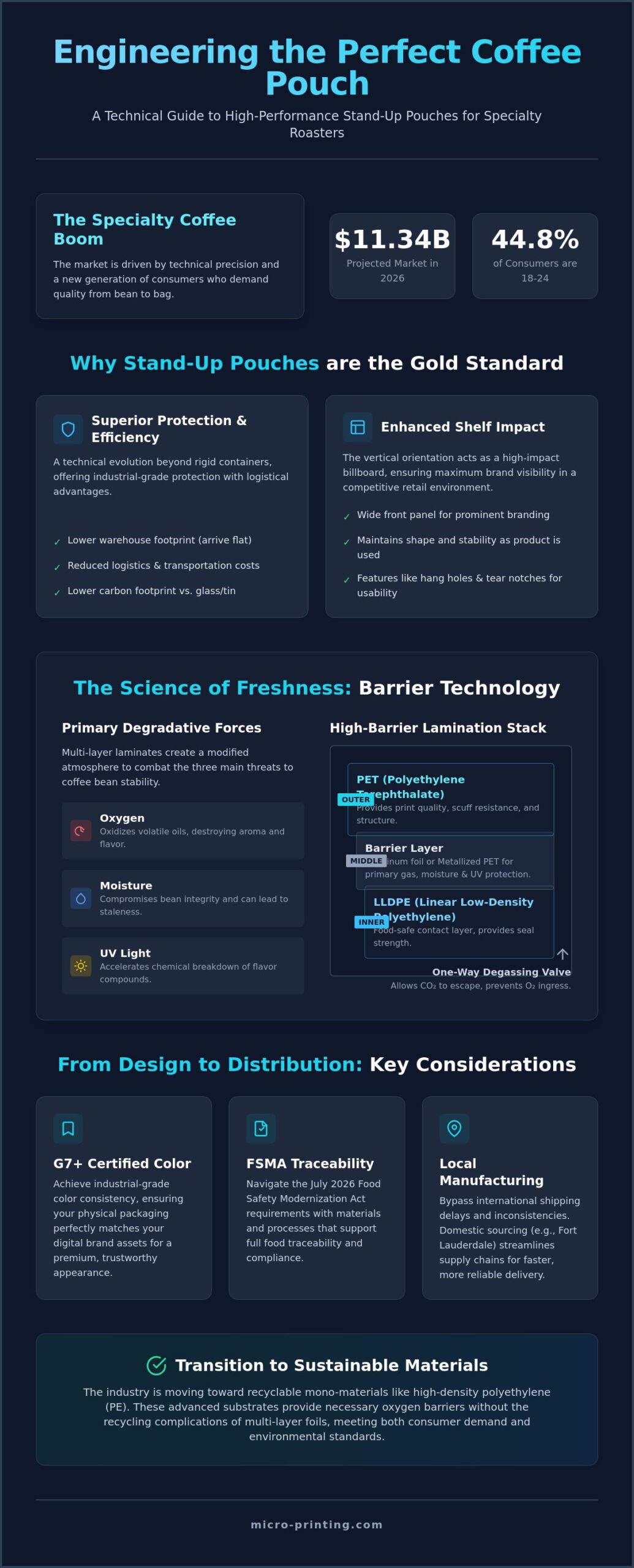
With the specialty coffee market projected to reach $11.34 billion in 2026, the 18-24 age group now accounts for 44.8% of total consumption. This demographic shift places unprecedented pressure on roasters to deliver high-performance, custom stand up pouches for coffee that balance industrial-grade protection with visual precision. You understand that a superior roast is only as good as its barrier technology. If oxygen ingress or moisture compromise the flavor profile before it reaches the consumer, the technical mastery of the roast is lost.
This guide details the engineering requirements and design strategies necessary to command premium shelf space in a competitive market. You’ll learn how to navigate the July 2026 FSMA food traceability requirements and utilize G7+ color standards to ensure your physical packaging matches your digital brand assets exactly. We’ll analyze the transition to recyclable mono-materials and the logistical advantages of domestic sourcing to bypass the inconsistencies and delays associated with overseas lead times.
Key Takeaways
- Analyze why the stand-up pouch format provides superior shelf stability and logistical efficiency for modern roasting operations.
- Discover the technical barrier requirements for custom stand up pouches for coffee to protect beans against oxygen and UV degradation.
- Implement G7-certified color standards to achieve industrial-grade consistency between your digital assets and physical retail packaging.
- Leverage local manufacturing in Fort Lauderdale to streamline supply chains and mitigate the risks of international shipping delays.
- Navigate the transition from structural design to full-scale production as your brand expands from small batches to regional distribution.
Why Stand-Up Pouches Are the Gold Standard for Coffee Packaging
The stand-up pouch (SUP) represents the technical evolution of flexible packaging, characterized by its gusseted bottom that allows the unit to remain upright without external support. For roasters, transitioning to custom stand up pouches for coffee isn’t just a branding choice; it’s a decision based on volumetric efficiency and product protection. Rigid formats like glass jars or tin canisters require significantly more storage space and energy to transport. In contrast, flexible pouches arrive flat, reducing warehouse footprint and logistics costs. By 2026, market expectations have shifted toward more functional designs. Consumers prioritize resealable, lightweight formats that maintain freshness long after the initial seal is broken. The SUP format meets these demands while providing a superior barrier against environmental contaminants.
Retail Performance and Shelf Visibility
The vertical orientation of a pouch serves as a high-impact billboard on the retail shelf. Unlike traditional side-gusseted bags that often slump or hide branding on the narrow side panels, stand-up pouches present a wide, flat front panel for maximum graphic visibility. This structural stability ensures that your brand remains prominent even as the product is consumed and the internal weight shifts. Precision in sizing is critical. A pouch that’s too large for its contents looks deflated, while one that’s too small risks seam failure. We integrate features like hang holes for pegboard displays and tear notches for accessible opening, ensuring the packaging performs at every touchpoint of the retail journey.
Sustainability and Material Footprint
Industrial roasting operations are increasingly scrutinized for their environmental impact. The 2026 specialty coffee market, valued at approximately $11.34 billion, demands transparency in material sourcing. Custom stand up pouches for coffee offer a lower carbon footprint than rigid alternatives because they require less energy to manufacture and transport. The industry is moving toward recyclable mono-materials, such as high-density polyethylene (PE), which provide the necessary oxygen barriers without the recycling complications of traditional multi-layer foils. Micro Printing prioritizes these advanced substrates, ensuring that structural integrity isn’t sacrificed for environmental compliance. This approach allows roasters to meet FSMA food traceability standards while reducing their overall material footprint through precise engineering and waste-reduction protocols.
The Science of Freshness: Barrier Films and Degassing Valves
Freshness in the specialty coffee sector is defined by chemical stability. Once roasting is complete, the beans face three primary degradative forces: oxygen, moisture, and ultraviolet (UV) light. Oxygen is the most aggressive, triggering the oxidation of volatile oils that give coffee its unique aroma and flavor profile. High-performance custom stand up pouches for coffee address these threats through sophisticated material engineering. By utilizing multi-layer laminates, roasters can achieve near-zero transmission rates, ensuring that the product remains in a modified atmosphere from the moment of sealing until it reaches the consumer’s grinder.
One-Way Degassing Valves Explained
Freshly roasted coffee releases significant volumes of carbon dioxide (CO2). If this gas isn’t managed, internal pressure will cause the package to swell or rupture. One-way degassing valves are essential components that allow CO2 to escape while preventing oxygen from entering the pouch. For premium roasts, valve integrity is a critical quality control metric. Internal valves offer a cleaner aesthetic for brand designs, while external valves are often used for high-volume industrial applications. We test these components to ensure they resist clogging from coffee particulates, which can lead to bag bloat or premature oxidation.
Lamination Layers and Protective Barriers
The structural integrity of a pouch depends on its lamination stack. A standard high-barrier construction for custom stand up pouches for coffee typically involves three functional layers. The outer layer is usually PET (polyethylene terephthalate) for print quality and heat resistance. The middle layer often consists of aluminum foil or metallized PET, providing the primary barrier against light and gas. Finally, the inner layer is LLDPE (linear low-density polyethylene), which provides the seal strength and ensures compliance with FDA regulations for food-contact paper and paperboard.
Choosing between metallized films and clear windows is a strategic trade-off. While windows allow consumers to see the whole bean, they expose the coffee to UV light, which accelerates the degradation of lipids. Oxygen Transmission Rate (OTR) defines the volume of oxygen that penetrates a barrier over a 24-hour period; lower OTR values are essential for maintaining the sensory integrity of specialty coffee over an extended shelf life. Achieving these technical benchmarks requires a partner who understands the intersection of material science and industrial production. If you’re looking to optimize your packaging’s barrier performance, Micro Printing provides the technical expertise to select the right laminate for your specific roast profile.
Custom Design and Color Precision: The G7 Standard
Visual identity is the primary driver of consumer trust in the specialty coffee sector. If the color of your packaging varies between batches, it suggests a lack of control over the product quality inside. For roasters producing high-volume custom stand up pouches for coffee, achieving chromatic accuracy across every production run is a technical necessity. This is where the G7 standard becomes indispensable for maintaining professional brand integrity.
G7 is a methodology for ensuring visual consistency across different printing systems. It focuses on gray balance and tonal reproduction rather than just ink density. By adhering to the G7 industry-leading set of specifications, we eliminate the variables that cause color shifts on flexible substrates. In 2026, the G7+ standard provides even higher precision for high-density printing systems. This ensures that your brand’s signature palette remains uniform regardless of the material used or the production volume required.
We utilize Heidelberg presses to achieve this level of industrial fidelity. These machines are engineered for precision, allowing for micro-adjustments in ink distribution that standard digital printers can’t match. While CMYK process printing handles photographic elements, premium coffee brands often require spot colors. Spot colors use pre-mixed inks for specific Pantone shades, ensuring a level of saturation and accuracy that process printing can’t replicate. This level of technical control is what separates retail-ready packaging from amateur attempts.
Achieving Brand Consistency Across Mediums
Roasters don’t just exist on the retail shelf. Your visual identity must translate seamlessly from your pouches to your commercial printing services florida, including catalogs and promotional brochures. Printing on non-porous flexible films presents unique technical challenges compared to standard paper stocks. Ink absorption and drying times differ significantly between substrates. G7 certification allows us to manage these variables systematically. This ensures that a multi-SKU product line maintains a cohesive look across all touchpoints.
Advanced Finishing Techniques for 2026
Texture is as important as color in the premium packaging market. Matte finishes reduce glare and provide a sophisticated, organic feel that resonates with modern consumers. Gloss finishes, conversely, enhance color vibrancy and maximize shelf presence. For limited edition roasts, spot UV and foil stamping add tactile depth that commands attention. Soft-touch coatings are increasingly popular for custom stand up pouches for coffee. They offer a velvet-like texture that enhances the consumer’s unboxing experience. These finishes aren’t just decorative; they’re functional tools used to differentiate your product in a saturated market.
Sourcing Custom Coffee Packaging in Fort Lauderdale
Regional supply chains provide a strategic buffer against global volatility. For roasters in South Florida, sourcing custom stand up pouches for coffee locally isn’t just a matter of convenience; it’s a risk mitigation strategy. By July 2026, the logistics landscape favors partners who offer immediate technical support and physical oversight. Florida’s tax structure supports this industrial focus. While the city implemented a 5% increase in the Local Business Tax for the 2026-2027 renewal period, the absence of state income tax continues to foster a robust manufacturing sector. Roasters can leverage the 7% combined sales tax rate in Broward County while significantly reducing the freight expenditures associated with long-haul shipping.
Local manufacturing allows for physical proofing, which is essential for maintaining the G7 color standards discussed previously. Digital proofs often fail to capture how ink interacts with specific laminates like PET or metallized films. By visiting our Fort Lauderdale facility, roasters can approve physical press samples, ensuring that the final production run meets their exact specifications. This level of oversight eliminates the “color drift” common in overseas production, where distance prevents real-time adjustments. Supporting the Florida business ecosystem also ensures that your packaging partner understands the specific humidity and environmental factors that impact coffee storage in the subtropics.
Logistics and Supply Chain Reliability
International shipping remains unpredictable in 2026. Partnering with a local facility allows for just-in-time inventory management, which is critical for seasonal releases and limited-edition roasts. This proximity is particularly vital given the FDA’s Food Safety Modernization Act (FSMA) Food Traceability Rule. With a compliance date of July 20, 2026, for foods on the Traceability List, roasters must maintain rigorous recordkeeping. A local partner facilitates easier data integration and faster response times for audits. Direct communication with our production team ensures that technical requirements for custom stand up pouches for coffee are met without the delays caused by time zone differences or language barriers.
The Micro Printing Advantage in South Florida
Our infrastructure supports rapid prototyping, allowing roasters to move from concept to retail-ready product in a fraction of the time required by international vendors. We integrate your packaging needs with broader growth strategies. For roasters launching subscription models, we coordinate with direct mail marketing companies to streamline the fulfillment of subscription boxes. This holistic approach to production management ensures that your brand identity remains consistent across every physical touchpoint. If you’re ready to secure your supply chain and elevate your brand’s retail presence, Micro Printing offers the industrial capacity and local expertise required for high-volume coffee packaging.
Strategic Packaging Solutions with Micro Printing
Micro Printing functions as a stable, high-capacity partner for roasters navigating the complexities of large-scale retail distribution. While the technical requirements for custom stand up pouches for coffee are demanding, our role extends beyond mere manufacturing. We provide a systems-level approach that manages the entire workflow from structural engineering to final industrial execution. This ensures that as your roasting volume grows, your packaging infrastructure remains a predictable and scalable asset rather than a logistical bottleneck.
Our facility utilizes state-of-the-art Heidelberg technology to maintain the G7-certified precision required for national brand recognition. This infrastructure allows us to support roasters at every stage of their development. Whether you’re launching a regional pilot or managing a national rollout, our production schedules are designed for industrial efficiency. We prioritize measurable quality and technical readiness to ensure that every pouch meets the rigorous barrier specifications necessary for specialty-grade beans. Our partnership-first approach means we don’t just deliver a product; we provide the technical background and infrastructure to prove your brand’s quality.
Beyond the Pouch: Holistic Brand Support
A cohesive brand presence requires more than just high-performance bags. To command premium shelf space and maintain consumer loyalty, your visual identity must be consistent across all physical media. We offer integrated production services that align your primary packaging with your broader marketing strategy. This comprehensive management of your brand’s physical footprint reduces the administrative burden of juggling multiple vendors and ensures chromatic uniformity across disparate substrates. Our capabilities include:
- Coordination with high-quality catalogs to showcase your full product range to wholesale partners and distributors.
- Production of custom labels for seasonal or micro-lot offerings that require shorter, more flexible runs without sacrificing print quality.
- Industrial-grade large format signage for trade show booths, industry events, and flagship retail locations.
Get Started with Your Custom Coffee Project
Initiating a high-volume packaging project requires a structured approach to ensure technical accuracy. Our consultation process begins by defining your specific barrier needs based on your roast profiles and expected shelf life. We provide technical dielines and structural templates to your design team, ensuring that artwork is optimized for the stand-up pouch format and our high-fidelity presses. This proactive management prevents errors during the transition from digital design to physical production.
To move forward with a custom stand up pouches for coffee project for the 2026 production cycle, we recommend a methodical start. Submit your volume requirements and barrier specifications for a technical review by our engineering team. You can request material samples to verify the tactile quality and seal integrity of our laminates before committing to a full run. For complex orders, we encourage scheduling a physical proofing session at our Fort Lauderdale facility to finalize color targets and ensure your brand’s integrity is maintained at every level of production.
Securing Your Brand’s Retail Future in 2026
Professional coffee packaging requires a rigorous fusion of material science and chromatic precision. You’ve seen how high-performance barrier films and one-way degassing valves are essential for protecting roast integrity against environmental degradation. Adhering to G7-certified color standards ensures that your custom stand up pouches for coffee maintain a consistent visual identity. This consistency is what commands consumer trust on the retail shelf and differentiates your brand in a competitive specialty market.
Micro Printing provides the industrial capacity and technical oversight necessary to scale your roasting operation. With over 35 years of South Florida printing expertise and state-of-the-art Heidelberg presses, we ensure that every production run meets the highest benchmarks of industrial fidelity. Don’t leave your brand’s physical presence to chance or unpredictable overseas logistics. Request a Custom Packaging Quote from Micro Printing to secure your supply chain and elevate your product’s shelf presence. Your roast deserves a technical partner that understands the high stakes of professional distribution.
Frequently Asked Questions
What is the best material for custom coffee pouches to ensure freshness?
High-barrier multi-layer laminates are the industrial standard for preserving specialty coffee. These constructions typically feature an outer PET layer for high-fidelity printing, a middle layer of aluminum foil or metallized PET for light and gas protection, and an inner LLDPE layer for secure heat sealing. This stack ensures near-zero oxygen transmission rates, which is essential for protecting the volatile oils and aromatic compounds that define your roast’s flavor profile.
Do I really need a degassing valve for my coffee bags?
One-way degassing valves are non-negotiable for freshly roasted whole beans. Coffee releases significant volumes of carbon dioxide after roasting; without a valve, this internal pressure can cause the package to swell or rupture. The valve allows CO2 to escape while preventing oxygen from entering the pouch and triggering oxidation. Omitting this component compromises both the structural integrity and the shelf life of your custom stand up pouches for coffee.
What are G7-certified color standards and why do they matter for packaging?
G7-certified color standards are a set of technical specifications used to achieve visual consistency across different printing platforms and substrates. Unlike traditional methods that focus on ink density, G7 prioritizes gray balance and tonal reproduction. This ensures that your brand’s signature colors remain uniform whether they’re printed on flexible films or paper catalogs. For professional roasters, this certification is the primary indicator of batch-to-batch quality and brand integrity.
How do stand-up pouches compare to traditional coffee bags in shipping costs?
Stand-up pouches offer significant logistical advantages over traditional rigid packaging and heavy side-gusseted bags. Their lightweight, flexible construction reduces the overall tare weight of each shipment, directly lowering freight expenditures. Because they ship flat to your facility, they also require less warehouse space. In a retail setting, their vertical stability allows for more units to be displayed per shelf inch, optimizing your return on shelf-space investment.
Can I use eco-friendly or recyclable materials for my custom coffee pouches?
Recyclable mono-materials, specifically high-density polyethylene (PE), are the leading sustainable option for the 2026 coffee market. These advanced substrates provide the necessary moisture and oxygen barriers while remaining compatible with standard recycling streams. While traditional multi-layer foils are difficult to process, modern material science allows roasters to meet environmental mandates without sacrificing the protective qualities required to maintain the sensory integrity of specialty beans.
What is the typical lead time for custom printed coffee pouches in Fort Lauderdale?
Lead times for locally manufactured pouches in Fort Lauderdale are significantly shorter than international alternatives, typically ranging from two to four weeks. By sourcing your custom stand up pouches for coffee from a local facility, you bypass the unpredictability of international freight and customs delays. This proximity supports just-in-time inventory management, allowing roasters to respond quickly to seasonal harvest changes and market demands.
What size stand-up pouch do I need for 12oz or 1lb of coffee beans?
A standard 12oz whole bean roast generally requires a pouch measuring approximately 6 inches by 9 inches with a 3-inch bottom gusset. For a 1lb (16oz) capacity, the industrial standard is closer to 7 inches by 11.5 inches with a 4-inch gusset. These dimensions provide enough headspace for the one-way degassing valve to function effectively while ensuring the pouch remains stable and upright on a retail shelf.
Can Micro Printing help with the structural design of my coffee packaging?
Micro Printing provides comprehensive structural support to ensure your packaging meets both aesthetic and technical requirements. We supply precise dielines and assist in selecting the optimal laminate stack based on your specific roast profile and distribution environment. Our team manages the entire workflow from initial prototyping to high-volume production on our Heidelberg presses, ensuring that your packaging is engineered for industrial performance and retail success.