
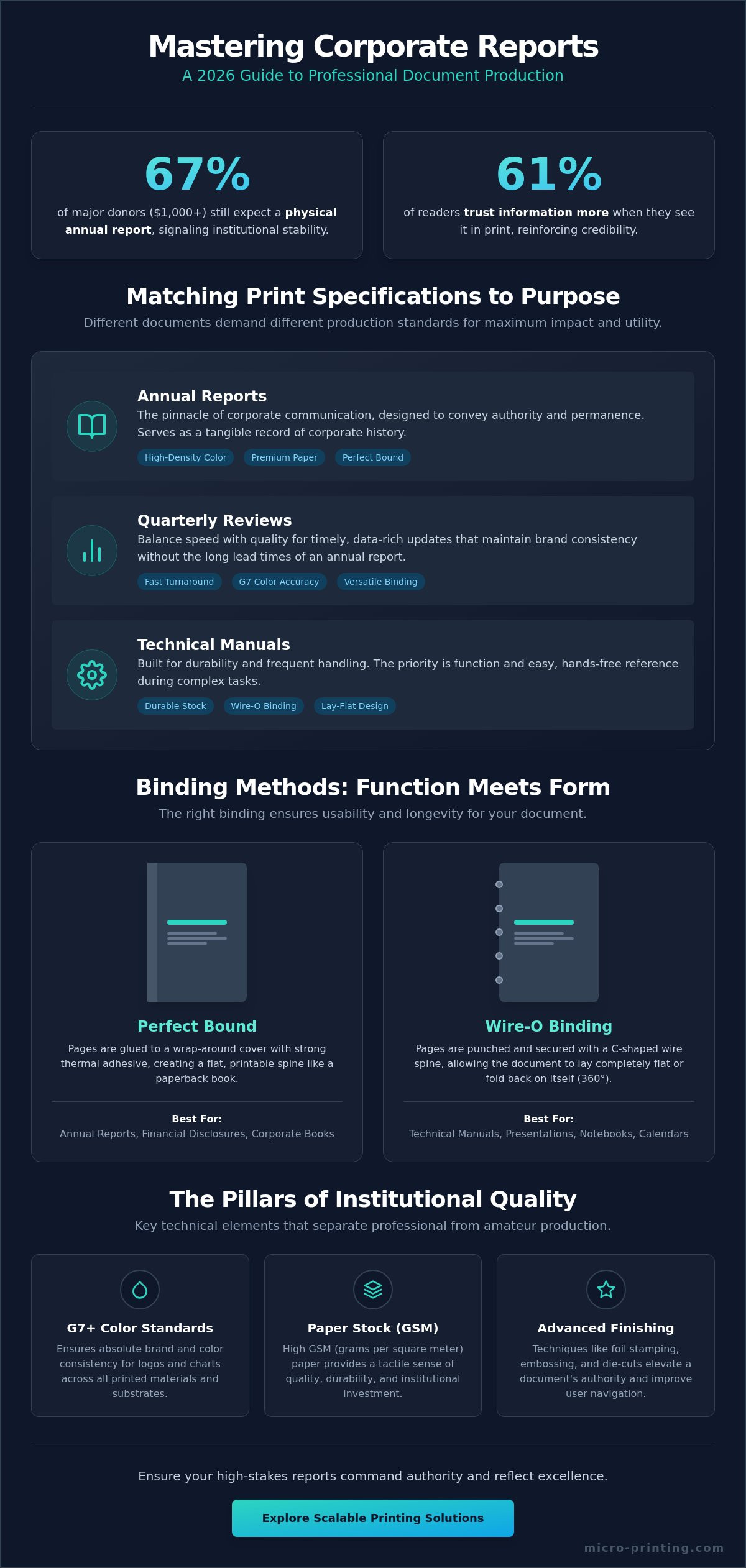
Did you know that 67% of major donors still expect a physical annual report when contributing $1,000 or more? In an era dominated by digital noise, the tangible weight of professional booklet printing for reports remains a primary marker of institutional stability and respect for stakeholders. You likely recognize that a high-stakes report is more than a data summary. It’s a physical extension of your brand’s integrity. The fear of seeing inaccurate colors in a financial chart or missing a critical shareholder mailing deadline is a risk no executive should have to manage.
This 2026 guide will show you how to master the technical nuances of production to ensure your corporate documents command authority and reflect institutional excellence. You’ll learn how to utilize the new G7+ color standards for absolute brand consistency across all substrates. We’ll also clarify the functional differences between Perfect Bound and Wire-O systems to match your document’s specific purpose. Finally, we’ll address the latest 2026 environmental reporting regulations and Extended Producer Responsibility laws to keep your distribution seamless and compliant.
Key Takeaways
- Understand why physical documents remain the benchmark for board reviews and how tactile quality directly influences the perception of institutional stability.
- Identify the ideal binding method, such as Perfect Bound or Wire-O, to ensure your professional booklet printing for reports meets specific functional and aesthetic requirements.
- Learn how G7-certified color standards and precise paper weight selection eliminate common printing errors in financial charts and corporate branding.
- Discover how premium finishing techniques like foil stamping and die-cut tabs can elevate the authority of your document while improving user navigation.
- Explore how to leverage industrial-scale press technology and integrated distribution to manage high-volume shareholder mailings with total precision.
The Strategic Importance of Professional Booklet Printing for Reports
Digital fatigue has reached a critical threshold in corporate environments. While electronic files offer convenience, they lack the permanence and gravitas required for high-stakes institutional communication. In 2026, the decision to utilize professional booklet printing for reports is a deliberate signal of stability. A physical document commands a specific type of attention that a screen cannot replicate; it occupies space on a boardroom table and remains accessible long after a browser tab is closed.
The transition from “copy shop” output to industrial-grade production is immediately apparent to the touch. Standard office printers often produce documents with inconsistent margins, flimsy paper, and toner that flakes at the fold. In contrast, commercial-grade production uses precision calibration and heavy-duty substrates. This technical superiority ensures that your financial data and strategic goals are presented with the clarity they deserve. When stakeholders hold a report with a high-GSM (grams per square meter) cover and crisp, offset-quality imagery, they’re subconsciously evaluating the organization’s attention to detail and resource management.
Institutional Credibility Through Tangible Media
Trust is a primary currency in B2B relationships. Research indicates that 61% of readers trust information more when they see it in print. For annual reports or shareholder reviews, this trust is non-negotiable. A physical report acts as a permanent record of corporate history, providing a tangible archive that digital formats can’t reliably match over decades. High-quality production values reinforce the message that the contents are vetted, accurate, and significant. It’s about creating an “artifact of authority” that reflects the scale of the institution behind the data.
Defining Your Report’s Purpose and Audience
Precision in printing requires a deep understanding of the document’s lifecycle. A public-facing annual report requires different specifications than an internal technical manual. You must consider the “hand-off”—how the document will be used, stored, and shared. For instance, a report intended for a single board presentation might prioritize high-gloss aesthetics, while a reference manual needs durability for frequent handling. Selecting the appropriate bookbinding methods is essential here; it determines whether the report stays intact after multiple uses or lays flat for easy note-taking. Balancing these functional needs with visual excellence ensures that the investment in professional booklet printing for reports translates into long-term utility and brand prestige.
- Annual Reports: Require high-density colors and “Perfect Bound” spines for a book-like finish.
- Quarterly Reviews: Often benefit from faster turnaround times without sacrificing G7 color accuracy.
- Technical Manuals: Prioritize Wire-O binding to allow for 360-degree page rotation and hands-free use.
Comparing Binding Options for Professional Corporate Reports
The selection of a binding method is a structural decision that dictates how a stakeholder interacts with your data. It’s not merely an aesthetic choice; it’s a functional requirement that ensures your document remains intact and legible throughout its lifecycle. When executing professional booklet printing for reports, the binding must align with both the page count and the intended environment of use. Choosing the wrong mechanical finish can lead to cracked spines or pages that won’t stay open during a critical board presentation.
The physical properties of the sheets, which are established during paper manufacturing and finishing, play a significant role in how well a binding holds. For instance, heavier coated stocks require different adhesives and mechanical punches than lighter uncoated papers. Understanding these technical intersections is what separates institutional-grade production from standard office output.
Perfect Bound: The Executive Choice
Perfect binding is the industry standard for high-stakes documents like annual financial disclosures and ESG reports. This method involves collating the pages into a block and adhering them to a wrap-around cover using a strong, flexible thermal glue. This creates a flat, printable spine that allows for brand visibility when the report is stored on a shelf. For a successful perfect bound finish, your report typically needs a minimum of 36 to 40 pages to provide enough surface area for the adhesive to secure the spine effectively. It’s the format that most closely resembles a high-end book, conveying a sense of permanence and authority that other methods can’t match.
Wire-O Binding for Functional Reports
If your report serves as a reference guide or a training manual, functionality often outweighs the need for a book-like spine. Wire-O binding uses a continuous series of twin-loop metal wires that pass through punched holes in the document. This allows for 360-degree rotation, meaning the report can lay perfectly flat on a desk or be folded back on itself without damaging the integrity of the pages. While plastic coil is an option for internal drafts, professional booklet printing for reports in a B2B context almost exclusively utilizes metal twin-loop wire for its superior durability and sophisticated industrial look. It’s the ideal choice for technical documentation that will be handled frequently by multiple users.
For shorter updates or quarterly brochures that don’t require a heavy spine, saddle-stitching remains a cost-effective and professional alternative. This method uses staples along the fold line and is perfect for documents under 32 pages. If you aren’t sure which mechanical finish suits your current page count, you can explore specialized booklet production services to see how different bindings handle various paper weights and volumes.
- Perfect Bound: Best for 40+ pages; provides a printable spine and maximum prestige.
- Wire-O (Twin Loop): Best for manuals; allows 360-degree rotation and flat positioning.
- Saddle-Stitch: Best for quarterly updates; efficient and professional for low page counts.
- Plastic Coil: Generally reserved for internal use or educational workbooks where high-end aesthetics are less critical.
Technical Precision: Paper Stocks, G7 Color, and Ink Quality
Precision in professional booklet printing for reports extends beyond the mechanical binding to the microscopic level of ink placement and paper fiber. When stakeholders review financial charts or complex infographics, they expect absolute clarity. Any deviation in color density or text sharpness can undermine the perceived accuracy of the data itself. High-fidelity production relies on industrial-scale technology, such as Heidelberg presses, which maintain the registration required to keep 6-point type crisp and legible. This level of technical execution ensures that your footnotes and fine-print disclosures remain professional and accessible.
The G7 Difference in Data Visualization
Corporate identity depends on visual consistency across every medium. If your strategic heat maps or branding elements vary in hue between the screen and the page, it creates a sense of institutional misalignment. Implementing a rigorous G7 color calibration process ensures that ink density and gray balance remain stable throughout a high-volume print run. G7+ certification represents the 2026 global benchmark for ensuring tonality and gray balance across diverse print technologies and substrates. This mathematical approach to color management eliminates the guesswork, ensuring that your corporate blue remains identical across every copy delivered to shareholders.
Paper Selection for Durability and Feel
The tactile experience of a report often dictates the reader’s initial impression of corporate health. Selecting the right paper weight involves a balance between interior “text-weight” sheets and heavy-duty “cover stocks.” For professional booklet printing for reports, a 100lb cover stock provides the necessary rigidity to protect the document, while 80lb or 100lb text interiors offer the opacity needed to prevent “show-through” on double-sided pages. You must also consider the finish based on the document’s content:
- Matte Finish: The preferred choice for data-heavy reports; it eliminates glare and makes long-form text easier to read under office lighting.
- Gloss Finish: Ideal for high-impact photography and marketing-heavy brochures, though it can make small figures harder to discern.
- Uncoated Stock: Provides a prestigious, tactile feel that’s easy to write on, often used for interactive workbooks or high-end executive summaries.
In 2026, sustainability is no longer optional. With the full implementation of the EU’s Empowering Consumers for the Green Transition Directive and various state-level EPR laws, your paper choice must reflect environmental responsibility. Modern recycled stocks now offer the same brightness and smoothness as virgin fibers, allowing you to meet compliance standards without sacrificing the professional aesthetic. Adding a “soft-touch” lamination to the cover can further enhance the prestige of the document, providing a velvet-like texture that resists fingerprints during heavy use.
Advanced Finishing Techniques for High-Stakes Reports
The final stage of production is where technical execution meets executive aesthetics. Finishing isn’t merely decorative; it’s a functional layer that ensures your document survives transit and heavy handling during board meetings. Professional booklet printing for reports requires a combination of protective coatings and navigational aids that allow stakeholders to find critical data quickly. When a report is passed between shareholders, the presence of aqueous coating or lamination prevents the degradation of the cover, maintaining the document’s integrity through multiple reviews.
Enhancing the Cover with Specialty Finishes
Specialty finishes create a tactile hierarchy on the page. Spot UV is a common choice for highlighting corporate logos or specific data points on a matte-finished cover. By applying a high-gloss polymer only to certain areas, you create a visual contrast that draws the eye to essential brand elements. For commemorative editions or significant institutional milestones, foil stamping provides a level of prestige that ink alone cannot achieve. This process involves heat-bonding a thin layer of metallic foil to the substrate, creating a reflective, high-end finish. Embossing and debossing further enhance this experience by physically altering the paper’s surface to create a three-dimensional texture that readers can feel as they hold the report.
Functional Finishing for Large Documents
As reports grow in complexity, navigation becomes a primary concern. High-stakes financial disclosures often exceed 100 pages, making index tabs or die-cut dividers essential for usability. These functional additions allow users to jump directly to specific sections like executive summaries or auditor reports without leafing through the entire volume. For organizations operating in the Southeast, leveraging commercial printing services florida provides access to high-volume equipment capable of executing these complex finishes at scale. Lay-flat lamination is another critical consideration for technical handbooks, as it prevents the cover from curling and allows the document to remain open on a desk during reference.
The value of a local partnership becomes clear during the proofing stage. While digital proofs are standard, they cannot convey the true weight of a paper stock or the exact hue of a foil stamp. Conducting a physical proofing session in Fort Lauderdale allows your team to inspect the finishing quality before the full industrial run begins. This step catches minor alignment issues or coating inconsistencies that could undermine the authority of a thousand-copy distribution. Precision at this stage eliminates the risk of costly reprints and ensures your institutional documents reflect absolute excellence.
You can secure these industrial finishes for your next high-stakes project by consulting with professional printing experts who specialize in institutional reporting.
Micro Printing: Scalable Solutions for Professional Report Printing
Production excellence is only half of the equation for institutional reporting. The final technical challenge lies in managing the logistics of high-volume distribution without compromising the document’s integrity. When executing professional booklet printing for reports at an industrial scale, the transition from the press to the recipient must be seamless. Utilizing state-of-the-art Heidelberg presses allows for massive output while maintaining the G7 color standards established in the earlier stages of the project. This industrial capacity ensures that whether you require 500 executive summaries or 50,000 full-length annual reports, the first copy and the last copy remain identical in quality and precision.
Managing large-scale orders also requires sophisticated post-press management. Custom packaging and folding cartons are often necessary to protect high-stakes reports during transit to stakeholders. Without proper structural support, even the most prestigious perfect-bound report can suffer spine damage or corner crushing. A professional partner oversees the entire lifecycle of the document, ensuring that the physical presentation reflects the institutional excellence contained within the data.
Integrated Distribution and Direct Mail
For many corporations, the printing process ends with a pallet of books, but the actual requirement is for those books to reach individual shareholders. Micro Printing manages end-to-end mailing for annual shareholder reports, integrating production directly with targeted distribution. This “print-to-post” model eliminates the risks associated with third-party logistics and reduces the window between production and delivery. Security is a primary concern for sensitive financial mailings. Maintaining HIPAA and data security compliance ensures that shareholder information is handled with the same level of confidentiality as the financial data itself. For organizations planning complex distribution schedules, consulting with specialized direct mail marketing companies provides the necessary infrastructure for reliable campaign execution.
Local Expertise for National Brands
The advantage of a Florida-based facility extends beyond regional convenience. Fort Lauderdale businesses and national brands alike rely on local facilities for rapid turnaround and “on-the-floor” proofing. This physical proximity allows project managers to inspect complex, multi-page booklets during the live run, catching potential issues that digital proofs might obscure. It’s a level of quality control that remote, online-only providers cannot offer. National organizations frequently utilize these local offset printing services to manage their most critical disclosures. By combining industrial-scale machinery with a hands-on approach to quality management, professional booklet printing for reports becomes a predictable, high-performance asset for the modern B2B sector.
Securing Institutional Authority Through Technical Excellence
Institutional credibility in 2026 relies on the precise execution of your physical communications. Mastering the technical nuances of professional booklet printing for reports ensures that your financial disclosures and strategic reviews meet the high expectations of global stakeholders. By selecting the correct binding method and adhering to G7 certified color standards, you eliminate the risks of visual inconsistency and functional failure. Whether you’re managing a local board review or a national shareholder distribution, the quality of your physical document remains a primary indicator of corporate health.
Micro Printing provides the industrial infrastructure required for these high-stakes projects. We utilize state-of-the-art Heidelberg presses and have been family-owned and operated since 1989. Our commitment to G7 standards and scalable logistics allows your organization to move from design to distribution with total confidence. Precision isn’t just an aesthetic choice; it’s a structural requirement for institutional stability.
Request a Professional Quote for Your 2026 Corporate Reports and partner with a team dedicated to technical excellence. Your corporate documents deserve a presentation that reflects your institutional prestige.
Frequently Asked Questions
What is the best binding for a 100-page annual report?
Perfect binding is the industrial standard for reports of this volume. It utilizes a thermal adhesive to create a flat, printable spine that provides the structural integrity required for 100 pages. This method offers a book-like finish that conveys maximum authority during board reviews. If your report needs to lay completely flat for hands-free reference, metal Wire-O binding is the preferred functional alternative for high-page-count documents.
How long does professional booklet printing for reports typically take?
Standard production cycles for professional booklet printing for reports generally range from five to ten business days following final proof approval. This timeline accounts for precision calibration on Heidelberg presses and complex finishing stages like spot UV or die-cutting. High-volume orders involving integrated mailing services may require additional lead time for data processing and postal coordination. Local production in Fort Lauderdale often allows for expedited proofing to maintain these schedules.
Can you match my specific brand colors for charts and graphs?
Yes, we utilize G7 certified color standards to ensure absolute tonality and gray balance across all substrates. This mathematical calibration process eliminates visual variance between your digital files and the physical page. By using high-fidelity ink systems on industrial presses, we maintain the integrity of your corporate palette in complex infographics. This precision is critical for financial reports where color-coded data must remain consistent and legible for stakeholders.
What is the difference between saddle-stitch and perfect binding?
Saddle-stitching uses industrial staples along the fold line and is most effective for reports under 40 pages. It’s a cost-efficient solution for quarterly updates or shorter brochures. Perfect binding involves adhering the page block to a wrap-around cover with a flexible adhesive, creating a professional spine. This method is reserved for thicker documents where a prestigious, book-style appearance is required for institutional credibility.
Do you offer eco-friendly paper options for corporate sustainability reports?
We provide a range of recycled and FSC-certified paper stocks that meet 2026 environmental compliance standards. These materials allow organizations to fulfill their corporate social responsibility goals without sacrificing the tactile quality of the document. Our facility stays current with Extended Producer Responsibility (EPR) laws and recyclability labeling requirements. This ensures your sustainability reports are physically responsible and legally compliant with the latest “greenwashing” regulations.
Can you handle the mailing and distribution of our reports to shareholders?
Our facility manages the entire lifecycle of your document from the press to the recipient’s mailbox. We offer integrated distribution services, including targeted direct mail and Every Door Direct Mail (EDDM) options. Our data management systems are designed for security and precision, handling sensitive shareholder information with institutional-grade confidentiality. This end-to-end approach reduces logistics risks and ensures your reports reach stakeholders according to your specific meeting deadlines.
What file format is best for submitting a report for professional printing?
The industrial standard for submission is a high-resolution, press-ready PDF. Files should be exported in the CMYK color space with a minimum resolution of 300 DPI for all imagery and charts. It’s essential to include a 0.125-inch bleed on all sides and clearly defined crop marks to ensure precision during the trimming process. Submitting files in this format prevents font substitution errors and maintains the intended layout of your technical data.
Is there a minimum order quantity for custom booklet printing?
We specialize in scalable B2B production, focusing on orders that leverage the efficiency of our industrial equipment. While we can accommodate smaller executive runs for board meetings, the maximum cost-efficiency for professional booklet printing for reports is typically reached at 250 to 500 copies. Our infrastructure is built to handle high-volume demands, allowing us to scale production up to 50,000 units while maintaining rigorous quality control across the entire run.