
In an era where digital noise has reached total saturation, a brand’s physical presence is no longer just a marketing choice; it’s a primary indicator of corporate stability. You’ve likely noticed how easily a pixelated logo or a flimsy brochure can undermine years of digital reputation management. When colors shift across different packaging or materials feel substandard, it signals a lack of operational control that customers instinctively distrust. Building customer trust with quality printing requires more than just ink on paper. It demands a commitment to technical precision and a systematic approach to brand consistency across every physical touchpoint.
This guide examines how high-fidelity printing and rigorous color management transform brand perception from a mere service provider into a reliable partner. We’ll explore the strategic implementation of G7+ standards to ensure visual uniformity and the role of premium tactile experiences in fostering long-term loyalty. By focusing on industrial-grade accuracy and the complex logistics of full-process management, you can establish an authoritative presence that resonates throughout 2026’s competitive market.
Key Takeaways
- Learn how the tactile weight and permanence of commercial print provide a cognitive trust signal that digital marketing lacks in a saturated landscape.
- Understand why G7 Master Status and color precision are critical for building customer trust with quality printing by maintaining brand integrity across all physical touchpoints.
- Discover how specialized finishing and structural design in folding cartons establish an immediate sense of sensory brand authority during the unboxing experience.
- Explore strategies for using brochures, catalogs, and targeted direct mail as high-value tools to foster long-term loyalty and deep industry expertise.
- Gain insights into the operational benefits of full-process manufacturing and technical expertise for ensuring consistent, large-scale production quality.
The Psychology of Tangibility: Why Print Builds Trust in a Digital Age
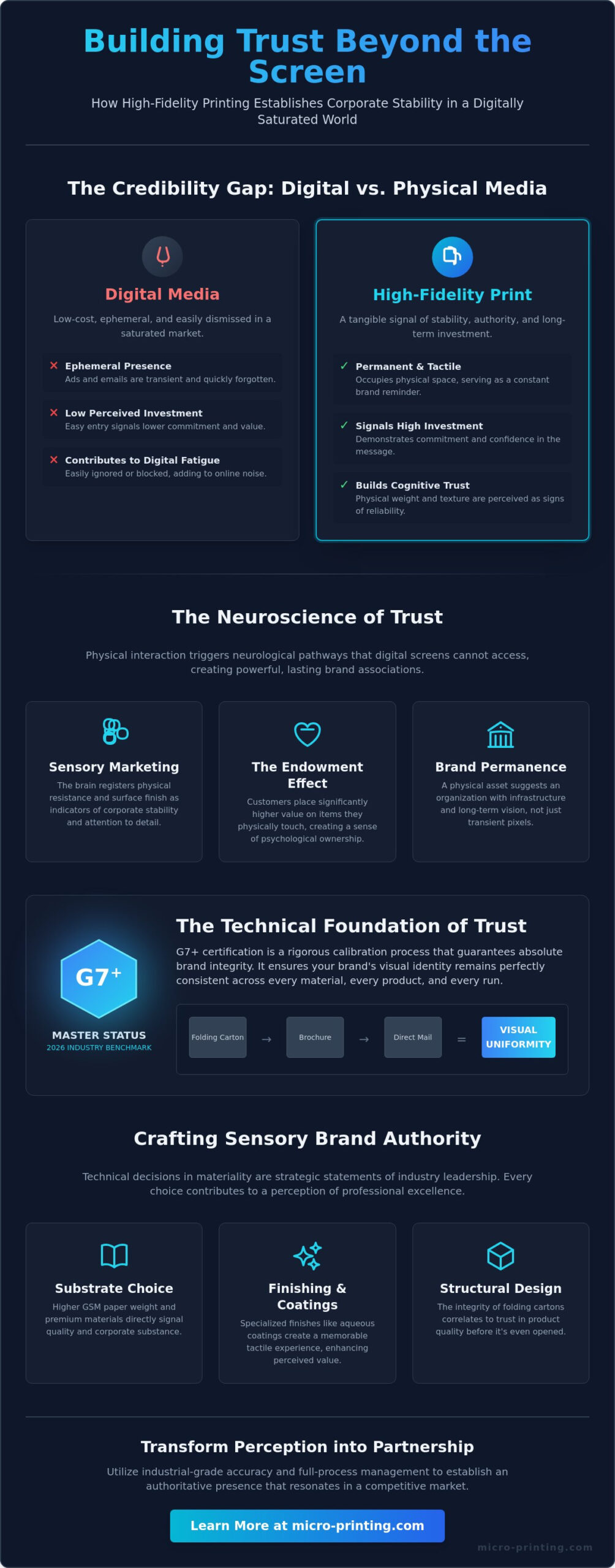
Sensory marketing isn’t a vague concept; it’s a measurable cognitive response. Physical weight and texture trigger neurological pathways that digital screens cannot access. When a potential partner holds a heavy, high-fidelity brochure, their brain registers the physical resistance and surface finish as indicators of corporate stability. This tactile feedback creates a foundation for building customer trust with quality printing by providing concrete evidence of a brand’s attention to detail. Technical precision in the physical world translates directly to perceived reliability in professional services.
Digital fatigue has reached a tipping point in 2026. Online advertisements and emails are perceived as ephemeral and easily discarded. In contrast, high-quality commercial printing represents permanence. A physical booklet or presentation folder occupies space on a desk, serving as a persistent reminder of a brand’s presence. This physical footprint acts as a proxy for brand stability. It suggests that the organization possesses the infrastructure and long-term vision to produce tangible assets, rather than existing solely as a series of transient pixels.
Behavioral economics identifies this as the “Endowment Effect.” Research suggests that customers place a significantly higher value on items they physically touch and hold. A well-constructed catalog or booklet creates a sense of psychological ownership that a digital link never will. By delivering a physical asset, you’re not just providing information; you’re providing a tangible piece of the brand that the customer can keep, reference, and trust.
The Credibility Gap: Digital vs. Physical Media
Physical media carries an inherent authority because the production process requires significant technical and financial investment. In an environment where anyone can launch a digital campaign in minutes, the commitment required to produce high-end catalogs or targeted direct mail signals that the content has been vetted and refined. You show customers you value the interaction enough to invest in a physical medium. Tactile media provides a definitive trust signal in a market saturated by low-cost digital alternatives.
Establishing Brand Authority Through Materiality
Substrate choice is a technical decision with strategic consequences. A higher GSM paper weight or a specific aqueous coating isn’t just an aesthetic preference; it’s a statement of industry leadership. For brands utilizing folding cartons, the structural integrity of the packaging directly correlates to the customer’s trust in the product’s safety and quality. If the packaging feels robust and precise, the contents are assumed to be of equal caliber.
To maintain this authority, technical standards like the G7 Method are essential for ensuring that these materials meet industrial-grade benchmarks for color accuracy. Catalogs bridge the gap between browsing and high-value purchasing by providing a detailed, sensory-rich environment that encourages deeper engagement. This methodical approach to materiality ensures that every physical touchpoint reinforces a perception of professional excellence and operational maturity.
Technical Standards: How G7 Certification Guarantees Brand Integrity
Trust is built through repeatability. G7 Master Status isn’t a mere badge; it’s a rigorous calibration process that defines the modern standard for visual consistency. It ensures that your brand identity remains constant across diverse substrates. Building customer trust with quality printing depends on this technical uniformity. When a client sees your folding cartons in a retail environment and later receives your targeted direct mail, the color profiles must be identical. The updated G7+ specification, which became the industry benchmark by June 2026, builds upon classic standards to work seamlessly with all modern printing technologies, ensuring that visual appearance remains neutral and balanced regardless of the material used.
The psychology of stuff and things suggests that physical objects become extensions of brand identity. If those objects are visually inconsistent, the brand’s perceived “self” appears fractured. This signals a lack of attention to detail that can be fatal in precision-reliant industries. Inconsistent brand colors across booklets or presentation folders suggest an operational instability that customers instinctively avoid. Technical precision in the pressroom is the only way to bridge this visual trust gap.
The Science of Color Consistency
G7 focuses on gray balance and visual appearance rather than just ink density. This methodology allows for a shared neutral appearance across different printing technologies, from digital to offset. In the medical sector, where precision is a matter of professional safety, “close enough” color is unacceptable. Retailers also rely on this consistency to prevent products from appearing like cheap imitations. Utilizing a G7-certified partner in Fort Lauderdale provides the technical framework necessary for this level of reliability, ensuring that your corporate colors remain stable across calendars, flyers, and postcards.
Equipment and Precision in 2026
Modern offset printing services now rely heavily on automated color control systems. State-of-the-art Heidelberg presses use integrated spectrophotometry to monitor ink levels in real-time. This prevents the “counterfeit” look often associated with low-quality, inconsistent copies. High-fidelity printing ensures that every piece in a 50,000-unit run of catalogs, brochures, or presentation folders matches the approved proof. Rigorous equipment maintenance protocols and calibrated ink-key settings are the primary drivers of final output reliability in high-volume industrial environments. If you require this level of technical assurance, consulting with an expert commercial printer is the first step toward securing your brand’s physical integrity.
- Gray Balance: Ensures neutral tones remain consistent across all media.
- Automated Control: Real-time adjustments on Heidelberg presses prevent color drift.
- Visual Uniformity: Connects disparate touchpoints like folding cartons and direct mail.
Sensory Brand Authority: The Role of Finishing and Materiality
High-fidelity printing provides the visual foundation, but the finishing process delivers the final proof of corporate caliber. Industrial finishing isn’t a decorative afterthought; it’s a critical layer of brand protection and sensory validation. When a recipient interacts with a physical asset, the transition from visual observation to tactile engagement is where trust is solidified. Building customer trust with quality printing requires a methodical approach to these “first-touch” experiences. A brand that invests in specialized finishing techniques demonstrates a level of operational control and attention to detail that digital-only competitors cannot replicate.
Tactile Trust: UV Coating and Foil Stamping
Surface treatments serve both functional and psychological purposes. Aqueous coatings provide a necessary protective barrier against scuffing during distribution, while Spot UV creates a high-contrast interplay between matte and gloss surfaces. This contrast directs the eye and the hand to specific brand elements, reinforcing key information through physical sensation. Foil stamping remains a definitive marker of authority in the luxury and medical sectors. It suggests a brand that doesn’t cut corners. For presentation folders, selecting the correct finish ensures a professional hand-off that maintains its structural and visual integrity throughout the client relationship. These technical choices aren’t just about aesthetics; they’re about demonstrating a commitment to excellence that persists long after the initial meeting.
Structural Reliability in Custom Packaging
Structural design is the primary foundation of trust in the logistics chain. If a folding carton fails to protect its contents or feels flimsy upon arrival, the perceived value of the product drops instantly. Precision die-cutting and custom engineering ensure that packaging performs exactly as intended, providing a secure and deliberate unboxing experience. In 2026, material selection has become a transparent indicator of brand values. Utilizing corrugated boxes and labels that comply with the latest environmental standards is critical for building customer trust with quality printing. This includes adhering to phenol-free regulations for thermal papers, which became effective in Washington State on January 1, 2026, and preparing for the EUDR legislation coming at the end of the year.
A brand’s ability to navigate these complex material requirements while maintaining high-end finishing standards signals a sophisticated supply chain. When a customer encounters a folding carton that is both structurally sound and aesthetically superior, they instinctively trust the product inside. This alignment of physical strength and visual precision establishes a baseline of reliability that fosters long-term loyalty in the retail and commercial space.
- Foil Stamping: Signals high-end authority and prevents visual counterfeiting.
- Spot UV: Enhances tactile engagement and highlights critical brand information.
- Structural Integrity: Ensures packaging survives the supply chain without compromising the unboxing experience.
- Regulatory Compliance: Demonstrates commitment to safety and environmental standards through material transparency.
Strategic Implementation: Using Quality Print to Close the Trust Gap
Strategy in 2026 requires a shift from passive production to active, high-impact deployment. Building customer trust with quality printing occurs when the physical medium matches the strategic intent of the brand. High-fidelity catalogs and booklets serve as authoritative educational tools. They don’t just list products; they demonstrate industry expertise through technical diagrams and high-resolution imagery. This creates a deep-seated perception of competence that digital links cannot achieve. When information is presented in a permanent, professionally bound format, it carries a weight of evidence that suggests the brand is a stable, long-term market participant.
Every Door Direct Mail (EDDM) remains a primary tool for building local neighborhood trust. By delivering a high-quality physical asset to every household in a specific area, a business establishes a non-intrusive but undeniable presence. This systematic approach to local outreach validates the brand’s commitment to the community. It provides a tangible touchpoint that residents can reference, which is far more effective for local service providers than transient digital ads that disappear after a single scroll.
Direct Mail as a Trust-Building Channel
Direct mail isn’t junk mail when it’s executed with technical precision. High-quality postcards and presentation folders feel like personal invitations. They bypass the digital “spam” filters of the human brain because the recipient recognizes the physical investment required to reach them. Trust ratings for physical mail remain high because the medium itself signals relevance and respect for the recipient’s time. Partnering with experienced direct mail marketing companies in Fort Lauderdale ensures that list procurement and targeting are handled with technical accuracy. This reduces waste and ensures that your message reaches an audience that actually values the interaction.
Consistent Environments with Large Format Signage
Consistency must extend to the physical environment to maintain B2B trust. A high-end brochure’s impact is neutralized if the trade show banner is pixelated or structurally flimsy. Professional large format signage production ensures that your brand’s scale is reflected accurately across all touchpoints. Physical presence at industry events validates legitimacy. It proves that the business possesses the industrial capacity to deliver on its promises at scale. When your banners, posters, and presentation folders share a uniform G7-certified color profile, it signals an operational maturity that fosters long-term partner confidence.
Request a technical consultation for your next print campaign to ensure your implementation strategy aligns with your brand’s quality standards.
- Educational Booklets: Position your brand as a primary source of industry expertise.
- Targeted Mailers: Increase engagement by treating direct mail as a premium invitation.
- Large Format Uniformity: Ensure banners and displays match your marketing collateral.
- EDDM Efficiency: Establish a reliable local presence through systematic geographic targeting.
Precision Manufacturing at Micro Printing: Your Fort Lauderdale Partner
Establishing deep-seated confidence requires a partner with a proven operational history. Since 1989, Micro Printing has provided the technical infrastructure necessary for building customer trust with quality printing from its Fort Lauderdale facility. Longevity in the commercial sector isn’t merely a measure of time; it’s a testament to consistent output and the ability to adapt to shifting industrial standards. By maintaining a family-owned and operated structure, we ensure that every project benefits from a legacy of professional accountability and technical mastery. This stability allows us to function as a high-capacity extension of your own brand’s production team.
Our facility manages the entire lifecycle of a physical asset. We handle everything from the initial structural design of custom folding cartons to the final stages of USPS delivery. This end-to-end management eliminates the risks associated with fragmented supply chains. By utilizing G7-certified color standards and Heidelberg-powered precision, we guarantee that the visual integrity established in your catalogs and brochures remains intact throughout the manufacturing process. Our Florida-based location serves as a strategic hub, providing local Fort Lauderdale expertise while maintaining the logistical capacity for nationwide distribution.
High-Capacity Solutions for Commercial Clients
Scaling a business requires a printing partner that can handle increased volume without a degradation in quality. We specialize in the high-volume production of folding cartons and labels, ensuring that the 100,000th unit is as precise as the first. Access to professional commercial printing services in Florida is a critical factor for B2B entities looking to expand their physical footprint. We position ourselves as a strategic partner, focusing on the technical complexities of manufacturing so you can focus on brand strategy. Our infrastructure is built to support the rigorous demands of large-scale retail and industrial operations.
Technical Mastery for Specialized Industries
The medical, food, and retail sectors demand a level of precision that smaller providers simply cannot meet. These industries require strict adherence to regulatory standards and material safety. We provide expert offset printing services for complex booklets and catalogs that require absolute color fidelity and structural durability. Our commitment to building customer trust with quality printing is reflected in our investment in the latest pressroom technology and automated quality control systems. This technical rigor ensures that every physical touchpoint reinforces your brand’s authority and reliability in the marketplace.
Contact Micro Printing today for a custom quote on your next trust-building project.
- Legacy Expertise: Over 35 years of industrial experience since 1989.
- Full-Process Management: Oversight from structural engineering to final distribution.
- Strategic Logistics: Florida-based hub optimized for local and national delivery.
- Technical Benchmarks: G7-certified workflows ensuring repeatable color accuracy.
Securing Brand Authority through Industrial Precision
Physical media remains the most reliable indicator of corporate stability in an increasingly saturated digital market. By prioritizing technical standards like G7 Master Certified color accuracy and investing in high-end finishing, you bridge the credibility gap that digital channels often leave open. Building customer trust with quality printing isn’t just about aesthetics; it’s a strategic commitment to operational excellence and visual uniformity across every touchpoint. From folding cartons to educational booklets, every tangible asset serves as a physical proxy for your brand’s reliability.
Micro Printing offers the systemic complexity and technical mastery required for modern commercial distribution. Our family-owned operation has refined these manufacturing processes since 1989, ensuring that high-volume runs of catalogs or direct mail maintain the same precision as a single proof. When you Partner with Micro Printing for High-Fidelity Brand Solutions, you gain access to state-of-the-art Heidelberg press infrastructure and a team dedicated to industrial-grade reliability. Take the next step in solidifying your market position by investing in the tactile authority of professional print. We look forward to engineering your brand’s physical success.
Frequently Asked Questions
How does print quality specifically impact customer trust?
High print quality serves as a physical proxy for brand stability and attention to detail. When a customer receives a high-fidelity brochure or booklet, they instinctively associate the technical precision of the medium with the reliability of the brand’s services. Poor quality materials signal operational negligence. This can alienate potential clients before a professional relationship even begins.
What is G7 certification and why should I look for it in a printer?
G7 certification is an industrial calibration method that ensures visual color consistency across different printing technologies and substrates. By choosing a G7-certified partner, you guarantee that your brand colors remain uniform whether they appear on folding cartons or postcards. This technical standard is essential for building customer trust with quality printing because it eliminates visual drift.
Can high-quality packaging really justify a higher product price?
Structural integrity and premium finishes increase the perceived value of the product during the unboxing experience. Custom folding cartons that utilize heavy paper weights and precise die-cutting signal that the contents are high-end and well-protected. This sensory validation justifies a higher price point by providing tangible evidence of the brand’s investment in the customer’s purchase.
How do I ensure brand color consistency across different types of printed materials?
You must utilize a printer that follows standardized color management profiles and employs spectrophotometry during production. Consistency across disparate items like catalogs, flyers, and presentation folders requires a systematic approach to ink density and gray balance. Working with a single, high-capacity partner ensures that the same technical benchmarks are applied to every physical touchpoint.
Is direct mail still an effective way to build trust in 2026?
Direct mail remains highly effective because it bypasses digital fatigue and provides a permanent physical touchpoint. In 2026, targeted direct mail is perceived as a more deliberate and respectful form of communication than unsolicited digital outreach. High-quality mailers establish a sense of legitimacy and permanence that helps bridge the trust gap in competitive sectors.
What finishing techniques are best for creating a “premium” feel?
Spot UV coating and foil stamping are the most effective techniques for signaling luxury and professional authority. These finishes provide tactile contrast and visual depth that demand attention. Additionally, aqueous coatings offer a sophisticated matte or gloss sheen while protecting the structural integrity of brochures and presentation folders during distribution and handling.
How does Micro Printing handle large-scale commercial orders in Fort Lauderdale?
We utilize a high-capacity infrastructure powered by state-of-the-art Heidelberg presses to manage industrial-scale production. Our Fort Lauderdale facility is engineered for end-to-end management, covering everything from the structural design of folding cartons to final USPS delivery. This systematic approach ensures that high-volume orders for catalogs and booklets maintain rigorous quality standards throughout the manufacturing cycle.
What is the difference between digital and offset printing for trust-based marketing?
Offset printing is the industrial standard for high-volume, high-fidelity production where unit cost and color precision are paramount. Digital printing offers flexibility for smaller runs and personalization, but offset provides the superior ink saturation and crispness required for building customer trust with quality printing at scale. For large-scale trust-based marketing, offset remains the preferred choice for its repeatable technical accuracy.