
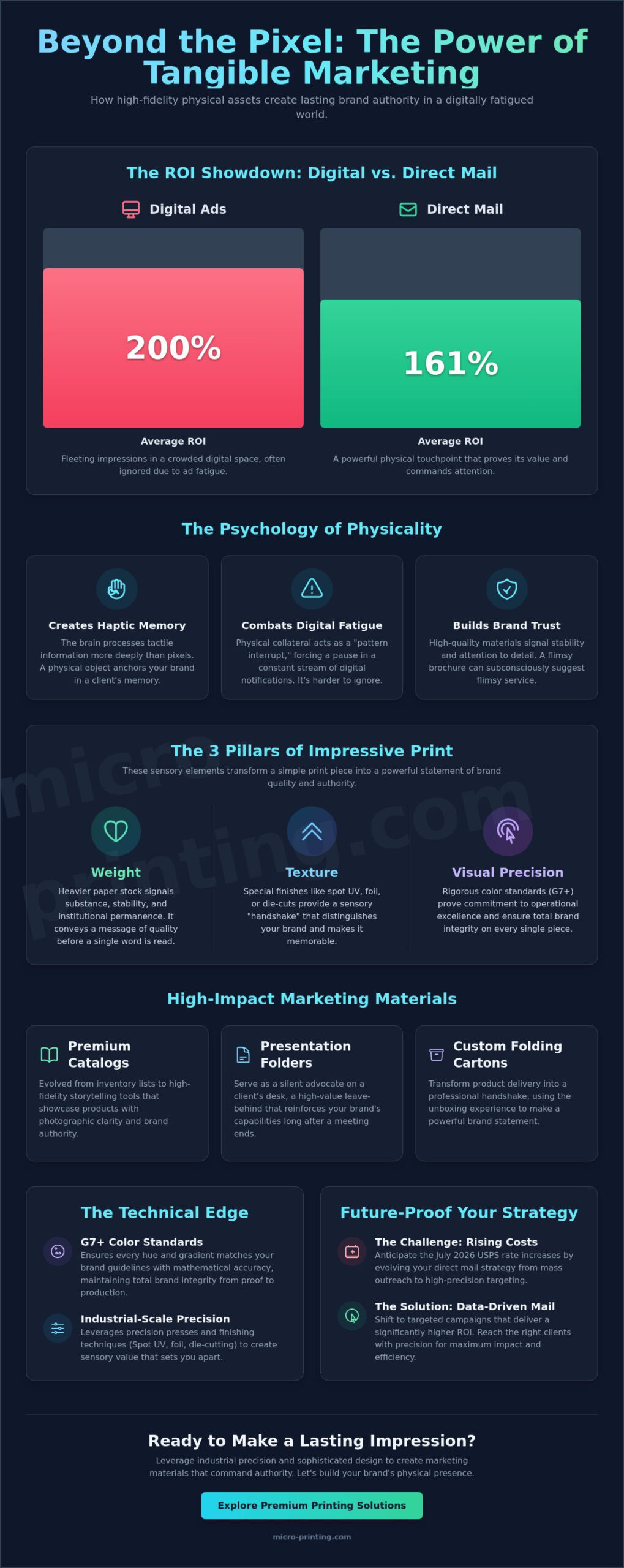
With digital ad ROI often hovering around 200 percent, the 161 percent average return on investment for direct mail proves that physical touchpoints are far from obsolete. You’ve likely experienced the frustration of seeing high-stakes emails ignored or felt the sting of a low-quality print job that made your brand look unprofessional. In a market where digital fatigue is the norm, choosing the right marketing materials to impress clients requires a shift from fleeting pixels to tangible, high-fidelity assets that command authority.
We understand that your brand demands industrial precision and absolute color consistency. This guide explores how to leverage premium catalogs, custom folding cartons, and targeted direct mail to create a lasting impression that digital ads simply cannot match. You’ll learn how to navigate the July 2026 USPS rate increases while maintaining a turnkey workflow that moves seamlessly from structural design to final delivery. We will detail how G7+ color standards and sophisticated packaging turn a standard delivery into a powerful, professional statement that stays on a client’s desk long after an email is deleted.
Key Takeaways
- Understand how physical touchpoints create haptic memory, anchoring your brand in a client’s mind more effectively than fleeting digital impressions.
- Identify the specific marketing materials to impress clients, including premium catalogs and presentation folders that serve as high-fidelity storytelling tools.
- Transform product delivery into a professional handshake by engineering custom folding cartons that prioritize both protection and brand impact.
- Navigate rising postage costs by shifting to data-driven, targeted direct mail strategies that deliver a significantly higher ROI than generic outreach.
- Maintain total brand integrity through G7+ color standards and industrial-scale precision, ensuring consistent quality from the first proof to the final production run.
The Psychology of Tangible Marketing: Why Physicality Still Impresses in 2026
Tangible marketing serves as the physical manifestation of brand authority. It transforms abstract corporate values into concrete objects that a client can hold, weigh, and examine. While digital advertisements are designed for rapid consumption and immediate disposal, premium print assets are engineered for permanence. This shift from the ephemeral to the physical is essential for firms looking to establish a dominant market presence. High-impact print doesn’t just deliver a message; it occupies physical space in a client’s office, creating a “desk-life” that digital ads can’t achieve. A well-executed catalog or presentation folder becomes a persistent reminder of your brand’s capabilities.
This lasting impact is driven by haptic memory. The brain processes tactile information differently than visual pixels. When a decision-maker touches a high-quality piece of collateral, they form a sensory connection that reinforces brand recall. To maximize this effect, you must focus on the three pillars of impressive materials: weight, texture, and visual precision. Weight signals substance and institutional stability. Texture provides a sensory “handshake” that distinguishes your brand from competitors. Visual precision, maintained through rigorous technical standards, proves your commitment to operational excellence. Using these elements correctly ensures your marketing materials to impress clients perform as intended.
Combating Digital Fatigue with Physical Touchpoints
Digital advertising costs are rising while click-through rates often stagnate. Clients are overwhelmed by a constant stream of emails and social notifications, leading to widespread digital fatigue. Physical collateral acts as a “pattern interrupt” in a professional’s daily workflow. It forces a pause. In high-value B2B relationships, a physical leave-behind is a requirement for maintaining presence after a meeting concludes. It serves as a silent advocate on a conference table or desk. It’s much harder to ignore a premium, heavy-stock booklet than it is to archive an unread email.
The Link Between Print Quality and Brand Trust
The technical specifications of your print jobs directly influence how clients perceive your company’s reliability. While the history of printing has moved from basic mechanical reproduction to high-fidelity industrial output, the core requirement for precision remains. Paper stock thickness acts as a non-verbal cue for company longevity. If a brochure feels flimsy, the client may subconsciously associate that lack of substance with your service delivery. Color consistency is equally vital. Deviations in brand colors suggest a lack of internal discipline. Haptic branding is the strategic use of physical materials to build sensory-based brand loyalty. By investing in precision-engineered print, you demonstrate that your firm values quality at every level of the process.
Premium Print Collateral: Catalogs and Folders that Demand Attention
High-impact marketing materials to impress clients are no longer just about information delivery; they’re about establishing a physical presence that commands respect. Premium catalogs and presentation folders act as the cornerstone of a sophisticated brand strategy. Unlike disposable digital assets, these physical products utilize industrial-grade finishing techniques to create immediate sensory value. Techniques like spot UV coating, metallic foil stamping, and intricate die-cutting provide the tactile factors that distinguish a market leader from a standard vendor. When a client feels the weight of a well-produced booklet, they’re physically experiencing your brand’s commitment to quality.
High-Fidelity Catalogs as Brand Anchors
Industrial and luxury sectors are experiencing a significant resurgence in catalog usage. These documents have evolved from simple inventory lists into high-fidelity storytelling tools that showcase product details with photographic clarity. Achieving this level of output requires strict adherence to G7-certified color standards. This ensures that every hue and gradient matches your brand guidelines with mathematical accuracy. For organizations requiring this level of technical rigor, partnering with commercial printing services florida provides the infrastructure needed for industrial-grade production. High-capacity presses allow for consistent quality even during massive print runs, ensuring that the last catalog off the line looks as sharp as the first proof.
Presentation Folders: The Executive First Impression
The housing of a proposal is often the first thing a client touches, making it as critical as the data within. A presentation folder must function as a durable, professional tool rather than a simple paper cover. Structural design is paramount. Incorporating custom die-cut pockets and precisely measured business card slits keeps your collateral secure and organized. Finishing options play a psychological role here too. Soft-touch lamination offers a sophisticated, matte feel that suggests modern elegance. Conversely, high-gloss UV coating provides a resilient, mirror-like finish that emphasizes vibrant colors and durability. These details prove to a client that your organization manages even the smallest operational variables with total precision.
The ROI of high-quality booklets and folders is particularly measurable in the medical and retail sectors. In medical marketing, where technical accuracy is non-negotiable, high-fidelity booklets provide a reliable reference that stays in a physician’s office for months. In retail, premium catalogs drive high-value sales by providing a tactile shopping experience that digital screens cannot replicate. Data regarding direct mail volume trends confirms that high-impact, physical touchpoints continue to be a primary driver for high-stakes B2B conversions. If you want to see how industrial-scale quality can transform your outreach, you should review our technical printing specifications to understand the impact of precision-engineered collateral.
Custom Packaging: Turning the Unboxing Experience into a Marketing Tool
Packaging serves as the first physical handshake between your organization and a high-value prospect. While brochures and catalogs provide information, custom packaging provides a container for your brand’s entire value proposition. It’s a critical category of marketing materials to impress clients because it combines structural engineering with high-fidelity aesthetics. Moving beyond standard shipping containers, precision-engineered folding cartons and corrugated boxes ensure that your product arrives in pristine condition while immediately communicating industrial stability. A client’s perception of your service quality begins the moment they evaluate the structural integrity and visual clarity of your packaging.
The choice between folding cartons and corrugated materials depends on your specific distribution requirements. Custom folding cartons offer a high-end, retail-ready finish perfect for medical devices, electronics, or premium samples. They allow for complex die-cutting and sophisticated coatings that reinforce brand authority. Corrugated boxes provide the industrial durability needed for heavier shipments without sacrificing brand presence. By applying high-fidelity graphics to corrugated surfaces, you maintain a cohesive brand ecosystem throughout the entire supply chain. Research from The British Psychological Society on marketing psychology highlights how sensory cues and hidden persuaders in physical design can significantly alter consumer perception and trust, making the tactile quality of your box a decisive factor in client retention.
The Art of the Unboxing Experience
Structural design dictates the perceived value of the contents. An unboxing experience should be methodical and logical, reflecting a professional workflow. Utilizing interior printing allows you to deliver technical instructions or brand messaging the moment the box is opened, creating a “pattern interrupt” that surprises the client. For high-volume production runs where color consistency is a technical requirement, leveraging professional offset printing services ensures that every unit meets industrial standards. This process provides the sharpest detail and most accurate color reproduction for complex packaging designs.
Labels and Pouches: Detail-Oriented Marketing
Precision extends to the smallest components of your packaging, such as labels and pouches. In the medical and food sectors, high-quality labels aren’t just marketing tools; they’re essential for regulatory compliance. Material selection is vital here. You must choose between durable synthetic stocks for moisture resistance or textured paper stocks for a premium, organic feel. Custom pouches offer a unique way to deliver samples that clients actually want to keep on their desks. When these smaller elements, or even custom-branded items like stationery and apparel, match the quality of your primary marketing materials to impress clients, it proves your organization manages every operational variable with total precision; to expand your range of professional touchpoints, you can check out The CEO Creative.
Strategic Direct Mail: Reaching the Right Clients with Precision
Direct mail yields an average return on investment of 161 percent. This efficiency stems from its ability to bypass saturated digital channels and land directly on a decision-maker’s desk. When selecting marketing materials to impress clients, you must distinguish between broad-reach Every Door Direct Mail (EDDM) and data-driven Targeted Direct Mail. While EDDM serves local saturation needs, Targeted Direct Mail utilizes specific firmographic data to reach high-value prospects with surgical precision. This approach ensures your investment is focused on individuals with the authority and budget to engage your services. It transforms a standard mailing into a high-stakes business tool.
Data-Driven Targeting Strategies
Refining your mailing list requires a combination of demographic and firmographic data. By identifying specific industries, company sizes, and job titles, you eliminate the waste associated with generic outreach. A highly effective tactic for high-stakes accounts is the use of “Lumpy Mail.” This involves combining a printed piece with a small physical sample, such as a custom pouch or a high-fidelity calendar. The physical weight acts as a pattern interrupt, ensuring your package is opened rather than discarded. To understand how professional firms manage these complex campaigns, you can explore the strategic role of direct mail marketing companies.
Seamless Execution: From Design to USPS
The logistics of a mailing campaign require industrial-level management. A turnkey provider handles the entire workflow, including addressing, presorting, and final delivery to the USPS. This end-to-end management is critical given the upcoming regulatory changes. Effective July 12, 2026, the USPS is implementing a postage rate increase of approximately 4.8 percent. Forever stamps will rise to $0.82, while one-ounce metered letters will increase to $0.78. Marketing Mail and EDDM rates are also expected to rise by 5 to 6 percent. Precision in sorting and list hygiene is now a financial necessity to offset these rising costs. Errors in addressing don’t just delay your message; they directly impact your bottom line.
Tracking the success of physical mail has become more sophisticated through the use of QR codes and dedicated landing pages. These tools bridge the gap between physical touchpoints and digital analytics, providing measurable data on engagement rates. By integrating these tracking mechanisms into your catalogs or postcards, you gain clear visibility into your campaign’s performance. This data-driven approach allows you to refine future mailings based on actual client interaction. For organizations ready to optimize their outreach, you can request a technical consultation for your direct mail strategy to ensure your campaign is engineered for maximum ROI.
The Technical Edge: Ensuring Quality with G7 Standards and Precision Presses
High-fidelity production is the foundation of effective marketing materials to impress clients. Strategy alone isn’t enough; the execution must rely on industrial-scale technology and rigorous quality control. Heidelberg presses represent the global standard for high-fidelity color reproduction, offering the speed and precision required for complex commercial runs. These machines allow for tight registration and consistent ink density, ensuring that every page of a catalog or every surface of a folding carton meets exact specifications. Scaling from a single functional prototype to a high-volume run of 50,000 units requires this level of technological confidence and infrastructure.
G7 Master Qualification: The Science of Color
G7 is a technical specification that ensures visual consistency across all print platforms, from digital proofs to offset presses. It’s not just a certificate; it’s a commitment to a shared neutral appearance. Maintaining brand integrity requires matching a catalog’s color to a folding carton’s color with mathematical precision. If your corporate blue looks different on a postcard than it does on a presentation folder, your brand’s professional weight is diminished. G7 standards eliminate the ‘color drift’ common in low-end print shops. The industry is currently moving toward the enhanced G7+ standard, as evidenced by the G7+ Expert Certification training held in Minneapolis from June 23 to 25, 2026. This evolution allows for even more precise color control in high-density printing systems.
Local Expertise, Nationwide Reach
Operating from a Fort Lauderdale facility provides a strategic advantage for South Florida logistics and nationwide distribution. We manage the entire process from structural design to final delivery, ensuring that your marketing materials to impress clients are handled by a single, accountable partner. Our use of microprint technology allows for security features and detail at a microscopic level, which is essential for pharmaceutical and high-security sectors. This combination of local presence and industrial capacity provides the stability that corporate partners require for long-term campaigns.
By integrating these technical standards with the strategic outreach discussed in previous sections, you create a brand presence that is both physically impressive and operationally sound. Precision is the ultimate differentiator in a competitive market. Contact Micro Printing today for a custom quote on your next high-impact project to see how our industrial infrastructure can support your brand’s growth through 2026 and beyond.
Securing Your Brand’s Physical Presence in 2026
Haptic memory and industrial precision transform standard outreach into a powerful brand anchor. Integrating G7 color standards with high-capacity Heidelberg presses ensures that every catalog, folding carton, and direct mail piece reflects total operational excellence. This technical rigor is essential for bypassing digital fatigue and establishing a permanent presence on a client’s desk. Selecting the right marketing materials to impress clients is a strategic investment in long-term brand authority that digital pixels simply cannot replicate.
Since 1989, our family-owned facility in Fort Lauderdale has delivered turnkey solutions that eliminate the complexity of managing large-scale campaigns. As a G7 Master Qualified printer, we provide the technical infrastructure required for consistent nationwide shipping and industrial-grade production. We manage the entire workflow from structural design to final delivery, allowing you to focus on high-level strategy while we handle the manufacturing precision and logistical coordination.
Request a Custom Printing & Packaging Quote from Micro Printing today to experience the impact of precision-engineered print. Your organization deserves a physical presence that matches its professional standards and commands the respect of your most valuable partners.
Frequently Asked Questions
What are the most effective marketing materials to impress high-value clients?
High-fidelity catalogs and premium presentation folders are the most effective physical assets for commanding a client’s attention. These items act as brand anchors that occupy physical space on a desk, unlike digital ads that are quickly scrolled past. By utilizing haptic memory, these marketing materials to impress clients ensure that your organization remains a constant, tangible presence in their daily workflow.
How does G7 certification impact the quality of my marketing materials?
G7 certification is a technical specification that ensures visual consistency across all printing platforms and materials. It relies on mathematical precision to achieve a shared neutral appearance, meaning your brand colors will match exactly whether they’re on a thin flyer or a thick folding carton. This certification is essential for maintaining professional brand integrity and eliminating the color drift common in lower-end production facilities.
Is direct mail still an effective marketing strategy in 2026?
Direct mail remains a high-performance strategy, yielding an average ROI of 161 percent. Even with the USPS postage rate increase scheduled for July 12, 2026, the physical nature of mail provides a pattern interrupt that digital channels can’t replicate. It’s particularly effective for high-stakes B2B outreach where a tangible touchpoint signals a higher level of investment and professional commitment.
What is the difference between a folding carton and a corrugated box for marketing?
Folding cartons are engineered for a high-end, retail-ready finish and are ideal for medical devices or premium samples. Corrugated boxes provide the industrial durability required for protecting heavier shipments during transit. Both serve as a marketing tool by providing a professional unboxing experience that acts as the first physical handshake with your client.
What finishing options make marketing materials look more professional?
Finishing options like spot UV coating, metallic foil stamping, and soft-touch lamination provide the tactile factors that signal brand authority. These techniques add a sensory layer to your collateral, making it feel more substantial and durable. Custom die-cutting also allows for unique structural designs in presentation folders, further distinguishing your brand from competitors using standard templates.
How can I ensure my brand colors are consistent across different printed products?
Total color consistency is achieved by partnering with a G7 Master Qualified printer that utilizes industrial Heidelberg presses. These machines allow for precise control over ink density and registration throughout the entire production run. This technical infrastructure ensures that your marketing materials to impress clients maintain a uniform appearance across catalogs, postcards, and packaging.
What are the benefits of using a local commercial printer in Fort Lauderdale?
Working with a local Fort Lauderdale printer provides industrial-scale capacity combined with regional logistical accountability. It allows for more efficient management of the entire workflow, from initial structural design to final delivery or mailing. Local expertise also reduces the variables associated with long-distance shipping, ensuring your materials arrive in pristine condition for South Florida and nationwide distribution.
How do I choose between Every Door Direct Mail (EDDM) and Targeted Direct Mail?
EDDM is best for broad neighborhood saturation where you want to reach every household on a specific mail route. Targeted Direct Mail is the superior choice for B2B outreach, as it uses specific firmographic data to reach high-value prospects. You should choose Targeted Direct Mail when your campaign requires reaching specific decision-makers based on industry, job title, or company size.